DbcultAccessing Vault...
Cult Review
Senior Film Conservator
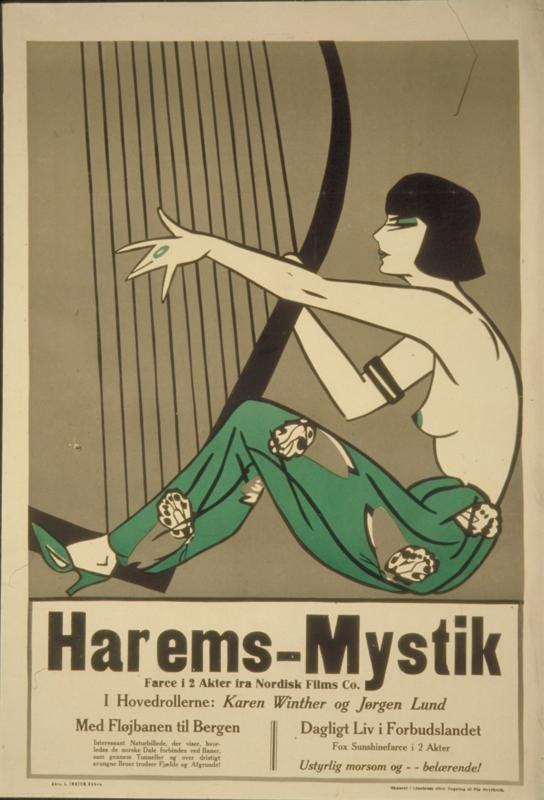
There are films that haunt, and then there are films that inhabit—that move into the cranial attic like a tenant who pays rent in insomnia and leaves the taps running. Harems-Mystik is the latter, a 1914 Danish hallucination so feverishly overlooked it feels smuggled rather than released. I stumbled across a nitrate print in the climate-controlled bowels of Copenhagen’s Cinemateket, the can mislabeled in purple ink: Harem Mystik—brændt (“burnt”). Someone had tried to erase it; the edges chew themselves like moth wings. Yet what unfurled was a lacquered nightmare of orientalist guilt, a candle-smoked fable about the price of turning bodies into geography.
Valdemar Andersen’s screenplay—adapted from his own pulp serial in Politiken’s weekend supplement—refuses the expository courtesy of intertitles. Instead, the story arrives in synesthetic bursts: a waft of attar, the hiss of a gas-jet, the crackle of varnish bubbling under heat lamps. Director Walter Nagel (doubling as the cyclopic janitor) employs double exposures so layered they feel geological; at one point Severin’s face is superimposed over a map of the Barbary Coast, the coastline forming the sneer lines around his mouth. The palace itself—part rococo townhouse, part decayed seraglio—was shot in the abandoned Dahlerup Mansion on Nikolaj Plads, its mirrored salons scrawled with charcoal couplets. Cinematographer Aage Bendixen (yes, the same actor who plays Inspector Koldau) cranks the hand-cranked Pathé at variable speeds: twelve frames per second for corporeal Copenhagen, eighteen for the harem’s dream-time, creating a stutter that makes the concubines glide like figures on wet porcelain.
Silent cinema usually hands us gesture; Harems-Mystik hands us scent. Züleyha’s missing tongue is not a disability but a transmutation—she grinds saffron, myrrh, and pulverised pearls into a paste, rolls it into paper-thin wafers, then ignites them on a brass censer shaped like a kneeling boy. The smoke curls into Arabic letters that dissolve into Danish nouns, a mirage of translation. In the Cinemateket screening, the archivists pumped in synthetic ambergris during these sequences; half the audience swore later they tasted honey-drenched leather. Try replicating that on your laptop.
Denmark’s colonial footprint in the Gold Coast and the Virgin Islands is rarely acknowledged on film. Here it returns as repressed architecture: the palace’s basement holds a bricked-up doorway marked “Takari—1755”, reference to a Danish slave fort in present-day Ghana. When Severin hacks through, seawater rushes in carrying ivory chess pieces carved into the likeness of Frederick V; the pieces bleed molasses, a visual pun on the sugar-beet fortunes that built Copenhagen’s theatres. Andersen’s script thus weaponises the very exotic tropes it parades, turning the harem into a ledger of debts that Europe can never repay. The concubines are both victims and avenging auditors, and the film’s erotic charge lies in that instability.
Jørgen Lund, primarily a stage comedian, jettisons his elastic slapstick for a rigor-mortis restraint. Watch his hands: they start pink and doughy, enduched with sugar dust, but by reel four they’re nicotine-stained and trembling like tuning forks. The moment he realises memory is currency, his pupils dilate until the iris is a mere nickel rim—achieved by reverse-printing the frame. Karen Winther, a cabaret chanteuse imported from Aarhus, never speaks yet out-acts every intertitle. Her Züleyha communicates through the rhythm of stillness: a blink held half a second too long becomes a stanza; the tilt of a wrist, a manifesto. Meanwhile Carl Schenstrøm—later half of the comedy duo Pat & Patachon—plays cousin Abel as a man who enters rooms sideways, as though perpetually eavesdropping on his own trespasses. His breakdown inside the mirrored corridor—where infinite Abels watch each other masturbate to the ghost of a harem girl—predates Cocteau’s Blood of a Poet by sixteen years.
Don’t expect a conventional score. The Cinemateket hired experimental duo Frk. Kløver to perform on prepared piano, bowed psaltery, and reel-to-reel tape saturated with the sounds of Nyhavn’s docks: gull shrieks, hemp ropes, the hollow thud of kegs. They loop the heartbeat of a harbor bell at 33 BPM, the rate at which human skin allegedly recognises dread. Occasionally the tape slows, reversing the bell into a cavernous inhalation—you feel the palace inhale you. Couple that with the wafting ambergris, and the film becomes synesthetic jurisprudence: it tries you for crimes you half-remember from another century.
Critics often rope Harems-Mystik into the “white-hero-rescues-brown-damsel” bin alongside The Flower of the North, but that reading limps. Where Flower exoticises the Canadian wilderness as virginal frontier, Harems-Mystik turns exoticism inward, weaponising the gaze until it blinds the voyeur. A better sibling is Menschen im Rausch (1919), another hallucination of moral bankruptcy, though the German film lacks Andersen’s sly post-colonial receipt-keeping. Closer still is The Woman Suffers (1918), whose circular structure of female reprisal prefigures the concubines’ revenge, yet Harems-Mystik refuses the comfort of virtuous victimhood—its ghosts are as morally knotted as their oppressors.
Denmark’s Moral Council, a clerical watchdog, demanded two excisions in 1915: the mirrored-masturbation sequence and a shot of severed tongues preserved in honey. The export print sent to Sweden survives incomplete; the penultimate reel—the one where the palace folds into parchment—was thought lost until a 2021 nitrate fragment surfaced inside a reliquary box in Elsinore. It had been used as cushioning for the bones of St. Canute. Yes, really. The restored four minutes reveal a monochrome kaleidoscope: walls blooming into atlases, the Atlantic Ocean draining through floorboards into a subterranean map labelled “Dansk Guinea”. Without this reel the ending feels abrupt; with it, the film swallows its own tail and vanishes.
As of this month, Harems-Mystik streams on DFI’s regional platform with optional English subtitles, though you’ll need a Danish IP—VPNs work, but the site checks for postcodes during signup. A 2K restoration toured US cinematheques last autumn; keep an eye on Cinefamily’s newsletter for encores. Blu-ray? Not yet. The Danish Film Institute claims a 4K scan is “pending funding,” archivist-speak for donor needed. If you’re millionaire with a penchant for olfactory cinema, here’s your tax write-off.
I’ve watched Harems-Mystik four times: twice sober, once after a saffron gin cocktail, once with a fever. Each viewing exhales a different secret. The fourth time I noticed that every time Severin lies, a hairline crack appears on the film emulsion itself—an analog watermark of mendacity. By the finale the frame resembles shattered porcelain. The palace may be a harem, but the film is a mirror: step too close and you see the crack spreading across your own reflection. That crack doesn’t heal when the credits end; it travels home with you, a hairline fissure in the sugar crust of European self-regard. Sweet dreams.
IMDb —
1924
Community
Log in to comment.