Summary
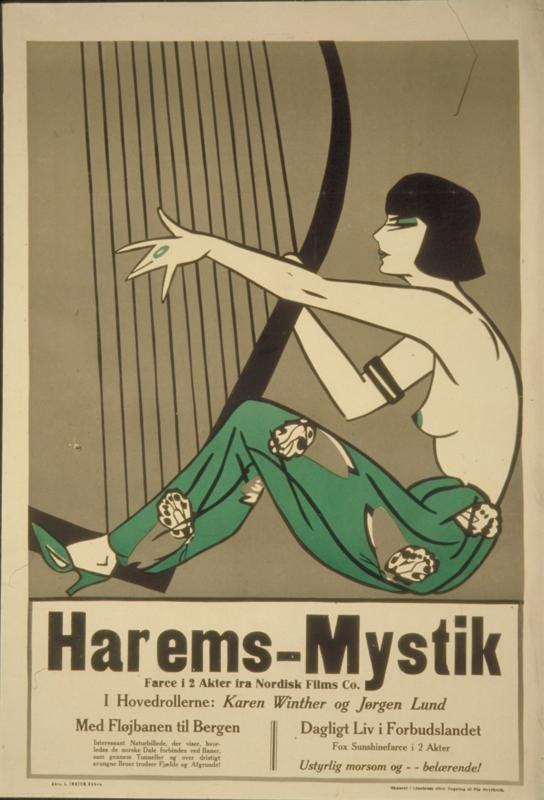
In a Copenhagen twilight that smells of tallow and tuberose, a bankrupt confectioner named Severin Mørk—played by Jørgen Lund with the hollow eyes of a man who has swallowed too much sugar and too little love—inherits a derelict palace once used as an Ottoman-style harem by a long-dead shipping magnate. The deed comes wrapped in a crimson veil stitched with verses in Arabic calligraphy; when Severin utters the lines aloud, the frescoed walls yawn open like silk petals, releasing three spectral concubines who step through time on bare feet, anklets clinking with the chill of melted coins. Karen Winther’s Züleyha, a Circassian poetess whose tongue was cut out for rhyming “Allah” with “gallows,” communicates only in perfumed smoke rings that condense into miniature hanging gardens above Severin’s gas-lamp; Else Jørgensen’s dark-skinned Nefret, part Nubian warrior, part soothsayer, drags a rusted scimitar that scrapes sparks across the parquet, foretelling deaths he refuses to believe; while the third, Lila, a Danish child sold in Algiers and returned as a translucent adolescent, hums lullabies that rot fruit in the bowl and silver in the seams of Severin’s waistcoat. Carl Schenstrøm’s antique-dealer cousin, Abel, arrives with a briefcase of Kierkegaard and a monocle fogged by voyeurism, determined to catalogue the palace’s erotic bric-à-brac; instead he catalogues his own unraveling as Züleyha’s smoke begins to sketch his future corpse. Aage Bendixen’s police inspector, Koldau, a moralist with a ledger of sins priced by the krone, suspects Severin of trafficking in “oriental contraband” and plants an informant—Walter Nagel’s one-eyed janitor, who sweeps the courtyards at night and pockets the tears crystallized on the marble, later selling them as aphrodisiac salt. The narrative coils like hookah smoke: Severin, desperate for solubility, bargains with Nefret—if she lifts the curse he will surrender his last pleasure, the memory of his fiancée’s lemon-balm scent; but memory is currency here, and every recollection spent manifests as a new room in the expanding labyrinth, until the palace folds in on itself like a paper theatre, corridors collapsing into script, until Denmark itself becomes a harem of borrowed nostalgias. In the final reel the concubines reveal they were never ghosts but the palace’s own conscience, exorcising colonial guilt by devouring the men who commodified them; Severin, now a wax figure in the foyer, drips slow into the shape of a sugar lion that future children lick until the tongue bleeds.
Review Excerpt
"
There are films that haunt, and then there are films that inhabit—that move into the cranial attic like a tenant who pays rent in insomnia and leaves the taps running. Harems-Mystik is the latter, a 1914 Danish hallucination so feverishly overlooked it feels smuggled rather than released. I stumbled across a nitrate print in the climate-controlled bowels of Copenhagen’s Cinemateket, the can mislabeled in purple ink: Harem Mystik—brændt (“burnt”). Someone had tried to erase it; the edges chew t..."