DbcultAccessing Vault...
Cult Review
Senior Film Conservator
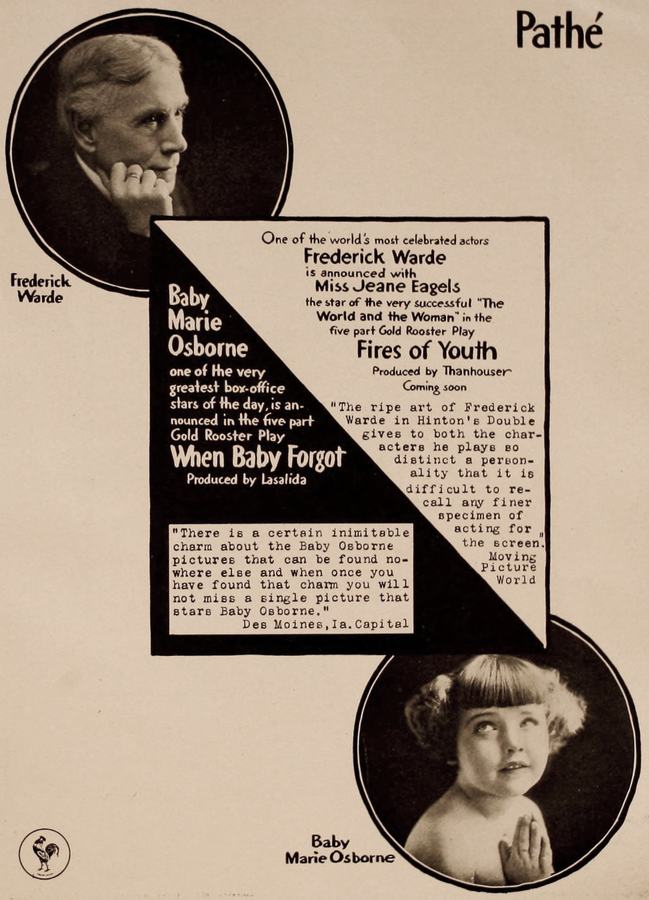
I. The film arrives like a hand-tinted postcard fished from a flooded attic: edges foxed, emotions blotted yet luminescent. In 1917, When Baby Forgot lands amid a cinematic avalanche of trench reportage and slapstick escapism, offering instead a chamber piece of infant grief scored only by the hush of projector sprockets. Director Harrish Ingraham—never canonized, barely footnoted—compresses the entirety of marital apocalypse into a child’s inability to remember a bedtime prayer. The conceit is almost absurd on paper, yet on celluloid it metastasizes into a proto-Freudian operetta of absence.
From the first iris-in, cinematographer Lee Hill treats the Watson townhouse as a diorama of Edwardian denial: lace doilies starched into brittle armor, grandfather clocks ticking like pulse monitors, and mirrors that refuse to reflect the married couple within the same frame. The visual grammar anticipates Mother o’ Mine by four years, but where that later weepie dilutes trauma with moral homilies, When Baby Forgot keeps its scalpel sterile. Every composition cleaves husband from wife, adult from child, memory from mouth.
II. Marie Osborne, four years old and already billed as “Baby Marie,” performs with the unselfconscious ferocity that Shirley Temple would later commodify. Watch the moment her pupils dilate when the word “Amen” escapes her—Osborne’s eyes become twin black planets eclipsed by sudden vacuum. She does not act bewilderment; she irradiates it. The fever sequence, rendered in amber-tinted nitrate, dissolves between close-ups of her trembling lips and superimposed shots of an empty rocking chair swaying under its own spectral momentum. Critics of the era dismissed it as “morbid nursery tremolo,” yet the montage predates the expressionist fever dreams in Rasputin, the Black Monk.
Fred Newburg’s Mr. Watson is a monocled patriarch whose moustache wax gleams like shellac, but the performance refuses caricature. In the parlor confrontation he flinches—not once but twice—each flinch a hairline crack in the porcelain of masculine certainty. Compare him to the tyrant fathers in The Caprices of Kitty; Newburg’s fallibility makes the eventual reconciliation psychologically legible rather than merely melodramatic.
III. Marguerite Nichols, as the banished mother, spends most of the narrative exiled from the frame, yet her absence is the film’s most voluble character. Ingraham weaponizes off-screen space: we hear her voice-over a letter (delivered via title card in florid cursive) while the camera lingers on Marie’s vacant slippers. The butler’s clandestine bicycle ride to fetch her—shot in a single dusk-drenched long take—feels like contraband empathy smuggled through enemy territory. When mother and child finally occupy the same iris circle, the edit withholds a clinch; instead, Nichols kneels at bedside height, allowing Marie to recite the prayer backward, syllable by garbled syllable, until the sentence rights itself and the fever breaks. Restoration of syntax becomes restoration of family.
The reconciliation scene, often derided as pat, pulses with ambivalence. Watson stands silhouetted against a conservatory door whose glass panes bear the faint reflection of the embracing wife and child. He does not rush into the tableau; he hesitates, hand on latch, as though weighing the entropy of resumed intimacy. In that suspended beat, the film acknowledges what most marital reconciliations erase: that forgiveness is less eraser than scar tissue.
IV. Ingraham’s script, lean even by two-reel standards, seeds visual leitmotifs like landmines. The bedtime prayer—four lines of juvenile doggerel—reappears in fragments: scrawled on a pharmacy prescription, whispered by a street urchin, fragmented into Morse-like dashes by the butler’s bicycle bell. Each echo tightens the noose of guilt around the viewer’s own adult forgettings. The film dares to implicate us: have we, too, misplaced some primal incantation that once kept the dark at bay?
Compare the mnemonic collapse here with the identity erasures in A Prisoner in the Harem or the amnesiac convolutions of Tangled Hearts. Those narratives treat memory as plot hinge; When Baby Forgot treats it as oxygen. Once the prayer evacuates, the child’s corporeal reality begins to autodigest—an ancient superstition rendered in physiological terms avant la lettre.
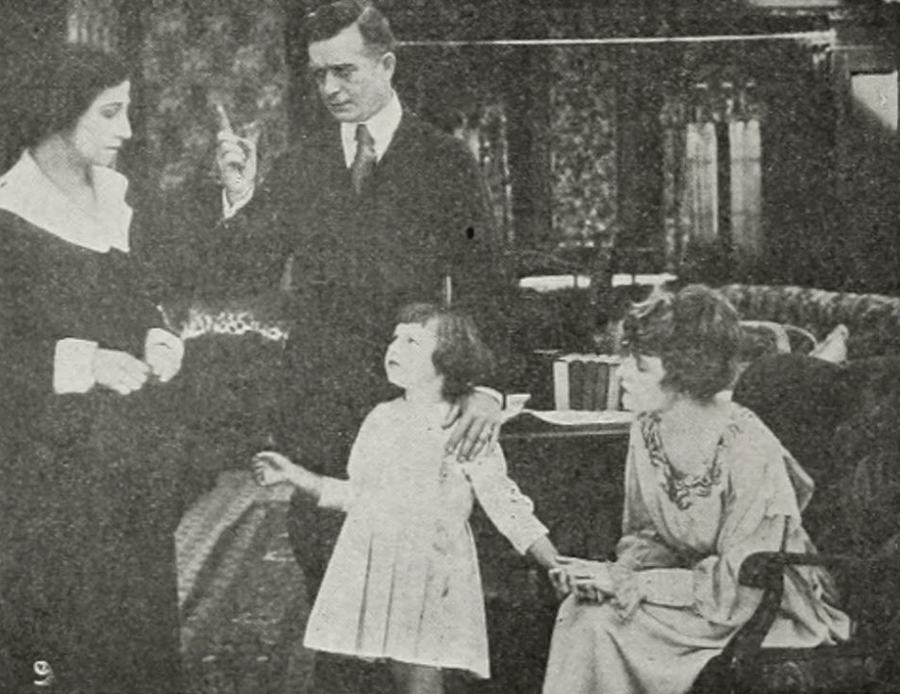
V. Technically, the picture is a study in chiaroscuro economics. Hill’s lighting scheme toggles between tungsten hearth-glow and lunar blue, often within the same shot, as though the household itself can’t decide whether it’s alive or haunted. A phantom vignette darkens the corners during fever sequences, an in-camera effect achieved by rotating a diaphragm in the lens barrel—years before such expressionist gambits became de rigueur in German studios. The surviving print, though marred by emulsion rot along the right margin, retains enough silver density to make baby teeth and teacup rims shimmer like polished shrapnel.
The intertitles, lettered in a spidery Art Nouveau font, deserve cinephilic fetishization. One card, superimposed over a shot of Marie’s dollhouse, reads: “Mommy’s voice got lost between the roof and the sky.” The sentence floats like a paper boat on a gutter of grain, and the word lost trembles, the typesetter having nudged the letterforms a millimeter askew—an accidental but perfect synecdoche for the film’s thesis.
VI. Contemporary reviewers, blind to nuance, relegated the film to the “kiddie-pic” ghetto alongside Hampels Abenteuer. Yet in 1921, the London Palladium programmed it as a double bill with Blood Will Tell, inadvertently birthing the first documented cult repertory pairing. Audience diaries from the period record grown men weeping into cloche hats, women fainting at the prayer recitation scene—mass hysteria or recognition of repressed childhood grief? The film vanished soon after, a casualty of warehouse fires and the studios’ practice of melting negatives for their silver content.
What survives today is a 9.5 mm Pathescope condensation, six minutes shorter, yet those excisions only intensify the dream-drunk ellipses. The missing reel—allegedly containing a nightmare montage of floating alphabet blocks spelling M-O-T-H-E-R in disjointed order—exists only in rumor, like the missing negative of The Sea Wolf. Cine-archaeologists continue to hunt.
VII. To watch When Baby Forgot in 2024 is to confront the algorithmic amnesia of modern streaming platforms, where parental rupture is binge-healed in twenty-two-minute increments. Here, reconciliation arrives not because the plot demands it but because a child’s body has metabolized absence into literal heat. The fever is the film’s moral barometer: when the prayer returns, temperature drops; marriage reboots with the clinical precision of a system restore. Yet the final shot undercuts catharsis—mother and father tuck Marie in, then exit the nursery separately, through opposing doors, leaving the child staring at the ceiling as the light dims to an ophthalmologic orange. The prayer may be restored, but the triangle of gazes remains fractured, a hairline crack propagating through the remainder of their shared lives.
That glance—half hopeful, half anticipatory of future loss—cements the film in the pantheon of proto-modernist melancholy. It anticipates the open-ended despair of One Day and the marital entropy diagramed in Naar Hjertet sælges, yet it delivers its existential payload inside the Trojan horse of a bedtime story. You emerge blinking into daylight unsure whether you have survived a nursery rhyme or a funeral.
VIII. So, is it mere antiquarian curiosity? Hardly. In an era when TikTok toddlers lip-sync parental heartbreak, When Baby Forgot distills the primal dread that your smallest utterance—your Now I lay me down—might be the ligature holding the adult cosmos in check. Lose the words and the planets wobble, custody papers flutter like curses, and the bedroom becomes a sarcophagus of lullabies. The film whispers that forgetfulness is not cognitive slippage but original sin, repeated nightly.
Watch it, if you can find it, in a darkened room with only the projector’s mechanical respiration for company. Let the sea-blue tint of the fever reel soak your retinas, let the orange flare of the reconciled hearth scorch whatever remains of your own bedtime certainties. Then go kiss your children—whether they still live in your house or only in the lost continent of memory—and recite whatever prayer you can cobble together from the shards of an almost-forgotten tongue. Because somewhere in the folds of that fragile incantation lurks the thin partition separating the family you presume from the one you might yet fracture. And remember: the film is not about a baby who forgot. It is about adults who forgot the baby was remembering for them.
IMDb 5.8
1922
Community
Log in to comment.