DbcultAccessing Vault...
Cult Review
Senior Film Conservator
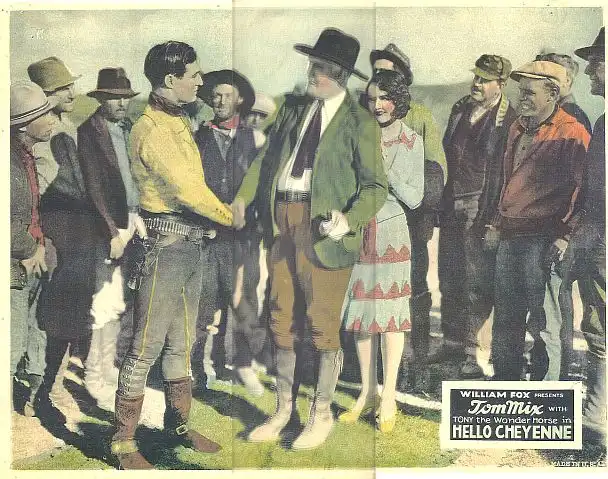
For silent film enthusiasts, devoted fans of classic Westerns, and especially those curious about the enduring appeal of Tom Mix, Hello Cheyenne (1928) is absolutely worth seeking out. It offers a unique premise within the genre – a race to connect telephone lines – that keeps it from feeling like just another cowboy picture. However, if you're accustomed to modern pacing, expect intricate character development, or find silent film conventions inherently challenging, this might be a tougher sell. It’s a historical artifact that delivers solid entertainment for its era, but requires a certain appreciation for its specific cinematic language.
What immediately stands out about Hello Cheyenne is its central conflict: two rival crews racing to string telephone lines across the rugged Wyoming landscape. This isn't the usual cattle rustling or land grab. Instead, it’s about the march of progress, framed with classic Western elements. The visual of telephone poles being erected against vast, untamed vistas provides a surprisingly compelling backdrop. It grounds the film in a tangible, almost industrial effort, contrasting sharply with the more traditional horse chases and fistfights.
The film opens quickly, establishing the competing crews and their respective leaders. On one side, we have Bill Adams (Joseph W. Girard), an earnest, somewhat down-on-his-luck foreman whose daughter, Doris (Caryl Lincoln), is romantically entangled with our hero, Tom Remington (Tom Mix). On the other, a conniving rival foreman (Martin Faust), whose sneering demeanor leaves no doubt about his villainous intentions. The stakes are clear: Adams needs this win for his livelihood, while Faust simply wants to crush the competition.
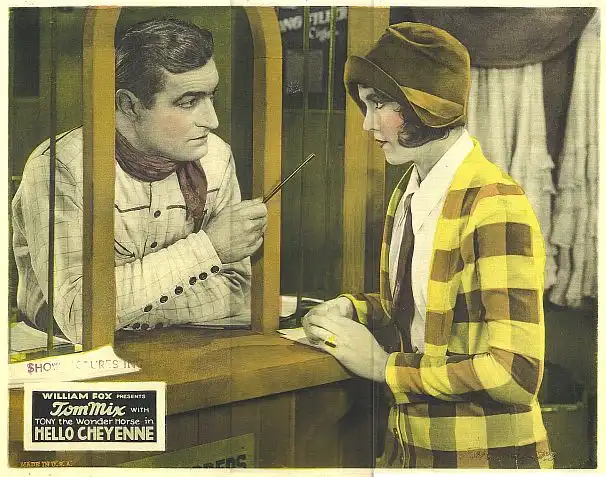
Tom Mix, as Lineman Tom Remington, is the undeniable center of gravity here. Mix projects a natural charisma that effortlessly fills the screen, even without dialogue. He's less of a gritty cowboy and more of a dashing, acrobatic hero, performing his own stunts with an easy confidence. One particular moment that sticks out is his effortless dismount from Tony at a full gallop, sliding to a stop with a flourish that feels more circus act than mere riding, yet perfectly in character for his showmanship.
And then there's Tony the Horse. Tony isn't just a prop; he's a co-star. His intelligence is showcased repeatedly, from untying ropes to signaling danger with a subtle ear flick and a nudge against Mix's arm. There's a scene where Tony seems to almost purposefully knock over a stack of equipment to create a diversion, a moment so well-timed it almost feels like he understood the director's cue. The chemistry between Mix and Tony is palpable, elevating many of the film's action sequences beyond simple chases.
Caryl Lincoln, as Doris, largely embodies the silent film heroine archetype – she's often in peril, requiring rescue. However, she’s not entirely passive. There are moments where her expressions, particularly during her father's stress or her own capture, convey genuine fear and determination, rather than just wide-eyed helplessness. Joseph W. Girard, as her father, delivers a performance tinged with a palpable desperation, his furrowed brow and slumped shoulders effectively communicating the weight of his financial struggles. Martin Faust, as the chief villain, is a wonderfully broad antagonist. His smirks and exaggerated gestures leave no ambiguity about his rotten character, making him easy to root against. Al St. John, playing Faust's bumbling henchman, provides some welcome, if predictable, comic relief, often stumbling into his own traps.
The pacing of Hello Cheyenne is generally brisk for a silent film, particularly once the race is fully underway. The cross-cutting between the two crews' progress effectively builds tension, even during the more mundane tasks of digging holes and raising poles. The film dedicates a surprising amount of screen time to the actual mechanics of stringing wire, which, rather than dragging, actually gives a sense of realism to the endeavor. One sequence shows a line crew struggling to hoist a particularly heavy coil of wire onto a pole, the camera lingering just long enough on their strained faces and the taut ropes to convey the sheer physical effort involved. This attention to the industrial aspect is a strong point.
Visually, the film benefits greatly from its Wyoming locations. The wide-open spaces are captured effectively, giving a sense of scale to the challenge of building a telephone line across such terrain. Director Fred Myton (credited as Dudley Early for the story) and cinematographer Harry Sinclair Drago make good use of the natural light, often silhouetting riders against the horizon or casting long shadows during dramatic moments. The action sequences, especially the horse chases, are well-staged and edited, maintaining a sense of speed and danger without becoming chaotic.
The primary strength of Hello Cheyenne is its novel premise, coupled with the star power of Tom Mix and Tony. The clear stakes and straightforward narrative make it easy to follow, and the blend of adventure, romance, and corporate espionage (of a sort) keeps things engaging. The film doesn't pretend to be more than it is: a thrilling Western adventure with a dash of ingenuity.
However, it’s not without its minor stumbles. The plot, while unique in its core idea, relies on some fairly standard silent-era contrivances, particularly the villain's increasingly desperate and cartoonish schemes, culminating in a somewhat boilerplate kidnapping. While effective for the period, some of the reaction shots from supporting characters can feel a tad overlong, holding on a surprised face for an extra beat or two more than necessary. The romantic subplot between Tom and Doris, while sweet, doesn't add much depth beyond providing a motivation for Tom's heroics. It's a functional romance rather than a passionate one.
Hello Cheyenne is more than just a historical curiosity. It's an entertaining and surprisingly fresh silent Western that leverages its unique premise to great effect. Tom Mix and Tony the Horse are in top form, delivering the kind of charismatic, stunt-filled performance that made Mix a superstar. While it adheres to many genre conventions of its time, its focus on the technological race sets it apart. If you're looking for a well-executed silent adventure that offers both thrilling action and a glimpse into a bygone era of Western expansion, give Hello Cheyenne a watch. It’s a solid piece of cinematic history that still delivers a good ride.
IMDb —
1921
Community
Log in to comment.