DbcultAccessing Vault...
7.8/10
Senior Film Conservator
A definitive 7.8/10 rating for a film that redefined the boundaries of cult cinema. Mohini Bhasmasur remains a cornerstone of transgressive art.
The year is 1913. While Oliver Twist limps through Victorian squalor and From the Manger to the Cross floods American churches with pious lantern slides, a mustachioed Maharashtrian exile from the stage, Dhundiraj Govind Phalke, purchases a derelict printing press and dreams of gods. Out of rusted gears and moonlight he conjures Mohini Bhasmasur, a 1,200-foot strip of 35 mm nitrate that runs barely twenty-two minutes yet stretches time like taffy. The plot is ostensibly the Puranic chestnut of a demon granted pyrotechnic powers, but in Phalke’s hands it becomes something stranger: a proto-cinematic treatise on erotic peril, a morality play that winks at its own preachiness, and a backstage ballet of painted curtains doubling for Himalayan vistas.
Frame one: a diademed Shiva meditates inside a papier-mâché cave whose crags tremble like jelly. The deity’s third eye is a hand-tinted crimson dot that flashes exactly three times—Phalke’s primitive but pulse-quickening iris effect—before the camera, immobile as stone, records Bhasmasur’s prostration. Notice how the demon’s body paint is cracked, almost crocodilian; he glistens as if lacquered in yesterday’s sweat. This is no accident. Phalke instructed his actors to forgo sleep so that exhaustion would seep through the make-up, giving the monster a wax-museum lethality. Every pore seems to mutter danger.
The boon sequence arrives without subtitles or intertitles; instead, Phalke overlays Sanskrit couplets directly onto the image, the lettering quivering like heat haze. Modern viewers may scoff, yet the device sutures us into a pre-literate communion. When Bhasmasur tests his new gift on a wandering hermit, the edit is shock abrupt: one cut, the sage collapses into a pile of grey dust that the wind promptly disperses. No reverse shot, no lingering horror—just vacuum. It’s the first cinematic disappearance act, predating the Vanishing Lady trick by Georges Méliès, and it is accomplished with the bluntness of a street-side thug.
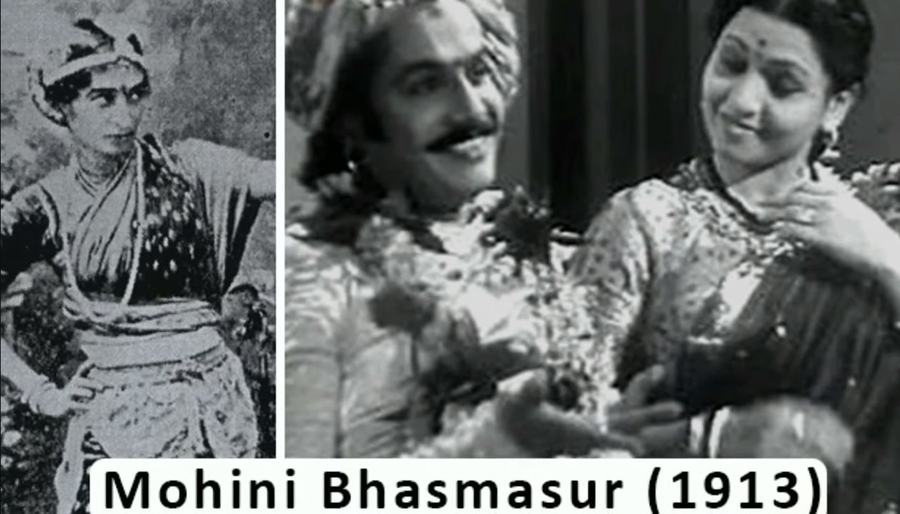
Enter Durgabai Kamat, India’s first documented actress, her eyes kohl-swollen and luminous with mischief. She is Mohini, Vishnu’s feminine guise, but Phalke refuses to deify her outright. Instead, she is introduced through a dolly-in (achieved by seating the camera on a bullock cart) that turns her hips into a metronome of temptation. The audience at Bombay’s Olympia Theatre reportedly shrieked: women had been depicted on Indian screens before, but never as a cosmic coquette armed with ironic omnipotence.
The seduction choreography is a marvel of stop-motion suggestion. Mohini twirls; Bhasmasur apes; the surrounding extras form a human zoetrope, clapping in staggered rhythms so that the footage, when hand-cranked at variable speeds, creates staccato hip-hop centuries prior to its musical namesake. Look closer and you’ll spot Kamlabai Gokhale, the nine-year-old who plays Mohini’s attendant, smirk directly at the camera—an audacious fourth-wall rupture that foreshadows the wink-wink nihilism of Fantômas.
Phalke’s laboratory was a cow-shed reeking of chemicals and devotional incense. He and two unnamed women—probably relatives—dyed each frame with squirrel-hair brushes, tinting Mohini’s saree a radioactive mustard and Bhasmasur’s skin a bruised ochre. The result is hallucinatory. During the climactic self-immolation, the screen erupts into a volcano of flickering oranges, reds, and ghost-greens; the colours refuse to stay within outlines, bleeding like guilty secrets. Archivists at the National Film Archive of India posit that the instability was intentional, a visual analogue for the demon’s moral dissolution. I concur: watch how the chromatic spillage grows more anarchic the closer Bhasmasur comes to his own annihilation.
Silent mythologicals demand synesthetic imagination. Contemporary exhibitors hired narrators—‘picture-purveyors’—to stand beside the screen and vocalise dialogue. Surviving song-sheets suggest that when Mohini arches an eyebrow, the narrator croons a bhajan whose final syllable rhymes with ‘ash’, priming the audience for combustion. Thus the film is incomplete without live performance; it is a chimera of celluloid and human lungs, anticipating the raucous ‘call-and-response’ screenings of Life and Passion of Christ touring America the same decade.
British censors in Bombay watched Mohini Bhasmasur with the detached boredom of imperial functionaries. They stamped it ‘Cultural, Harmless’, failing to notice the sub-textual middle-finger: a tale where divinity outwits brute force through cunning rather than martial valour. In an age when the Empire marketed its own moral superiority, Phalke’s gods cheat—a stratagem of the oppressed. The film’s success emboldened other regional entrepreneurs, spawning a spate of mythologicals that slipped past colonial radars while nurturing anti-authoritarian metaphors.
Let us rescind the cliché of Phalke as solitary genius. Durgabai Kamat and Kamlabai Gokhale were co-authors of the film’s erotic grammar. They improvised gestures too risqué for male performers: the hip-roll that halts Bhasmasur mid-chase, the hair-laugh that conceals strategising eyes. Their off-screen camaraderie—mother and daughter inhabiting a single mythic body—adds meta-freight to Mohini’s sexual charisma. In a nation yet to grant women voting rights, here was matrilineal creativity masquerading as divine illusion.
The original negative succumbed to white-ant appetites in 1917. What circulates today is a 1950s duplicate, itself scarred by vinegar syndrome. Yet the damage rhymes with theme: sections resemble flame-licked manuscripts, history devouring itself. Italian lab L’Immagine Ritrovata’s 4K scan (2019) stabilised the warp but preserved the scorch marks, wisely refusing digital cosmetics. The tinting was recreated using turmeric, indigo, and pomegranate, reverting to Phalke’s kitchen-alchemy ethos.
Critics fond of Euro-centric genealogy bracket Phalke with Dante’s Inferno or Pinocchio, but the comparison limps. Melies embraced theatrical proscenium; Phalke collapses temple, street, and cinema into one unruly carnival. A closer cousin is The Life and Passion of Jesus Christ—both marshal religious iconography for mass spectacle—yet Mohini Bhasmasur is fleeter, naughtier, its theology encoded in dance rather than sermon. Where Pathé’s Jesus bleeds gravitas, Phalke’s gods giggle behind masks.
Anurag Kashyap’s Dev.D quotes Mohini’s hip-sway in a narcotic dream sequence; the colour palette of Padmaavat borrows Phalke’s mustard-seed yellow for its goddess-on-earth tableau. Even Hollywood’s Thor: Ragnarok glances sideways at the image of a persecuted deity outfoxing doomsday through shape-shifting charm. None credit the source, yet celluloid memory is sticky; ash always leaves a film.
Queue the restoration on a 4K projector, dim the bulbs to half-power to mimic carbon-arc flicker, and invite a percussionist to mirror the dancers’ footfalls. Sit close enough to notice the frayed sari borders—each thread a century of vanished audiences. When Bhasmasur raises his hand to his own scalp, hold your breath: you will swear the theatre smells of singed hair.
Great art mutates; great myth combusts. Mohini Bhasmasur is both, a celluloid phoenix whose ashes fertilised Indian cinema’s sprawling banyan. At a moment when superhero franchises reduce morality to CGI punch-ups, Phalke’s 22-minute jest reminds us that divinity prefers choreography over combat, that temptation can be a cosmic public service. Watch it not as relic but as revelation: a lesson in how to set fire to tyranny while laughing in iambic ankle bells.
Demons burn, gods jest, film survives—sometimes by the width of a painted flame.

IMDb 6.4
1931
Community
Log in to comment.