DbcultAccessing Vault...
4.5/10
Senior Film Conservator
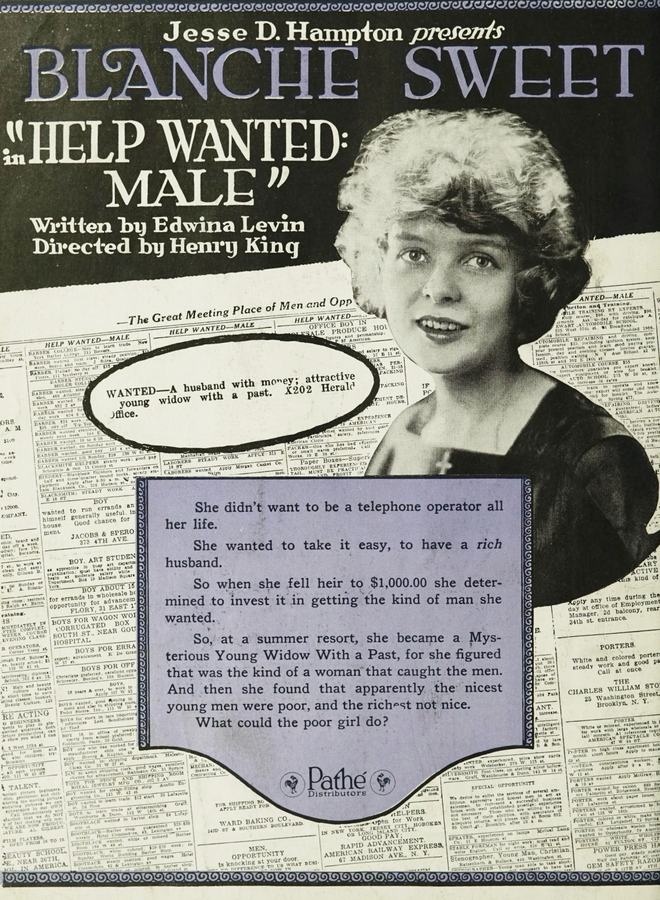
A definitive 4.5/10 rating for a film that redefined the boundaries of cult cinema. Help Wanted - Male remains a cornerstone of transgressive art.
The celluloid gods were feeling puckish in 1922. While Europe stitched itself together with frayed nerves and cheaper gin, Hollywood—bloated on box-office helium—decided to gift the world a mischievous bauble titled Help Wanted – Male. Ostensibly a feather-light comedy of errors, this seven-reel flirtation is actually a scalpel in kid-gloved hands, dissecting the marriage market with the same glee a child shows yanking wings off flies. Watch it once and you chuckle; watch it twice and you wince at how little the transactional heart has changed.
Blanche Sweet’s Leona enters frame left like a question mark wearing a Parisian hat. The actress—famed for tragic gravitas in The Foundling—here flexes comedic cartilage most audiences never knew she owned. Observe her pupils dilate the instant that thousand-dollar inheritance lands: not greed, but calculus. In a nation drunk on Horatio Alger mythology, every cent is seed money for reinvention. She spends it all on clothes, because fabric is the fastest passport across class borders.
The film’s visual lexicon is a cocktail of chiaroscuro and sun-drenched artifice. Cinematographer Henry Cronjager (unjustly forgotten today) shoots the resort’s grand ballroom as though it were an aquarium: couples swirl beneath chandeliers that dangle like jellyfish tendrils, while the camera glides, ghost-like, above waltzing waistlines. Notice how he frames Leona through balustrades and ferns—bars of a gilded cage she both hates and desperately wants to own. The symbolism arrives without neon underlining; you absorb it osmotically.
And then there is the dog—Kid the Dog, billed with star swagger right after human actors. A scruffy mongrel who wanders in and out of scenes, he operates as a living barometer of authenticity. When Leona lies, Kid cocks his head in canine skepticism; when love finally lands, the pup flops contentedly at her feet. Silent-era audiences, many of them immigrant laborers starved for sentiment, would have erupted at this four-legged moral compass. Today, he reads as proto-cute clickbait, yet the device still works.
Screenwriters Edwina LeVin and George H. Plympton lace the intertitles with acid. One card, after Leona’s scheme ignites, reads: "She hunted for a husband the way Wall Street hunts for suckers—ruthlessly, and with excellent posture." The line skewers both genders: women reduced to stock quotations, men to gullible IPOs. It’s tempting to call such writing pre-code, but the Hays Office had yet to cinch its noose; moral censorship in 1922 was sporadic, enforced by local firebrands who considered Chaplin’s shoe-ballet pornographic.
Jean Acker, later infamous as Rudolph Valentino’s estranged bride, plays the hotel’s resident gossip with a fluted nasality you can almost hear despite silence. She drifts through lobbies trailing a parasol like a satellite dish hungry for rumor. Watch how director Henry King cuts from her arched eyebrow to a chambermaid dropping a tray: causality without exposition, pure visual haiku.
The plot’s MacGuffin—Captain Cromwell’s disappearance—ripples from newspaper headlines into parlor chatter, demonstrating media contagion decades before Twitter. When Tubbs (revealed as Cromwell) finally unmasks, the film stages the confession not in a moonlit garden but in a drab cloakroom lit by a single swinging bulb. The ordinariness undercuts romance, suggesting identities are costumes you can hang beside moth-eaten coats. It’s a moment that anticipates the disenchanted wit of Fedora and the ontological shell-games of later noir.
Mayme Kelso, essaying the resort’s battle-axe proprietress, delivers reaction shots worthy of a Daumier lithograph. When she spies Leona tête-à-tête with the supposed vagrant, her face cycles through affront, calculation, and barely suppressed glee at potential scandal—all in five seconds of screen time. Silent cinema at its best is anthropology in a hurry.
Scholars sometimes slot Help Wanted – Male alongside trifles like A Pair of Sixes, yet the DNA is darker. Beneath screwball antics hums existential dread: the dread of being female, broke, and over twenty-five in a culture that prices brides like used Ford Model T’s. Leona’s machinations feel less conniving than Darwinian. When she sighs in relief at snagging Tubbs/Cromwell, the film lingers on her eyes and you glimpse exhaustion, the sudden slump of a woman who realizes the game was rigged, but still has to smile for the victory portrait.
Frank Leigh’s aviator—when he finally appears in flashback—projects a peculiarly American hybrid: half barnstormer, half stock-market tip-sheet. He embodies the reckless optimism that would, within seven years, augur the Crash. Tubbs’s tramp disguise, meanwhile, riffs on hobo iconography then rampant in vaudeville. Note how his patched coat is tailored just rakish enough to stay attractive; even poverty must be photogenic.
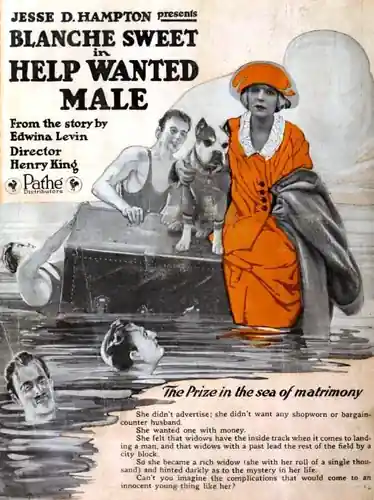
King’s direction toggles from Altman-esque crowd bustle to intimate close-ups where pores and panic are comrades. In one insert, Leona’s gloved finger traces the rim of a champagne flute; the squeak of silk against crystal becomes the scene’s only sonic signpost, delivered via synesthetic suggestion. Viewers supplied the sound in their heads, a participatory alchemy lost to Dolby surround.
Comparative context: if you adore the acidic matrimonial satire of When It Strikes Home or the Alpine class farce in Die Claudi vom Geiserhof, Help Wanted – Male operates as their cynical Yankee cousin, swapping Tyrolean peaks for a hotel that might as well be a meat market. It lacks the Expressionist shadows of Szulamit or the flamboyant danger in On the Trail of the Spider Gang, but its prosaic brightness is precisely the point: venality under sunlamps.
Contemporary critics in 1922 praised the film’s "effervescent nonsense" (Photoplay) yet sniffed at its "lack of uplift." Translation: no angelic orphans, no sermons. What they missed was the stealth feminism: LeVin’s screenplay lets a woman orchestrate her own rescue, even if the escape hatch is wedlock. Compare that to An American Live Wire, where the hero invents his fortune; here invention is social, stitched from silk and lies.
Jay Belasco’s art direction deserves a bow. He converts the hotel into a labyrinth of visual puns: elevator doors yawn like courtrooms, corridor corners jut like elbows nudging scandal. The spatial logic is theatrical—characters pop from pillars the way farce actors enter through French windows—yet the camera’s mobility prevents staginess.
Thomas Jefferson (no, not the Founding Father) essays the mail-order detective with vaudeville snap. His performance is a study in self-inflated mediocrity: every time he tips his hat, the brim smacks a lampshade, undercutting the menace. The gag anticipates Inspector Clouseau by four decades, proving slapstick and suspense can share a bunk bed.
Restoration status: only two incomplete 16 mm prints survive—one at MoMA, one in a private Parisian archive. The Paris reel contains an alternative ending shot for French audiences where Leona winks at the camera, breaking the fourth wall like a flapper Ferris Bueller. Cinephiles trade rumors of a 35 mm nitrate in Buenos Aires, but hopes dim with each decade. If you chance upon a retrospective, sprint. The tinting—amber for interiors, cerulean for exteriors—shifts like mood rings, a ghostly beauty lost on DCP.
Why does it still matter? Because the film foretells our influencer era where persona is product, romance a leveraged buy-out. Leona’s thousand bucks is today’s follower count; Cromwell’s aviator fame is blue-check clout. The hotel ballroom could be any algorithmic feed: curated, predatory, relentless. Watching it, you taste déjà vu wrapped in gabardine.
Reception then mirrors reception now. A hundred years ago, audiences tittered at the gold-digger label; today we hashtag #sugarbaby without irony. The film’s genius is that it refuses to condemn. LeVin’s script ends on an embrace, not a courtroom, implying society—not the individual—must stand trial.
So, the verdict? Help Wanted – Male is a shot of Prohibition-era moonshine: sweet on the tongue, corrosive in the throat, leaving you dizzy enough to believe the Twenties roared for fun, not survival. Watch it for the frocks, stay for the guillotine wit, leave questioning every transaction you’ve ever masked as serendipity.
Stream if you can find it. Tape-trade if you’re analog. Whisper its title in darkened archives and hope the projector gods are listening. Because films like this don’t die; they just wait for the next century to catch up.
IMDb 7.8
1931
Community
Log in to comment.