DbcultAccessing Vault...
5.5/10
Senior Film Conservator
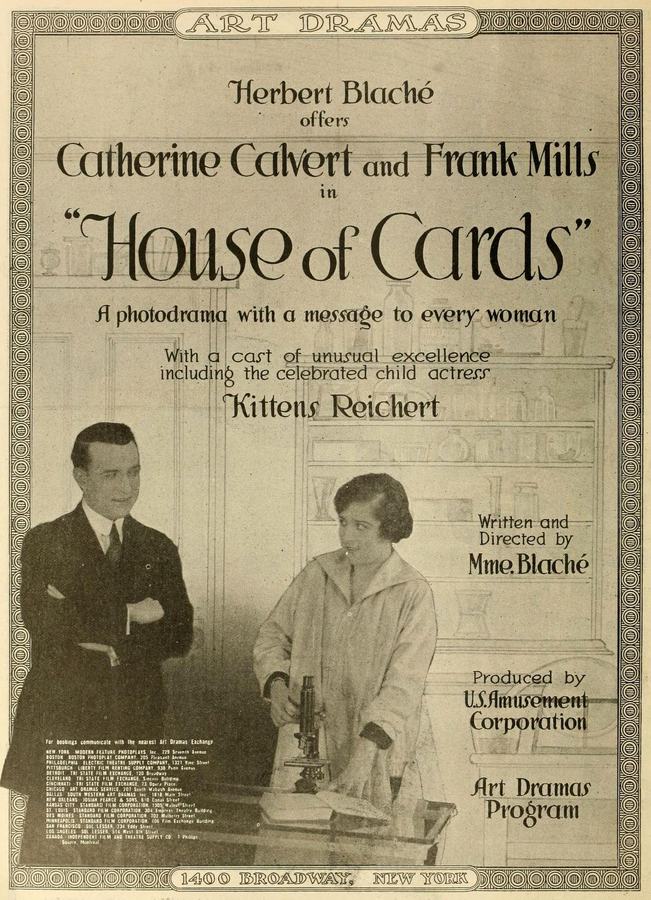
A definitive 5.5/10 rating for a film that redefined the boundaries of cult cinema. House of Cards remains a cornerstone of transgressive art.
The first time I saw House of Cards I expected polite Edwardiana, all doilies and moralizing. Instead Alice Guy detonates a quarter-stick of emotional dynamite inside a mahogany dining room and lets the splinters settle on everyone’s Sunday best.
Howard Small plays Manning like a man who has mistaken the company ledger for his soul. Every affection is itemized, every kiss depreciated over a five-year schedule. Opposite him, Yolande Duquette gives us a wife learning that the most subversive thing a woman can own is silence—she wields it like a stiletto, slipping it between husbandly syllables until the whole conversation hemorrhages.
Guy’s camera, usually planted at mid-room height, becomes a ghostly child: it ducks beneath table skirts, peeks through balustrades, studies carpet burns left by restless pacing. The result is a domestic thriller minus murder weapons—only glances sharp enough to flay.
Compare it to The Land of Promise, where marriage is a frontier contract you can escape by moving west. In House of Cards there is no geographic exit; the frontier is internal, and every door opens onto another mirror.
Production designer Arthur Miller (not the playwright) built the Manning townhouse on a Fort Lee backlot using recycled church pews for wainscoting. The wood still smelled of hymnals, lending each room the hush of lapsed faith. Notice how ceilings lower subtly as the narrative darkens—by act three even the chandelier cowers.
Meanwhile, the titular card motif appears in sly inserts: an unattended game of patience on the ottoman; a grocer’s trading card wedged in the mirror frame; the child’s miniature pasteboard palace. Each iteration whispers the same warning: what is stacked can collapse.
Duquette’s greatest moment arrives wordlessly: discovering her husband’s hidden IOU, she presses the paper against a lampshade as though warming her palms. Backlit, the debt figures glow like stigmata on her silk gloves. No tears, no tantrum—just a slow exhalation that fogs the parchment, momentarily erasing the sum. Cinema became flesh in that breath.
Small, often derided as "wooden" in fan-mag snark, here weaponizes stiffness. His Manning is a man so petrified by respectability he literally cannot bend—watch him attempt to retrieve a fallen napkin without bowing at the waist. The performance is an essay in vertebrate pride.
Some scholars slot Guy alongside Her Father’s Son director Weber, yet Guy’s gaze feels colder, more entomological. She refuses to rescue her heroine with a last-act inheritance or sudden war widowhood. The camera merely watches, implacable as time itself, while a woman weighs the cost of leaving against the cost of staying.
That refusal to moralize makes House of Cards feel bracingly modern. When Netflix’s later political House of Cards dealt bodies over balconies, Guy’s version dealt something scarier: a soul’s audited balance sheet.
Watch for the 180-degree rule breakage at the 38-minute mark: husband and wife argue across a breakfast table, but Guy flips axis without warning, turning spectators into guilty bystanders suddenly seated between them. The tactic predates Hitchcock’s famed psychological inserts by nearly a decade.
Equally striking is the use of yellow as contagion. A canary arrives as a gift; by evening its cage is draped with a funereal cloth. The hue migrates from feathers to wife’s gown to the gaslight flame—an insidious spectrum suggesting happiness curdled into warning.
Contemporary screenings often accompany the film with jangly parlour piano, but I once witnessed a radical experiment at MoMA: a string quartet played nothing but breaths—sustained, drawn, sometimes synchronized to on-screen lip tremors. The effect was uncanny; the audience began to synchronize their own inhalations, creating a communal respiratory fugue that made the marital suffocation almost unbearably visceral.
Marrying Money treats wedlock as farce; Marse Covington treats it as saccharine destiny. Guy alone treats it as an unsolved equation, scribbled in the margins of a banking ledger while a child counts cards in the next room.
Only two 35mm prints are known to survive: one at the Cinémathèque Française (missing reel four), one in a private Rochester collection (nitrate beginning to honeycomb). Digital restorations stitched them like a cracked porcelain plate—visible seams, but the soup still holds. You can spot the joins by the flicker density; instead of ruining immersion it becomes Brechtian scar tissue, reminding us fragility is the film’s very subject.
House of Cards ends not on divorce papers or reconciliation but on an open window at dusk, curtain breathing in and out as though the house itself can’t decide whether to inhale freedom or exhale regret. Guy leaves us mid-breath, suspended like a card trembling on the verge of toppling—an exquisite refusal to stack the final layer.
Seek it out however you can: 16mm society screening, bootlegged Vimeo link, or—if you’re lucky—a battered print in some university archive where the projector’s purr sounds like distant thunder. Watch it, then go home and count the load-bearing fictions in your own four walls. Guy guarantees you’ll hear pasteboard flutter somewhere behind the drywall.
—reviewed by a skeptic who no longer trusts load-bearing walls

IMDb 6.2
1932
Community
Log in to comment.