DbcultAccessing Vault...
Cult Review
Senior Film Conservator
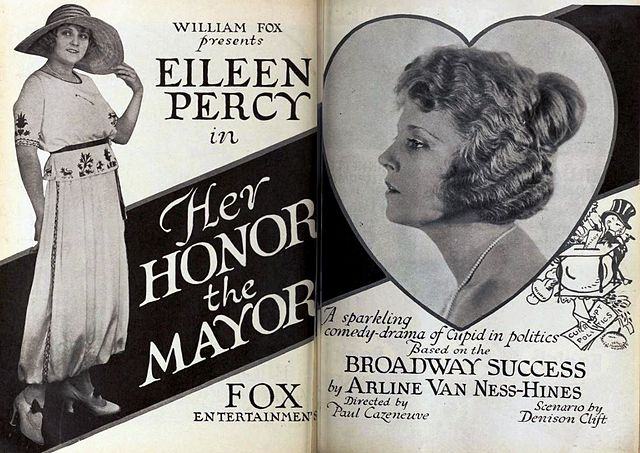
In the annals of early cinema, certain films, often overlooked by contemporary scholarship, occasionally resurface to remind us of the medium's nascent power to reflect, and sometimes even presage, profound societal shifts. Among these forgotten gems, 1917’s Her Honor the Mayor stands as a surprisingly prescient artifact, a narrative tapestry woven with threads of political intrigue, gender subversion, and an unwavering belief in moral rectitude. Directed with an earnest hand and penned by Arline Van Ness Hines and Denison Clift, this film, starring Eileen Percy as the titular trailblazer Julia Kennedy, offers more than just a glimpse into a bygone era; it serves as a fascinating lens through which to examine the nascent stirrings of female empowerment on the silver screen and within the public consciousness.
The very premise of Her Honor the Mayor is, in itself, an audacious statement for its time. Julia Kennedy, a woman of evident intellect and conviction, shatters the glass ceiling of municipal politics, securing the mayoral seat against a backdrop of deeply entrenched male chauvinism. Her victory is not merely a political win; it’s a seismic event, a direct challenge to the established order personified by the antagonistic District Attorney Frank Stanton and the notoriously corrupt ward boss Jerry McGrath. This initial setup immediately establishes the film's central conflict: not just a battle for political control, but a clash of ideologies, a struggle between progressive ideals and the calcified traditions of a patriarchal system. It positions Julia not just as a mayor, but as a symbol, a harbinger of a future where gender would not be an insurmountable barrier to leadership.
Julia's character is immediately distinguished not by her political acumen alone, but by her profound sense of social justice and empathy. Her decision to befriend Minnie Scott, an unwed mother, is a pivotal moment, showcasing her moral compass and highlighting the film’s willingness to tackle sensitive social issues. In an era when such women were often ostracized and condemned, Julia's act of compassion is both radical and politically perilous. It further solidifies the animosity of Stanton and McGrath, who view her progressive stance as a weakness, a deviation from the 'proper' decorum expected of a public servant, let alone a woman in power. This subplot resonates with the spirit of films like The Mother and the Law, which similarly grappled with societal prejudices and the often-harsh judgments leveled against vulnerable women. Julia's unwavering support for Minnie underscores a core theme: true leadership extends beyond policy to encompass profound human understanding and a willingness to challenge societal norms for the sake of justice.
The performances, particularly Eileen Percy as Julia, are crucial in conveying the weight of these themes. Percy imbues Julia with an inner strength and quiet determination that transcends the often-melodramatic conventions of the period. She is not merely a figurehead; she is a woman of substance, capable of both tender empathy and steely resolve. Ramsey Wallace, as District Attorney Stanton, undergoes a compelling transformation, initially embodying the rigid, skeptical male gaze before gradually succumbing to Julia's undeniable integrity. Edwin B. Tilton's portrayal of Jerry McGrath, the archetypal ward boss, is predictably villainous, a caricature of corruption that serves as a necessary foil for Julia’s moral clarity. The ensemble effectively navigates the narrative's emotional currents, making the societal stakes feel palpable despite the inherent limitations of silent film acting.
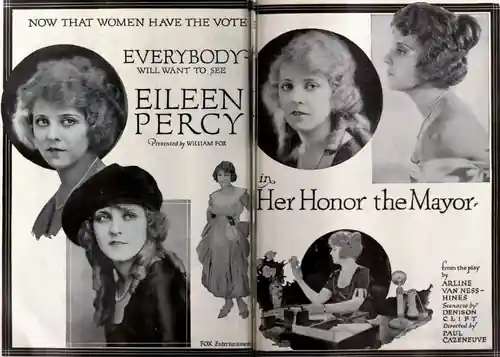
The film truly ignites when McGrath, unable to tolerate Julia's presence and influence, resorts to outright blackmail. His weapon of choice: a hidden past involving Julia's nephew, Buddy, and his father, John Martin, an embezzler. This tactic, designed to publicly disgrace Julia and force her resignation, is a classic political maneuver, a cynical attempt to exploit personal vulnerability for political gain. It's a testament to the film's shrewd understanding of power dynamics, recognizing that even in the early 20th century, personal lives were often fair game in the ruthless world of politics. The tension here is not merely about scandal; it's about the very integrity of Julia's office and her ability to withstand the kind of dirty tricks that are sadly timeless in their application.
However, Julia Kennedy is no passive victim. Her response to McGrath's threat is not one of panic or capitulation, but of strategic counter-offensive. The screenplay, by Arline Van Ness Hines and Denison Clift, grants Julia an agency that feels remarkably modern. Instead of being cowed, she delves into McGrath's own past, unearthing his prior conviction for the embezzlement of public funds. This revelation is a masterstroke, a moment of narrative catharsis where the hunter becomes the hunted. It’s a satisfying reversal that speaks to the enduring power of truth and justice, echoing the themes found in films like The Dollar and the Law, where legal and moral battles often intertwine with personal vendettas. Julia's investigative prowess and her willingness to fight fire with fire, albeit ethically, firmly establish her as a formidable political force, not just a figurehead.
With McGrath’s machinations effectively neutralized, the film pivots to address the lingering antagonism of District Attorney Frank Stanton. Stanton, initially a staunch opponent driven by a mix of professional rivalry and perhaps unconscious gender bias, represents the more respectable, yet still traditional, wing of the establishment. His reservations about Julia are not rooted in outright malice like McGrath's, but in a patriarchal worldview that struggles to reconcile itself with a woman in such a position of power. The evolution of his character, from antagonist to admirer, is one of the more subtle and compelling arcs of the film. It’s a testament to Julia’s consistent demonstration of competence, integrity, and grace under pressure that she gradually chips away at his prejudices. This transformation, culminating in his falling in love with 'her honor the mayor,' is not merely a romantic resolution; it’s a symbolic surrender of the old guard to the new, an acknowledgment that merit and character transcend gender.
The narrative’s conclusion, while offering a conventional romantic pairing, elevates it by grounding it in mutual respect and admiration. Stanton’s affection for Julia is born not out of weakness, but out of a profound recognition of her strength and virtue. This particular resolution distinguishes Her Honor the Mayor from many contemporary films where a woman's ambition might ultimately be sacrificed for domestic bliss. Here, Julia retains her office and her dignity, her political triumph seamlessly integrated with her personal fulfillment. It’s a narrative choice that, even today, feels remarkably progressive, suggesting that a woman can indeed have both a successful career and a loving relationship without compromise.
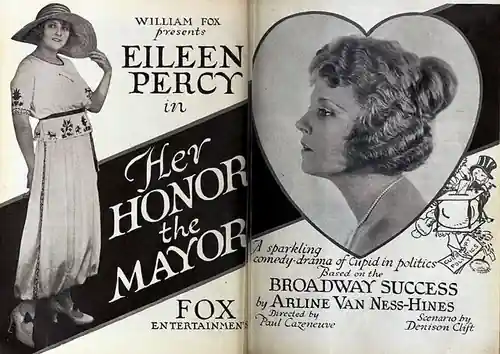
From a purely cinematic perspective, Her Honor the Mayor, like many films of its era, relies heavily on theatrical performances, expressive intertitles, and a relatively straightforward visual style. However, within these constraints, the film manages to convey its powerful message with clarity and conviction. The pacing, while slower by modern standards, allows for character development and plot intricacies to unfold deliberately, inviting the audience to engage with the moral dilemmas at hand. The use of close-ups, though perhaps not as sophisticated as in later silent films, effectively draws attention to the emotional states of the characters, particularly Julia's moments of resolve and Stanton's evolving expressions of doubt and admiration. The film's black and white cinematography, while rudimentary, effectively captures the stark contrast between the city's shadowy political underbelly and Julia's beacon of integrity.
Comparing Her Honor the Mayor to other narratives of ambition and struggle, one might draw parallels with the tenacity displayed by protagonists in films like A Successful Failure, though Julia's journey is distinctly marked by her gender and the specific challenges it presents. Her battle against entrenched power structures and societal prejudices also finds echoes in the dramatic confrontations seen in Protsess Mironova, where individuals often stand against formidable institutional forces. What truly sets Her Honor the Mayor apart, however, is its explicit embrace of female leadership as not just viable, but morally superior in the face of corruption.
The film's exploration of ethics within political office, and the personal sacrifices often demanded, remains remarkably pertinent. It’s a narrative that implicitly asks: what does it truly mean to serve the public? And can a system riddled with old prejudices truly adapt to new, more equitable forms of leadership? Julia Kennedy’s journey provides a hopeful, albeit idealistic, answer. Her character embodies a vision of civic duty rooted in compassion, intelligence, and unwavering courage, qualities that transcend the specific political landscape of 1917. The film's ultimate message, that integrity and empathy can ultimately triumph over cynical power plays and entrenched biases, resonates with a timeless appeal.
In conclusion, Her Honor the Mayor is far more than a simple period piece. It is a proto-feminist statement, a daring exploration of female leadership at a time when women had only recently begun to secure the right to vote in many parts of the world. It prefigures later cinematic portrayals of strong, independent women who challenge societal norms, making it a crucial, if often forgotten, entry in the history of cinema’s engagement with gender politics. The film's enduring power lies in its optimistic assertion that character, intelligence, and a steadfast moral compass are the most potent weapons against corruption and prejudice, regardless of who wields them. It's a compelling reminder that even in its earliest forms, cinema was capable of not only reflecting society but also gently nudging it towards a more equitable future. For those interested in the evolution of women's roles in film and society, or simply in a well-crafted tale of political and personal triumph, Her Honor the Mayor offers a surprisingly rich and rewarding viewing experience.
The film’s quiet defiance, embodied by Julia Kennedy, stands as a testament to the power of the individual to effect change, even when confronted by seemingly insurmountable odds. It’s a narrative that champions not just a woman in power, but the very principles of fair governance and social responsibility. The challenges Julia faces, from overt sexism to insidious blackmail, are timeless hurdles for anyone daring to disrupt the status quo. Her ultimate victory, therefore, feels not just like a happy ending, but like a foundational myth for a more inclusive political landscape. It's a film that deserves to be rediscovered, studied, and celebrated for its bold vision and its subtle yet impactful contribution to cinematic and social history.
IMDb —
1920
Community
Log in to comment.