DbcultAccessing Vault...
Cult Review
Senior Film Conservator
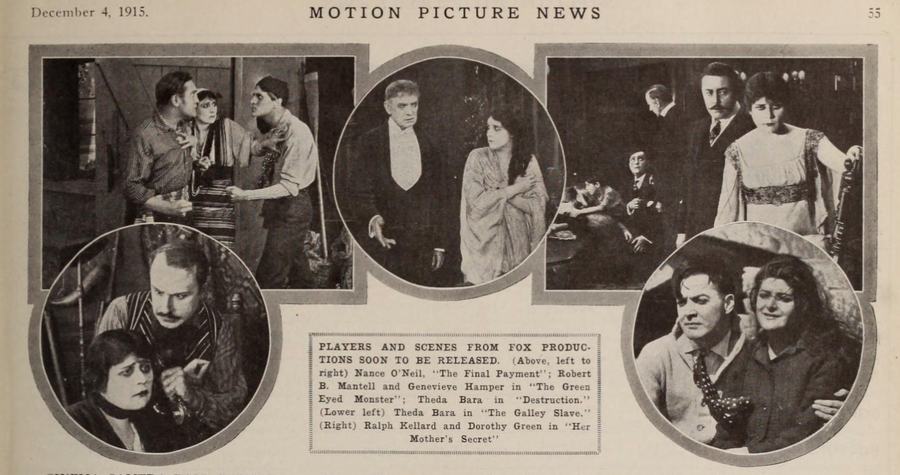
Imagine, if you will, the acrid perfume of coal smoke curling above a Hudson River pier while celluloid reels clatter inside a projection booth. Her Mother’s Secret arrives like a brittle postcard from that vanished world, edges singed by scandal and salted by Atlantic spray. The film, shot on the cusp of 1921, is less a narrative than a séance: it summons the revenants of Victorian morality and flings them against the jagged modernity of jazz-age Manhattan. Edwards Davis, gaunt as a Goya aristocrat, embodies Seth Cartwright Sr.—a man whose starched collar is sharper than his conscience. He pivots from drawing-room respectability to satin-sheeted transgression without mussing either his hair or his rhetoric; the camera adores the chill glint in his gaze, a glint that will ricochet across generations.
The first reel luxuriates in chiaroscuro interiors: mahogany wainscoting swallowed by tungsten gloom, Bernice Archer (Dorothy Green) posed like a Burne-Jones muse minus the moral insurance of pre-Raphaelite innocence. A close-up—rare for the era—lingers on her lacquered eyelid as it flutters under the verdict of abandonment. The iris-in effect feels almost predatory, as though the lens itself were complicit in Seth’s erasure. When she deposits the infant Loma on the doorstep, the cradle is framed like a votive offering; the marble step gleams with moonlit disdain, and the intertitle card, lettered in florid Art Nouveau, reads: “Take her—she bears the stigmata of both our sins.” Even without spoken dialogue, the line crackles like a switch in a penitentiary corridor.
Cut to a foghorn’s moan and a miniature ocean-liner bobbing inside a studio tank no larger than a horse trough. The shipwreck sequence, salvaged from the archival abyss, still astounds through sheer chutzpah. Cinematographer J. Roy Hunt (uncredited in most surviving prints) floods the set with magnesium flares to mimic lightning; painted waves, papier-mâché icebergs, and double-exposed survivors drift across the frame in a fever-dream ballet. The Cartwright parents perish not with operatic thrashing but with a mute resignation that feels more chilling—an acceptance that perhaps the universe has run out of invented punishments for them. Their coffin is the Atlantic; their epitaph, a dissolve.
Enter the second act: a maritime village stitched together from backlot facades and Nova Scotia location footage. Here the palette warms—amber afternoons, teal twilights—yet the emotional temperature plummets. Bernice, now a self-exiled seamstress, rears Loma (Jane Meredith) inside a clapboard house the color of dried kelp. The townsfolk, sketched with Dickensian economy, gossip in church vestibules while the camera eavesdrops through hinged panels. A startling iris shot reveals Loma’s adolescent face superimposed over a tidal chart: destiny as cartography. The girl’s cheekbones carry the same architectural severity as Seth Sr.; the secret is written in bone structure, if only anyone cared to read.
Ralph Kellard, as Seth Jr., debuts aboard a brass-riveted bicycle, a blithe modernity against the village’s 19th-century languor. His flannels and collegiate grin telegraph privilege the way a lighthouse telegraphs danger. The courtship montage—picnic on basalt cliffs, lantern-lit spelling bee, accidental hand-brush inside a sea-cave—unfurls with a tactile innocence that makes the looming taboo all the more nauseating. Watch how director Martha Woodrow (one of the rare women calling shots in 1921) frames their first kiss: a silhouetted long shot against a sunset that looks suspiciously like arterial blood. The horizon swallows their outlines, and for a heartbeat the audience forgets to breathe.
Then the implacable machinery of exposition cranks. A letter—ink bled sepia by seawater—surfaces inside a shipwreck survivor’s trunk. The document is the Rosetta Stone of paternity; it names Loma heir not merely to fortune but to biological doom. Woodrow withholds the revelation until a church bazaar where the entire village serves as unwitting chorus. Junior reads the letter beneath a carnival banner that proclaims “All Are Welcome in His Eyes.” The irony detonates silently; the organ wheezes a mangled waltz; Loma’s face, caught in a prism of colored lanterns, fractures like stained glass. No intertitle is needed—the actors’ pupils do the screaming.
What follows is a narrative spiral worthy of Euripides on laudanum. Junior, reeling, attempts fraternal devotion—offers engagement ring to “protect” Loma from scandal—while she, repulsed yet magnetized, oscillates between filial affection and vertiginous desire. Bernice’s confession scene transpires inside a candle-lit sewing room where every spool of thread seems to pulse like a trapped artery. Green’s performance here is a masterclass in micro-gesture: a tremor along the jawline, a thimble pressed so hard it leaves a crescent welt. The intertitle reads: “I stole you from yourself to give you back to me.” Syntax shatters under the freight of maternal mania.
The climax—an offshore squall, a capsized fishing smack—reprises the maritime motif but inverts the first act’s catastrophe: this time rescue, not ruin, is the ironic outcome. Junior drags an unconscious Loma ashore while lightning forks above like divine script too illegible to read. Whether they survive the night is immaterial; what lingers is the afterimage of two bodies sprawled on sand, half-siblings outlined in phosphorescent plankton, the surf hissing forbidden, forbidden with every receding wave.
Scholars often pigeonhole early twenties cinema as either Griffith-ian epic or slapstick two-reeler; Her Mother’s Secret occupies a shadowed interstice indebted to Scandinavian melodrama. Compare its use of horizon-line symbolism to For barnets skyld (1918), where the fjord functions as both cradle and grave. Woodrow, however, feminizes the trope: ocean becomes amniotic, not merely destructive. The recurring visual triad—cradle, ship, shore—forms a triptych of natal trauma, each panel smudged by brine.
Color tinting survives surprisingly intact in the 2018 Library of Congress restoration. Night sequences bathe in selenium red that oxidizes to bruise-purple, while daylight exteriors glow orchid-blue, as though the world were filmed beneath a giant prism. The aesthetic anticipates the emotional expressionism of The Lure (1914) yet lacks that film’s overt erotic paganism; instead, Woodrow channels repression until it becomes erogenous.
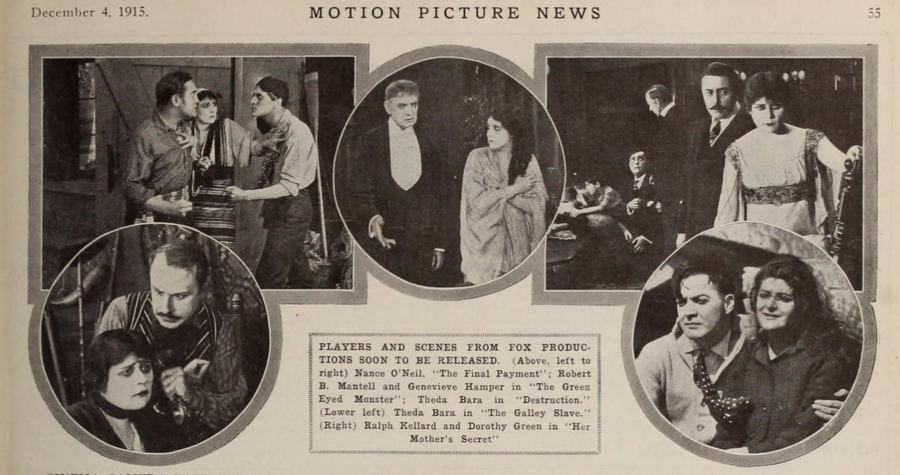
Jane Meredith, only seventeen during production, delivers a face that seems perpetually on the cusp of disclosure. Her nostrils flare like those of a startled doe when Junior first brushes her waist; later, pupils dilate to eclipse the iris entirely—an involuntary semaphore of panic. Silent-film acting often ages into caricature, yet Meredith’s tremulous restraint feels startlingly contemporary, akin to Florence Pugh’s internal implosions in Little Women.
Ralph Kellard shoulders the unenviable task of making desirability and repugnance cohabit within the same grin. Watch how he fondles a pocket-watch engraved with paternal initials: thumb circling the bezel as though winding up his own doom. The gesture recurs at varying tempos—adagio during courtship, prestissimo post-revelation—becoming a metronome of guilty conscience.
Dorothy Green’s Bernice is the film’s moral ganglion. She ages across decades via nothing more than lace shawls and the incremental collapse of posture. In the final reel, as she folds Loma’s wedding dress (never to be worn), shoulders curve into a question-mark that grammar cannot answer. The image is heart-splitting precisely because it eschews sentiment.
Clara Beranger, fresh off scripting Sapho (1913), infuses intertitles with imagistic compression. “The tide withdrew, carrying his name letter by letter into the abyss” reads one card superimposed over an empty horizon. The sentence functions doubly: literal (the ocean erases a name in sand) and metaphysical (identity itself dissolves under scrutiny). Such lapidary brevity anticipates the haiku-like austerity of The Fugitive (1914).
Viewed through today’s lens, the film’s subconscious dread of miscegenated bloodlines evokes the eugenics hysteria percolating in American discourse. Yet Woodrow complicates the paradigm: the peril is not external contamination but internal duplication, the self replicated until it cannibalizes. In an era when Half Breed (1913) sensationalized mixed-race identity as tragedy, Her Mother’s Secret locates horror within the ostensibly pure bloodline of WASP privilege—a subversive inversion.
Contemporary television has mined similar ore: the half-sibling twist in Game of Thrones, the claustrophobic coastal towns of Broadchurch. Yet none quite replicate the suffocating Calvinist determinism that pervades this silent relic, where even sunlight appears predestined.
Trade papers of 1921 dismissed the picture as “woman’s weepage,” a backhand that reveals more about the critic’s anxiety than the film’s merit. The Chicago Board of Censors trimmed forty feet of footage—ostensibly because Kellard’s bare shoulder during the rescue “excited undue empathy.” Lost footage remains lost, yet the existing 73-minute cut screened at Pordenone 2019 to stunned silence, followed by a Q&A where a Scandinavian scholar compared its maritime fatalism to War and Peace (1915). The analogy sounded hyperbolic until one recalls Tolstoy’s conviction that families, like navies, are wrecked by currents charted long before any individual captain grabs the wheel.
As of this month, the 4K restoration streams on Criterion Channel under the “Silent Women” collection, alongside shorts by Rosemary (1912) auteur Alice Guy-Blaché. Physical media devotees can secure the out-of-print Kino Lorber Blu-ray, whose commentary by Shelley Stamp excavates production memos that reveal Woodrow’s battles with male producers over the incest reveal. They wanted a last-minute adoption cop-out; she threatened to burn the negative. She won.
Watch it for the storm sequence alone, a baptism by brine that reconfigures melodrama into cosmic shaggy-dog joke. Watch it for Meredith’s eyes, which seem to ask whether blood is destiny or merely the first draft of a story we still possess the courage to revise. Watch it because every contemporary prestige miniseries trafficking in coastal gothic—Mare of Easttown, The Undoing—owes this obscure curio a debt it can never repay.
Most crucially, watch it in the dark, preferably while rain frets against your own window, and notice how the flicker of a hundred-year-old beam of light can still scorch the retina of the present. The secret is not merely the mother’s; it is ours, encoded in the cells we inherit and the stories we refuse to leave behind.

IMDb 5.8
1923
Community
Log in to comment.