DbcultAccessing Vault...
Cult Review
Senior Film Conservator
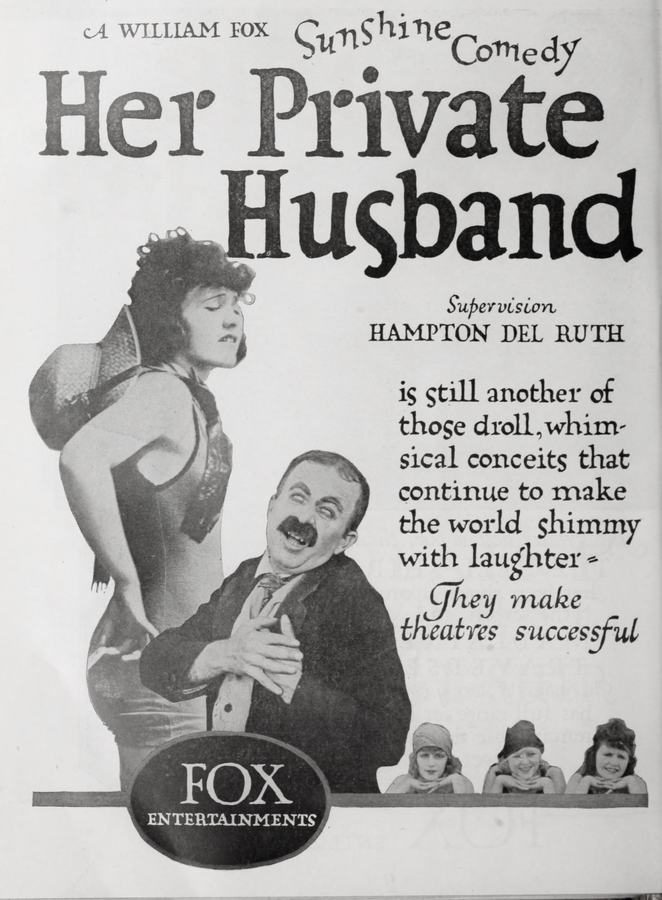
In the annals of early cinema, where brevity often dictated narrative and slapstick reigned supreme, a particular charm emanates from those fleeting glimpses into everyday life, however exaggerated for comedic effect. Her Private Husband, a silent era offering featuring the considerable talents of Alice Davenport and Chester Conklin, stands as a fascinating artifact, not merely for its historical placement, but for its surprisingly nuanced (for the genre and time) portrayal of post-war domestic readjustment and the perennial struggle for marital harmony. It’s a film that, despite its apparent simplicity, offers a rich tapestry of human experience, woven with threads of aspiration, frustration, and an enduring, if often tested, affection.
The narrative, lean as a silent film script often is, centers on a doughboy's earnest attempts to reconnect with his wife after what we can only assume has been a prolonged absence due to his service. The title itself, 'Her Private Husband,' hints at a desire for exclusivity, for a sacred space of conjugal bliss that the world, in its infinite chaotic wisdom, seems determined to deny. Chester Conklin, a master of physical comedy and expressive pantomime, embodies the returning soldier with a palpable sense of hopeful anticipation. His very gait, his eager glances, convey a man ready to shed the horrors of the battlefield for the comforting embrace of hearth and home. One can almost taste the idealized vision of domesticity he carries, a vision undoubtedly nurtured through countless lonely nights in the trenches.
Alice Davenport, a veteran of early cinema whose comedic timing was often understated yet profoundly effective, plays the wife. Her performance is crucial in anchoring the film’s domestic setting, providing a counterpoint to Conklin's more boisterous antics. She is not merely a prop for the husband's desires but a character grappling with her own routine, perhaps even the subtle shifts in her own independence that occurred during his absence. The friction, the comedic tension, arises from the collision of these two worlds: his idealized return and her established, albeit perhaps equally longing, reality. This dynamic is not unlike the thematic undercurrents found in films like Welcome Home, which, though perhaps more overtly dramatic, also explored the complexities of soldiers returning to altered domestic landscapes.
What elevates Her Private Husband beyond mere slapstick is its subtle commentary on the chasm between expectation and reality. The doughboy, yearning for quality time, for intimacy, for a simple moment of shared peace, finds himself perpetually thwarted. His efforts to engage with his wife are met with a succession of hindrances: a ringing telephone, an unexpected visitor, an urgent household chore, or perhaps even an adorable but disruptive pet. Each interruption, though seemingly trivial, compounds his frustration, building a comedic crescendo that is both relatable and profoundly human. This isn't just about a man failing to get a kiss; it's about the universal human experience of desiring connection and finding it elusive amidst the clamor of daily life. The film, in its own quaint way, touches upon the anxieties of a society rebuilding itself, where personal desires often take a backseat to the exigencies of a world in flux, a sentiment echoed in the broader societal shifts depicted in films like The Land of Promise.
Conklin's physical comedy is, as always, a highlight. He possesses an extraordinary ability to convey a gamut of emotions through exaggerated gestures, facial contortures, and an almost balletic clumsiness. His exasperation is never truly angry; it's a frustrated bewilderment, a silent scream of a man who simply wants to sit down with his wife and perhaps share a quiet moment. Davenport’s reactions, often subtle eye-rolls or resigned sighs, perfectly complement his more overt expressions. Their chemistry, though largely unspoken, is tangible, lending a layer of authenticity to the domestic chaos unfolding on screen. It’s a testament to their skill that even without dialogue, the viewer understands the unspoken language of their marital dance.
The film’s reliance on visual gags and situational irony is characteristic of its era. The humor doesn't derive from clever wordplay, which was impossible, but from the universal recognition of life's absurdities. The constant interruptions serve as a metaphor for the relentless demands of modern life, even in the early 20th century. The home, often seen as a sanctuary, becomes a battleground of minor skirmishes, a place where peace is a fleeting visitor. This theme, of domestic life as a source of both comfort and vexation, is a timeless one, explored in countless comedies across cinematic history. One might even draw a parallel to the struggles for personal space and peace in a more dramatic context, such as the internal conflicts depicted in The Mirror, albeit with a vastly different tone and outcome.
Technically, Her Private Husband likely adheres to the standard filmmaking practices of its time. Static camera shots, clear blocking to emphasize the physical comedy, and minimal editing would have been the norm. Yet, within these constraints, the filmmakers managed to craft a coherent and engaging narrative. The pacing, though perhaps brisk by today's standards, would have been perfectly suited for the vaudeville-like programming of early nickelodeons. These short films were designed to entertain quickly, to deliver a punchline, and move on, leaving the audience with a smile. The effectiveness of such films lay in their immediate impact and their ability to tap into universal experiences without requiring complex exposition.
The enduring appeal of films like Her Private Husband lies in their ability to transcend their historical context. While the specific attire and societal norms might seem quaint, the core human desires and frustrations remain remarkably constant. The desire for connection, the struggle against everyday annoyances, the humor found in life's little mishaps – these are themes that resonate across generations. It’s a reminder that even in the nascent years of cinema, filmmakers were adept at capturing the essence of the human condition, albeit through a comedic lens. The film serves as a charming counterpoint to the more dramatic narratives of its time, such as the poignant struggles portrayed in A Corner in Cotton, highlighting the diverse storytelling approaches available to early cinematic artists.
One could argue that the film also subtly critiques the idealized notions of post-war life. The soldier returns not to instant serenity, but to a world still buzzing with its own demands, a wife who has her own routine, and a home that is anything but a quiet sanctuary. This subversion of the 'hero's welcome' trope, while played for laughs, offers a glimpse into the psychological readjustment faced by countless veterans. They returned from a world of stark life-or-death realities to the comparatively trivial, yet maddeningly persistent, challenges of domesticity. The film doesn't dwell on the trauma of war, but rather on the humorous disjuncture between the soldier's internal world of longing and the external world of everyday interruptions.
The performances of Conklin and Davenport are particularly noteworthy for their ability to convey character and emotion without the crutch of dialogue. Conklin's rubbery face and expressive body language are a masterclass in silent film acting. He makes the doughboy's plight instantly understandable and sympathetic. Davenport, with her more restrained but equally potent expressions, provides the perfect foil. Her subtle exasperation or mild amusement grounds the more hyperbolic actions of her screen husband. Together, they create a believable, albeit exaggerated, marital unit. Their work here, like in many other short comedies of the era, contributed significantly to the development of character archetypes that would populate comedies for decades to come, influencing future performers who sought to capture similar domestic dilemmas, perhaps even in the spirited pursuit of happiness seen in Smiles.
In retrospect, Her Private Husband is more than just a forgotten relic; it’s a vibrant testament to the power of early cinema to entertain, to observe, and to comment on the human condition. It’s a film that, in its brief runtime, manages to encapsulate a universal truth about relationships: that even the deepest affection can be tested by the relentless march of daily life, and that sometimes, the greatest challenge isn't overcoming an external foe, but simply finding a quiet moment with the one you love. For anyone interested in the evolution of comedic cinema, the social history embedded in early films, or simply a charming, lighthearted diversion, this film offers a delightful, if fleeting, experience. It stands as a small but significant piece in the vast mosaic of silent film, a genre that continues to reveal its treasures to those willing to look beyond the absence of sound, much like discovering a hidden gem in the narratives of Little Fox or the compelling intricacies of Sooner or Later, each offering its unique insight into its respective era and human drama.
The charm of Her Private Husband also lies in its unpretentious nature. It doesn't aspire to grand statements or profound philosophical insights. Its ambition is simply to amuse, to provide a moment of laughter, and in doing so, it achieves something far more resonant: a timeless portrayal of domestic foibles. The film reminds us that even after monumental global events, life, in its mundane, often irritating, but ultimately endearing way, continues. The soldier may have faced unimaginable horrors, but his greatest, most immediate challenge upon returning home is often the pursuit of simple, personal comfort and connection. This subtle irony is what gives the film its lasting appeal, distinguishing it from purely mechanical slapstick. It injects a dose of humanity into the comedic chaos, making the doughboy's exasperation not just funny, but genuinely felt. It’s a delicate balance, a testament to the filmmakers' understanding of both comedic timing and human psychology, however basic the narrative structure may appear on the surface.
The film also provides a window into the societal expectations of marriage and gender roles in the early 20th century. While the wife is not portrayed as maliciously thwarting her husband, her preoccupation with household duties or social calls reflects the common understanding of a woman's domain at the time. The husband, despite his wartime experience, is reduced to a somewhat helpless figure within the domestic sphere, unable to impose his will or secure his desired intimacy. This dynamic, while played for laughs, subtly highlights the shifting power dynamics and gendered expectations that were beginning to be questioned in society. It’s a far cry from the overt heroism or dramatic struggles seen in films like Mazeppa, der Volksheld der Ukraine, yet it offers its own kind of social commentary through the lens of everyday life. The domestic comedy, in its seemingly trivial scenarios, often holds up a mirror to broader societal patterns, revealing anxieties and norms that might otherwise go unexamined.
Ultimately, Her Private Husband is a delightful, compact piece of cinematic history. It showcases the comedic prowess of Alice Davenport and Chester Conklin, offers a charming, if exaggerated, look at post-WWI domestic life, and reminds us that some human experiences are truly universal. It's a film that, despite its age and silence, speaks volumes about the enduring quest for connection and the humorous chaos that often accompanies it. Its legacy is not in grand technical innovation but in its heartfelt, if comical, portrayal of a very human predicament. It’s a film that invites a gentle smile, a knowing nod, and a quiet appreciation for the timeless art of making people laugh at themselves and the world around them. Like a well-preserved photograph, it captures a moment in time, distilling it into a universally understood narrative of longing and frustration, proving that even the simplest stories can resonate profoundly, much like the compelling narratives found in Joy and the Dragon or the introspective journey of La verdad.
IMDb —
1932
Community
Log in to comment.