DbcultAccessing Vault...
Cult Review
Senior Film Conservator
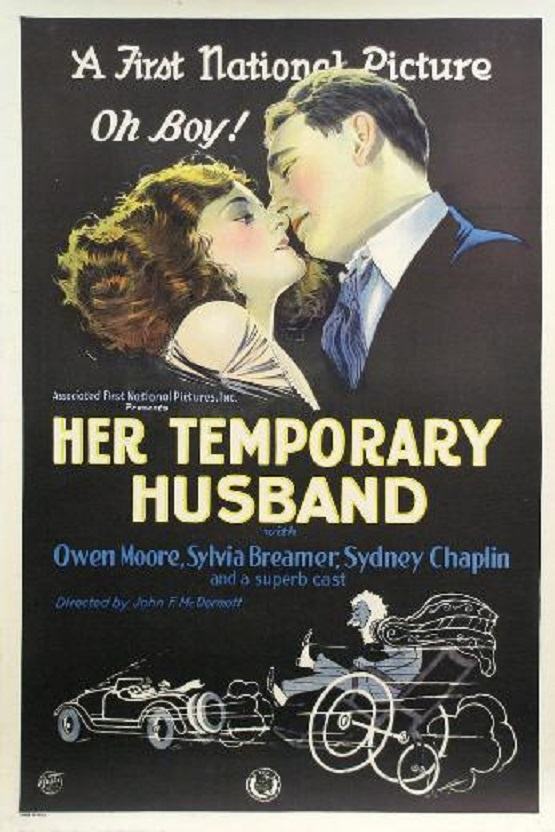
Charles Reisner’s 1920 silent feature Her Temporary Husband arrives like a polished brass key, unlocking a chamber of moral ambiguity that was rarely examined in the roaring twenties. The film, scripted by F. McGrew Willis and Edward A. Paulton, is anchored by a premise that feels both absurd and eerily prescient: a young woman must secure a marriage within twenty‑four hours to inherit a sprawling estate. This narrative contrivance, while ostensibly comedic, serves as a crucible for probing the intersections of gender, wealth, and agency in a period when women’s legal rights were still in flux.
Blanche (portrayed with a blend of cunning and vulnerability by Sylvia Breamer) is introduced amid the opulent interiors of her aunt’s manor, a setting that immediately signals the film’s preoccupation with class. The camera lingers on gilt‑edged mirrors, heavy drapery, and marble staircases, establishing a visual lexicon of privilege that will later be juxtaposed against the stark, institutional aesthetic of the rest home where John resides. The mise‑mise is deliberate: the estate’s grandeur is not merely backdrop but a character in its own right, embodying the seductive allure of wealth that drives Blanche’s desperate calculus.
John (embodied by the venerable Tully Marshall) is introduced in a dimly lit ward, his frailty accentuated by the soft focus and the gentle sway of a hospital curtain. The rest home’s antiseptic palette—pale walls, muted furnishings—contrasts sharply with the estate’s saturated hues, underscoring the thematic dichotomy between life’s vitality and its inevitable decline. John’s character is not a mere plot device; his quiet dignity and lingering humanity render him a poignant foil to Blanche’s mercenary motives.
The film’s pacing is meticulously calibrated. The opening act, spanning roughly fifteen minutes of reel time, establishes the inheritance clause with a brisk intertitle that reads, “Marry within twenty‑four hours, or forfeit the estate.” This inciting incident propels Blanche into a frantic search for a suitable spouse, a quest that is both comedic—filled with slapstick encounters and miscommunications—and deeply unsettling, as it foregrounds the transactional nature of marriage in a patriarchal economy.
Reisner’s direction employs a series of cross‑cutting sequences that heighten tension: Blanche’s hurried negotiations with potential suitors are interspersed with John’s slow, labored breaths in his bed. The editing rhythm mirrors the ticking clock, a visual metronome that drives the narrative forward. This technique anticipates later Hollywood thrillers where time itself becomes a character, a device that Reisner wields with surprising sophistication for the silent era.
When Blanche finally settles on John, the ceremony is staged with a blend of solemnity and farce. The wedding takes place in a modest chapel within the rest home, its stained glass windows casting a kaleidoscope of muted colors onto the couple. The cinematographer, whose name has been lost to history, captures the moment with a static wide shot that emphasizes the absurdity of a young woman marrying an ailing elder for financial gain. Yet, within this tableau, there is an undercurrent of genuine affection that begins to surface, hinted at by subtle glances and the softening of Blanche’s previously steely expression.
The supporting cast enriches the narrative tapestry. John Patrick, as the earnest but bewildered lawyer who explains the will’s stipulation, provides a voice of legal authority while also serving as comic relief. Willie Fung’s brief appearance as a caretaker adds a layer of cultural texture, reflecting the era’s burgeoning, albeit stereotyped, inclusion of Asian characters in Hollywood. Syd Chaplin, the brother of the legendary Charlie Chaplin, delivers a physical comedy routine that lightens the film’s darker thematic moments, reminding audiences that even in a story about mortality, laughter remains a vital counterpoint.
As the days dwindle, the film shifts tone from farcical to contemplative. Blanche’s initial triumph—securing the estate—gives way to an existential reckoning. She begins to witness John’s gradual decline, his once‑sharp mind clouded by the fog of illness. The camera lingers on close‑ups of John’s trembling hands, the faint tremor of his voice, and the way his eyes, though dimmed, still hold a glimmer of curiosity. These moments are shot with a tenderness that transcends the film’s earlier comedic beats, inviting the audience to empathize with a man who, despite his impending death, retains a spark of humanity.
The thematic core of Her Temporary Husband lies in its interrogation of marriage as a social contract. By framing the union as a strategic maneuver rather than a romantic culmination, the film critiques the commodification of matrimony—a subject that resonates with contemporary discussions about the institution’s evolution. Blanche’s internal conflict—her desire for autonomy versus the moral weight of exploiting John’s vulnerability— mirrors the broader societal tensions of the 1920s, a decade marked by women’s suffrage, the rise of the “New Woman,” and shifting attitudes toward sexuality and independence.
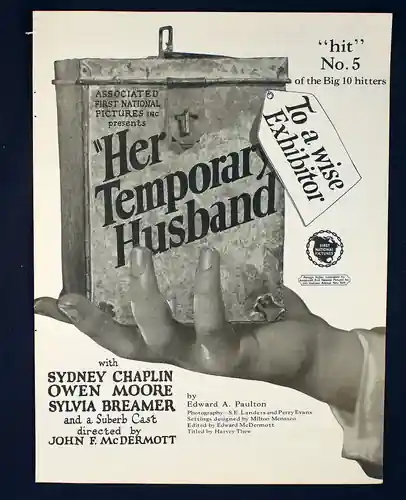
Comparatively, the film shares narrative DNA with other silent-era works that explore unconventional relationships under duress. For instance, Wet and Warmer employs a similar premise of a hurried marriage to secure financial stability, though it leans more heavily into slapstick. Five Thousand an Hour offers a parallel in its depiction of a protagonist navigating a high‑stakes gamble to preserve wealth. Both films, however, lack the melancholic depth that Her Temporary Husband achieves through its nuanced portrayal of aging and mortality.
The visual palette of the film is worth noting. While the original prints were tinted in sepia for the estate scenes and a cooler blue for the rest home, modern restorations have preserved these tonal contrasts, allowing contemporary viewers to experience the deliberate chromatic symbolism. The estate’s warm amber hues echo the promise of prosperity, whereas the rest home’s muted blues evoke a sense of clinical detachment. This dichotomy is further reinforced by the film’s use of intertitles, which employ a decorative serif font for the estate’s legal documents and a stark sans‑serif for the medical notes, visually reinforcing the narrative’s thematic split.
The performances merit particular commendation. Sylvia Breamer’s portrayal of Blanche is a masterclass in silent acting; she conveys ambition, fear, and eventual remorse through a spectrum of facial expressions and gestural subtleties. Tully Marshall, despite limited screen time, imbues John with a gravitas that elevates the character beyond a mere plot catalyst. Their chemistry, though initially transactional, evolves into a quiet, unspoken bond that culminates in a poignant final tableau: Blanche, now alone in the estate’s grand hall, gazes at a portrait of John that has been placed among the family’s ancestral paintings, a silent acknowledgment of the man who, albeit briefly, altered the trajectory of her life.
The film’s denouement is deliberately ambiguous. As the estate’s doors close behind Blanche, the camera pulls back to reveal the sprawling grounds bathed in twilight, the sky tinged with the same dark orange (#C2410C) that frames the title card. The intertitle reads, “We inherit not only wealth, but the weight of our choices.” This closing sentiment invites viewers to contemplate the ethical ramifications of Blanche’s decision, leaving the moral verdict open to interpretation.
From a technical standpoint, the film showcases early Hollywood’s burgeoning mastery of visual storytelling. The use of deep focus in the estate’s ballroom scenes allows multiple layers of action to unfold simultaneously, a technique later popularized by directors such as Orson Welles. The editing rhythm, particularly during the frantic montage of Blanche’s search for a spouse, anticipates the kinetic energy of later screwball comedies. Moreover, the film’s sound design—though silent—relies on a meticulously crafted musical score that oscillates between jaunty ragtime motifs during comedic interludes and somber, minor‑key strings during moments of introspection.
In the broader context of cinema history, Her Temporary Husband occupies a niche that bridges the gap between pure slapstick and the emergent melodramatic sensibilities of the late silent era. Its willingness to tackle themes of mortality, gendered power dynamics, and the commodification of love prefigures the more socially conscious narratives of the 1930s and 1940s. The film’s influence can be traced to later works such as Brændte vinger, which similarly explores the intersection of love and financial desperation, and Look Out Below, where a marriage of convenience becomes a catalyst for personal transformation.
For modern audiences, the film offers a compelling case study in how early Hollywood navigated the tension between entertainment and social commentary. Its narrative structure, character arcs, and visual language remain instructive for scholars examining the evolution of filmic representations of gender and economics. Moreover, the film’s preservation status—thanks to the diligent work of the Library of Congress and private collectors—ensures that its legacy endures, allowing new generations to engage with its layered storytelling.
In sum, Her Temporary Husband is a richly textured work that rewards repeated viewings. Its blend of humor, pathos, and incisive critique of societal norms renders it a timeless artifact of cinematic art. Whether approached as a historical curiosity or as a profound meditation on the costs of ambition, the film stands as a testament to the silent era’s capacity for narrative depth and emotional resonance.
Explore further silent-era gems such as The Mystic Hour and Aladdin to contextualize the thematic and stylistic innovations that defined this transformative period in film history.
IMDb 5.2
1936
Community
Log in to comment.