DbcultAccessing Vault...
Cult Review
Senior Film Conservator
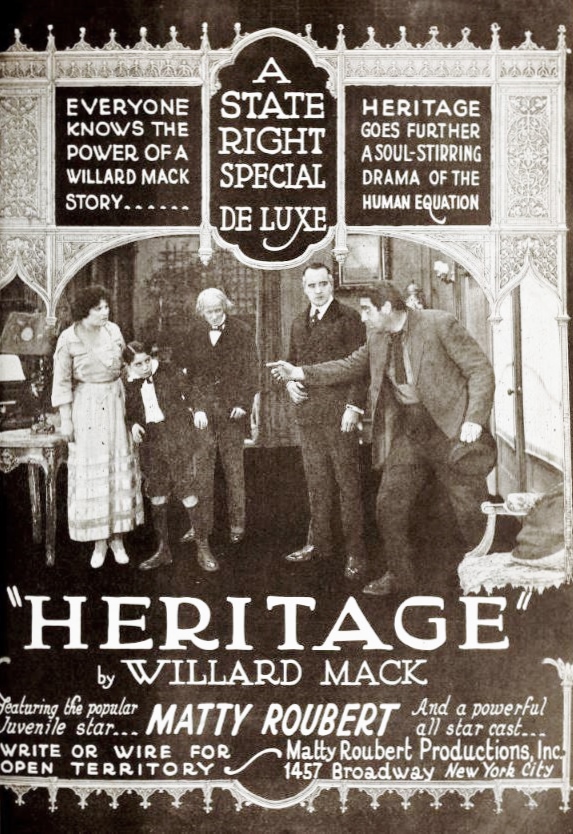
The nickelodeons of 1919 coughed up a spree of vice-and-virtue parables, but few swirled the footlight dust with such reckless elegance as Heritage. Picture a world where gas lamps still hiss at dawn, where Broadway’s marquees bleed into the Bowery, and where a child’s cradle can be bartered for a grudge. Director William L. Roubert—also doubling paternally behind the camera—unleashes a yarn that pirouettes on the knife-edge between Dickensian sob-fest and proto-noir revenge fantasia, all while the celluloid itself threatens to combust from sheer emotional torque.
From the first iris-in, the film refuses comfort. We meet Tony—stable rat, cardsharp, repository of grudges—framed against hay bales that resemble gallows. Joseph Burke plays him with a slouch that suggests vertebrae molded around resentment; every flick of his currycomb feels like a threat. When Charles Suydam—sleek mogul, silk cravat as sharp as contract clauses—dismisses him for pilfering oats, Tony’s reprisal is biblical: he lifts the infant heir as casually as one might swipe a flask, vanishing into a Manhattan night rendered by cinematographer Phil Sanford in chiaroscuro so stark it could slice bread.
The kidnapping sequence, shot mostly in silhouette against a backdrop of tenement windows, prefigures German Expressionism before most Americans had tasted Wiener schnitzel. Shadow Tony enlarges, ogre-like, across brickwork; the baby’s blanket flutters like a surrender flag. Intertitles—sparse, white-on-black—bleat single syllables: “MINE.” Cut to black. The audience in 1919 reportedly gasped loud enough to rattle the theater’s gas fixtures.
Forward a decade. Jit—now embodied by Matty Roubert with the wary gaze of a kid who’s slept in coal scuttles—believes Tony is father, jailer, and providence. Roubert, barely fourteen during filming, channels a lifetime of calluses into each flinch. The movie lingers on his back: scarred, map-like, a parchment where every whip stroke wrote illegible futures. Yet hope arrives in Edward Brackett, an aging tragedian whose monocle catches limelight like a wink from the cosmos. Herbert Standing essays this mentor with tremulous hands that steady only when reciting Shakespeare—an elixir that transforms alley refuse into Rosicrucian verse.
Their first shared frame is a masterclass in spatial poetry. Brackett crouches beside a gutter, rain stippling his topper; Jit, barefoot, shelters under the actor’s moth-eaten cloak. The camera dollies back, revealing a billboard for The Square Deceiver looming above them—advertising a morality play whose very title mocks their precarious bond. Visual irony, silent-era style.
Brackett, half Falstaff, half failed Prospero, schools Jit in theatrical arcana: how to pitch a line so the balcony weeps, how to hoard silence like coin. Their rehearsals unfold in a succession of shabby rooms—each doorway a proscenium, each window a spotlight. When Jit finally auditions for a Suydam-produced extravaganza, the film stages a hall-of-mirrors climax: the boy must perform for the biological sire who discarded him. Adelaide Fitz-Allen, as the company’s grand dame, registers recognition first—her fan freezes mid-flutter, eyes widening like a Klieg lamp hitting mercury. The moment hangs, trembles, detonates.
Matty Roubert’s audition scene is pure cinematic fission. He delivers a monologue about exile—ironically penned by the real-life Willard Mack—that feels wrenched from his marrow. Close-ups alternate between Jit’s trembling jawline and Suydam’s dawning horror, the editing rhythm approximating cardiac arrest. By the time paternal arms fling wide, the camera spirals in a 360° pan—an audacious flourish for 1919—suggesting destiny itself pirouetting on a dime.
While the plot orbits male vendetta, the women supply its torque. Augusta Perry plays Muriel, Suydam’s secretary and unacknowledged moral gyroscope. She glides through scenes in shirtwaists the color of weak tea, eyes cataloging every ledger discrepancy, every paternal neglect. Perry’s performance is a seminar in micro-gesture: a fingertip tapping a ledger column equals entire suffrage manifestos. Muriel’s eventual confrontation with Tony—where she offers her life savings in exchange for Jit’s location—unfurls in a single take, the camera anchored at waist height so the actress looms like deferred justice.
Less developed yet spectral is Jit’s vanished mother, represented only in a cracked tintype. Her absence haunts the negative space of every frame; when Jit finally clutches that photograph to his chest on the glittering stage, the gesture fuses personal and mythic loss. The film whispers: heritage is not merely blood or coin, but the stories we salvage from silence.
Roubert and Sanford conspire to make New York a character: elevated trains spew sparks that mirror emotional short-circuits; East River fog swallows screams whole. Interior sets brim with overstuffed Victorian bric-a-brac, yet the camera carves negative space—doorways yawn like absences, mirrors reflect characters doubled, fractured. One memorable shot positions Jit behind a moth-chewed scrim; as he rehearses, his silhouette duels with the painted backdrop of an idyllic countryside—an apt visual metaphor for a boy wrestling counterfeit futures.
Color tinting—amber for interiors, cerulean for exteriors, rose for the reconciliation—heightens affect without sliding into garish. The restoration by the Library of Congress revives these hues; viewed on 35 mm, the palette sings like stained glass kissed by dawn.
Burke’s Tony could have capsized into moustache-twirling, yet he underplays, letting stillness radiate menace. Notice how he polishes a boot while interrogating Muriel—every circular motion tightening the screw. Standing, as Brackett, toggles between bombast and pathos without warning; when he forgets his lines during rehearsal, his panic feels documentary. Roubert, the linchpin, never begs for sympathy—he earns it through stoic bewilderment, as though discovering emotions in real time.
Special mention to Phil Sanford’s dual role as cinematographer and bit-part stagehand: in a sly meta-gag, he appears onscreen clapping the slate, a wink at artifice that never disrupts immersion.
Critics may fault the third act’s torrent of coincidences—Tony’s sudden confession, the rushed legal restitution—as melodramatic scaffolding. Yet the film anticipates such critique: Brackett quips, “Audiences forgive contrivance if the heart stays true,” a line that feels like screenwriter Mack’s pre-emptive riposte. Moreover, the movie’s obsession with identity-as-performance presages mid-century noir and even post-modern gender studies; Jit’s ability to code-switch between street urchin and princeling echoes Counterfeit’s shape-shifting antihero.
Comparative lens: where An Innocent Adventuress romanticizes mobility, Heritage warns that upward trajectories often hinge on hidden brutality. Both films, released within months, chart the fault line between aspiration and exploitation—yet Heritage refuses easy catharsis. Even the final embrace is undercut by a lingering close-up of Tony in shackles, eyes blazing with unextinguished grievance.
Viewed today, the film vibrates with uncanny frequencies: child abduction, wealth disparity, the commodification of talent. Jit’s journey from exploited labor to commodified performer mirrors contemporary gig-economy narratives. When Suydam finally claims his heir, the transaction feels less reunion than acquisition—an anxiety the camera acknowledges by retreating to a wide shot that dwarfs the reunited family beneath an oversized payroll poster.
And then there is race—unspoken yet coded. Tony’s swarthy complexion and working-class garb position him as ethnic other, while Suydam’s WASP poise signifies institutional power. The film never utters “eugenics,” yet 1919 viewers, fresh from racial-hierarchy discourses, would have absorbed the subtext: heritage equals not only bloodline but pigment, privilege, and property.
Is Heritage flawless? Hardly. The subplot involving a comic-relief stagehand (played with vaudevillian gusto) clanks like a tin drum amid tragedy. Intertitles occasionally lapse into purple doggerel. Yet these imperfections humanize the artifact; they remind us that movies, like people, bruise and scar.
Ultimately, the film endures because it understands heritage as verb, not noun—a continuous negotiation between what we inherit and what we invent. Long after the projector’s clatter fades, Jit’s wary eyes linger, challenging us to audit our own genealogies of complicity and desire. For that reason alone, Heritage deserves not relegation to archive dust, but revival in midnight screenings where its shadows can mingle with ours, twenty-four flickers per second, forever.
If this review sent you spiraling into silent-era rabbit holes, consider exploring The Two Orphans for parallel lost-child pathos, or Money Madness for post-war economic angst. For something lighter yet equally incisive, Nutt Stuff lampoons social climbing with slapstick finesse.
IMDb 6.6
1918
Community
Log in to comment.