DbcultAccessing Vault...
Cult Review
Senior Film Conservator
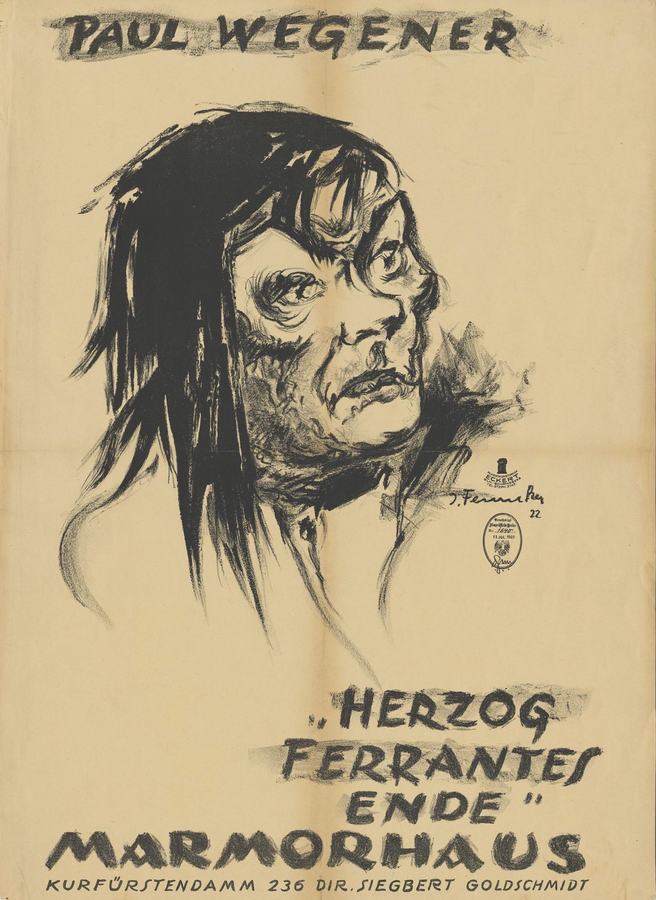
Paul Wegener’s third dalliance with the arcane, Herzog Ferrantes Ende, arrives like a sulphurous letter sealed in wax—postmarked 1922 yet smelling of wet parchment and scorched iron. Where The Oldest Law flirted with civic morality and Sylvi indulged pastoral melancholy, this film detonates the very notion of linear narrative, opting instead for a fevered mosaic of rusted keys, alchemical retorts, and faces that flake away like damp frescoes.
Forget acts; think convulsions. The Herzog—played by Wegener himself in Kabuki-white cracked with soot—doesn’t do things; he accumulates guilt the way antique clocks hoard dust. Ferdinand Gregori’s dual turn as the Herzog’s “ideal” youthful self is no mere flashback but a parasitic incarnation, a doppelgänger who steps out of a mercury bath wearing the same signet ring yet radiating carnal appetites the elder has long petrified. Their pas de deux around a collapsing parapet feels less like a confrontation than a botched surgical graft, each body rejecting the other in real time.
Meanwhile, Lyda Salmonova (the director’s perennial muse) utters not a syllable, yet her eyes—framed by a coif that seems carved from obsidian—recite whole epics of skepticism. The camera, drunk on shadows, keeps iris-ing in until her pupils become twin planetariums where comets commit suicide. In those brief ocular eclipses, the film whispers its thesis: memory is a predatory loan, and the past always collects.
Critic Lotte H. Eisner once claimed Caligari’s sets writhed; Ferrante’s don’t merely writhe—they menstruate. Hallways pimpled with gargoyle-heads secrete black treacle; banisters twist into vertebral curls that snap at gloved fingers. Production designer Albrecht Viktor Blum allegedly forced assistants to mix plaster with powdered mummy-brown pigment and actual iron filings so that rust blooms would break through the paint like post-filmic stigmata. The result is a space that appears allergic to occupancy: every footstep triggers off-kilter echoes, as if the castle itself is clearing its throat before devouring whoever lingers.
Lighting, credited to the otherwise undocumented Hellmuth Bergmann, deserves a monograph. Lanterns swing without human agency; their beams carve sluice gates in dry ice, birthing chiaroscuro so dense you could lay it on a knife and spread it. In one signature tableau, Gerhard Bienert’s necromancer-priest stands between two mirrors positioned at acute angles, spawning a dizzying mise-en-abyme that multiplies him into a Gregorian chant of selves. The exposure flares until the edges of each reflection erode, leaving only eyes—blazing yellow wounds that seem to watch us, the modern viewer, with unquiet appetite.
Though released a year before the synchronized soundtrack boom, Ferrantes Ende anticipates acoustic haunting. Intertitles appear sparingly and venomously, often half-obscured by superimposed moth wings. When characters do speak, Wegener denies us lip-reading clarity: faces turn away, or a sudden zoom smears the mouth into illegible blur. The absence of verbal cushion forces the viewer to listen to silence—the creak of your own seat, the thrum of blood—until the theater itself becomes the Herzog’s acoustic dungeon. Compare this strategy to the verbose moralism of False Ambition, where intertitles sermonize every glance; Wegener trusts the image to infect, not explain.
Wegener’s Herzog never walks; he drags the burden of centuries like damp velvet, each footfall a referendum on dynastic rot. Watch the sequence where he attempts to recite childhood prayers: his tongue curls as though allergic to its own language, finally ejecting a mouthful of blackened petals. It’s a gesture so grotesquely intimate you half expect the celluloid to bruise.
Adele Sandrock, essaying the role of the Herzog’s wet-nurse-turned-abbess, provides the film’s most serrated comic relief. She enters astride a sedan chair carried by emaciated altar boys, face pancaked into kabuki nullity. In her wake wafts a scent of benzoin and desiccated roses so pungent one suspects Wegener of scratch-and-sniff experimentation decades before Polyester. Her aria of derision—delivered via placards reading “Your soul belches sulfur, my lord”—lands like a slap that draws no blood yet leaves a welt on the narrative’s conscience.
Where contemporaneous Gothic yarns—The Waif, for instance—paint womanhood as sacrificial currency, Ferrante complicates the ledger. Lyda’s mute frescoist wields the brush that literally paints men out of existence. Each daub of lapis or cinnabar siphons a year from the Herzog’s lifespan and grafts it onto her own; by midpoint she has acquired the tremulous hands of a centenarian while her irises gleam with newborn’s wonder. The film thus stages occult feminism: not the moral rectitude of Heidi’s mountain purity, but a transactional sorcery that weaponizes the very commodification of female labor.
Yet Wegener refuses triumph. In the penultimate reel, Lyda discovers her own reflection aging at double speed: the castle’s economy of time is a Ponzi scheme destined to bankrupt all participants. When she finally plunges her brush into the Herzog’s chest—an injection of pigment rather than steel—the act feels less like coup than mutual euthanasia. Their shared death rattle is superimposed over a fresco of Orpheus, whose eyes have been chiseled out: art, love, memory—all sink into the same cracked plaster.
Scholars routinely bracket Ferrante with The Cabinet of Dr. Caligari due to shared expressionist topographies. Fair—both feature deranged authority, stylized décor, and a protagonist who might be projecting the entire narrative from a padded cell. Yet Caligari’s twist restores bourgeois order; Ferrante’s final freeze-frame offers only a Möbius strip of culpability. Compare likewise to Down the Mississippi, where riverine expanse promises regenerative flight; Wegener’s Carpathian keep is a hermetic bell jar, its atmosphere too thin for absolution.
Curiously, Ferrante anticipates the psychosexual labyrinths of Blind Hearts yet dispenses with moralistic comeuppance. Its DNA even resurfaces—mutated—in later supernatural chamber pieces like The Hidden Woman. But none rival its alchemical synthesis of mysticism and materialism.
For decades Ferrante languished in the lost film catalogs, victim of a 1923 warehouse blaze that the press blamed on “spontaneous nitrate combustion”—ironic given the movie’s obsession with self-immolation. Enter the Munich Filmmuseum’s 2018 excavation: a 35mm tinted print, German censor cards intact, buried under reels of an innocuous Heimat short. Digital 4K scanning revealed hand-patched perforations shaped like tiny alchemy circles, suggesting each projectionist became an unwitting adept. The restoration team opted to retain flicker and water stains, arguing—rightly—that damage is dialectic: history’s own palimpsest overlaying Wegener’s fever dream.
Let’s not mince adjectives: Herzog Ferrantes Ende is a bruise on the retina of Weimar cinema, a film that dares to propose memory as a pyramid scheme and identity as communal hemlock. It’s also ravishingly gorgeous, perversely funny, and—at a brisk 73 minutes—more concentrated than absinthe. Watch it for Sandrock’s gilded sneer, for Salmonova’s ocular soliloquies, for the moment a corridor sneezes dust that morphs into moth swarms. Watch it because most contemporary Gothic content mistakes opacity for depth; Wegener achieves both, then dissolves the boundary.
Just don’t watch it alone—unless you crave the sensation that your living room walls have started tallying your sins in chalk. And if, days later, you detect a whiff of benzoin and roses in your hair, don’t say the Herzog didn’t warn you.
IMDb 6.4
1934
Community
Log in to comment.