DbcultAccessing Vault...
Cult Review
Senior Film Conservator
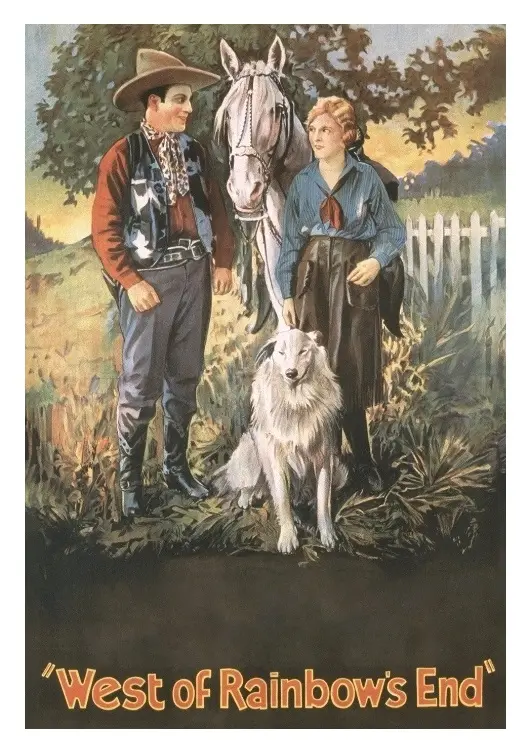
Is this film worth watching today? Short answer: Yes, but primarily as a historical artifact of early Western tropes. This film is for the silent cinema completionist and fans of 'Poverty Row' efficiency; it is not for those who require the psychological nuance of modern storytelling.
West of the Rainbow's End operates on a frequency of pure, unadulterated frontier justice. It doesn't waste time with subplots or existential dread. It is about a man, a horse, a dog, and a very bad neighbor.
If you enjoy seeing the foundations of the American Western being poured, then yes. It is a lean, mean 1926 production that highlights the physical charisma of Tom London before he became a ubiquitous character actor. However, if you find silent-era overacting or predictable plot beats tedious, you will likely find this a chore.
1) This film works because it utilizes animal actors like Rex the Dog and Starlight the Horse to provide genuine emotional stakes that the human script occasionally lacks.
2) This film fails because the villain, Palmer, is a one-dimensional obstacle rather than a compelling character.
3) You should watch it if you want to see a proto-typical example of the 'returning veteran' archetype in American cinema.
The 'returning soldier' narrative is a staple of post-WWI cinema, often seen in more dramatic fare like The Light That Failed. Here, the trope is transplanted into the dusty canyons of the West. When Brandon returns from France, the film skips the pleasantries. There is no parade. There is only the realization that while he was fighting for his country, he was losing his home.
The pacing in the first act is surprisingly brisk. We see the contrast between Brandon's military discipline and the lawless opportunism of Palmer. Palmer isn't just a thief; he represents a parasitic element of the home front. He thrived while better men bled. This creates an immediate, visceral sympathy for Brandon that carries the film through its slower middle section.
One specific scene stands out: Brandon standing at the edge of his former property, looking at a fence he didn't build. It’s a simple shot, but it communicates the entire theme of the film. The land hasn't changed, but the ownership has. It’s a quiet moment of realization before the inevitable violence begins.
In the 1920s, animal stars were often billed alongside their human counterparts, and West of the Rainbow's End is no exception. Rex the Dog and Starlight the Horse aren't just props. They are narrative engines. In many ways, the dog displays more outward emotion than Tom London’s stoic Brandon.
There is a sequence where Rex alerts Brandon to an ambush that feels more choreographed and tense than the actual fistfights. The dog’s performance is a testament to the training standards of the era. It’s a bit absurd, yes. But it works. It adds a layer of charm to a story that would otherwise be quite grim.
Compare this to the technical wizardry of Sherlock Jr., which was released just a couple of years prior. While Buster Keaton was pushing the boundaries of what a camera could do, the creators of West of the Rainbow's End were perfecting the 'B-movie' formula. They weren't trying to reinvent the wheel; they were just trying to keep it turning.
Tom London is the anchor here. Most modern viewers know him as the man with over 600 credits, usually playing a secondary henchman or a grizzled sheriff. Seeing him as a young, athletic lead is a revelation. He has a physical presence that feels authentic. He doesn't look like a movie star; he looks like a man who has spent time in a trench.
Pauline Curley, as the love interest, is unfortunately given very little to do. She is the 'prize' to be won at the end of the conflict. While this was standard for the time, it feels particularly thin here. Her character lacks the agency we see in other films of the period, such as The Woman Pays. She exists to be rescued, and while she does it well, it's a missed opportunity for a more dynamic partnership.
The villain, Palmer, played by Jim Welch, is purely functional. He sneers. He cheats. He dies. There is no attempt to explain why he killed Brandon’s father beyond simple avarice. It’s a binary moral world. Good vs. Evil. Black hat vs. White hat. It’s simple. It’s effective. But it’s flawed.
The cinematography is functional. There are some lovely wide shots of the California landscape that evoke a sense of isolation. However, the film suffers from the typical 'Poverty Row' issues: flat lighting in interior scenes and a lack of creative camera movement. It feels static compared to the more experimental works coming out of Europe at the time, like Blind Chance (though that is a much later comparison of narrative structure, the contrast in visual ambition is notable).
The editing is where the film shows its age. Some transitions are jarring, and the intertitles occasionally over-explain things that the actors have already made clear. Despite this, the final confrontation is edited with a decent sense of rhythm. The tension builds effectively as Brandon closes in on Palmer’s hideout.
The film’s tone is remarkably consistent. It never veers into slapstick, which was a danger for Westerns of this era. It maintains a somber, determined atmosphere that honors the protagonist’s veteran status.
If you are looking for a deep dive into the evolution of the Western hero, then absolutely. West of the Rainbow's End provides a missing link between the early, simplistic shorts and the more complex features of the 1930s. It’s a lean narrative that doesn't overstay its welcome.
However, if you are looking for a film with high production values or a groundbreaking script, look elsewhere. This is a blue-collar movie. It was made to entertain rural audiences for a Saturday matinee. It succeeded then, and it remains a sturdy, if uninspired, piece of filmmaking today.
Pros:
- Strong, physical lead performance by Tom London.
- Excellent use of animal actors.
- Efficient, no-nonsense storytelling.
- Historically interesting 'returning veteran' theme.
Cons:
- Low production values lead to flat visuals.
- The female lead is entirely sidelined.
- The antagonist is a cardboard cutout.
- Predictable ending.
West of the Rainbow's End is a meat-and-potatoes Western. It doesn't offer the technical brilliance of Sherlock Jr. or the historical weight of The Kelly Gang, but it serves its purpose. It is a story about a man taking back what belongs to him. It is simple. It is direct. It works. But it’s flawed. If you can appreciate it for what it is—a low-budget 1920s revenge flick—you’ll find it a rewarding 60 minutes. Just don't expect it to change your life.
IMDb —
1916
Community
Log in to comment.