DbcultAccessing Vault...
6.6/10
Senior Film Conservator
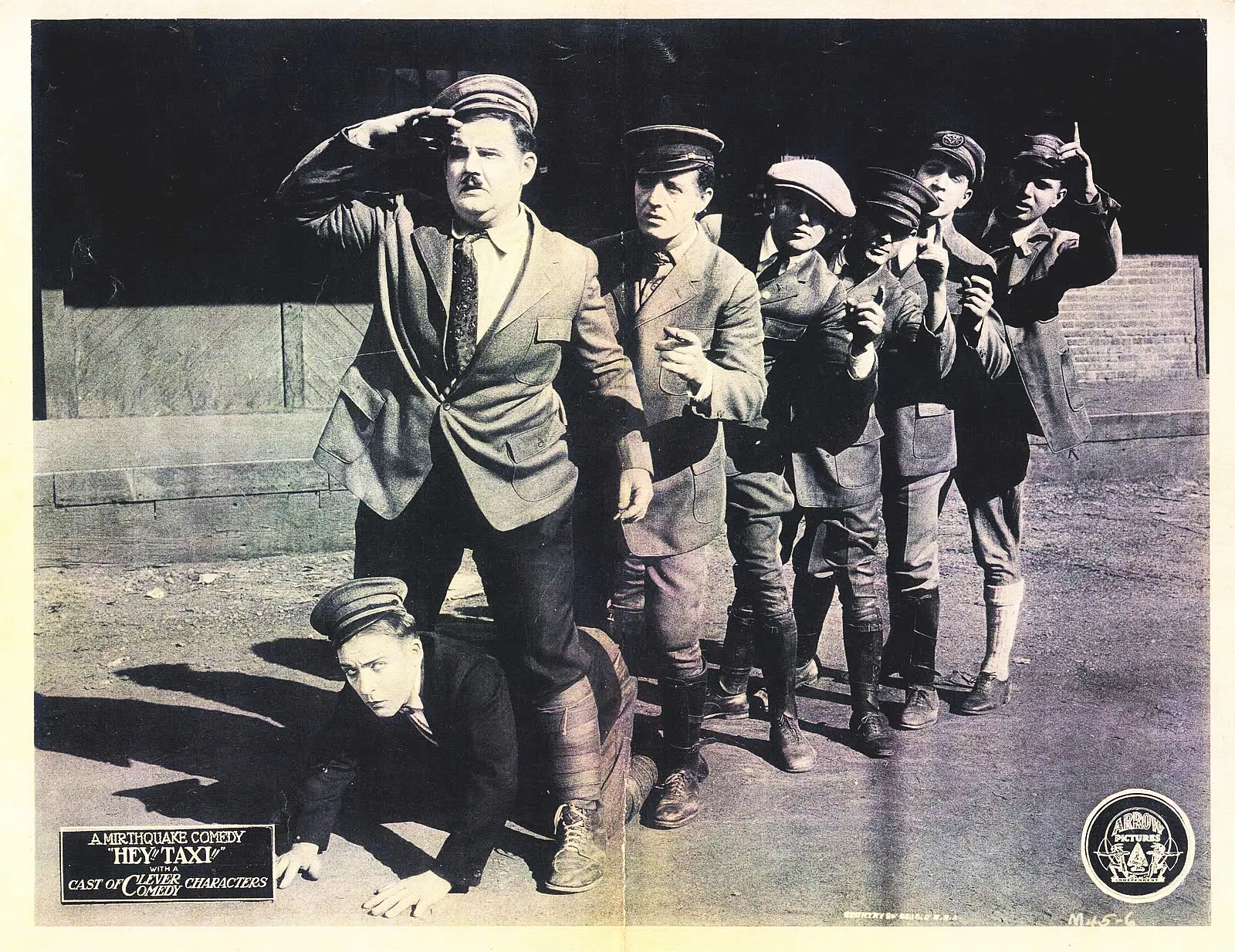
A definitive 6.6/10 rating for a film that redefined the boundaries of cult cinema. Hey, Taxi! remains a cornerstone of transgressive art.
Is Hey, Taxi! a hidden gem of the silent era or just a dusty relic? Short answer: It is a fascinating, high-energy artifact that proves Oliver Hardy was a comedic powerhouse long before he met Stan Laurel. This film is for silent comedy enthusiasts and those who appreciate the 'physics of funny'; it is not for audiences who require a complex narrative or high-definition polish.
This film works because Oliver Hardy’s physical timing is impeccable, turning even a simple door-slam into a moment of character-driven humor.
This film fails because the plot is essentially a series of disconnected vignettes that lack a cohesive emotional payoff.
You should watch it if you want to see the DNA of the 'Hardy' persona—the pomposity, the frustration, and the delicate hand gestures—in its rawest form.
Watching Hey, Taxi! in the modern era requires a shift in perspective. We are so accustomed to seeing Hardy paired with the thin, waif-like Stan Laurel that seeing him solo feels almost transgressive. In this 1925 short, Hardy is the undisputed center of gravity. He doesn't have a partner to play off of, so he plays off the world itself. His taxi is his antagonist. His passengers are his hurdles. It works. But it’s flawed.
Hardy’s performance here is more aggressive than his later work. He is a man of action, or at least a man trying to be. When he interacts with Marjorie Beebe, there is a frantic energy that mirrors the pacing of other shorts like Some Cave Man. He hasn't yet mastered the 'slow burn' that would define his later career, but the seeds are there. You can see it in the way he adjusts his tie after a collision—a small moment of dignity in a world of chaos.
Hey, Taxi! is worth watching for any viewer interested in the evolution of visual comedy. It serves as a bridge between the pure chaos of the early Mack Sennett era and the more refined character comedies of the late 1920s. While it may not provide the belly laughs of a Laurel and Hardy feature, it offers a distinct, high-octane charm that is missing from modern cinema.
The cinematography in Hey, Taxi! is surprisingly dynamic for a short of its budget. The use of moving vehicle shots—likely achieved by strapping a camera to a lead car—gives the chase sequences a visceral quality. This isn't the static, stagey filming found in The Frame-Up. Instead, the director (Bobby Ray, who also stars) pushes the camera into the middle of the traffic.
There is a specific scene involving a flat tire that stands out. Hardy’s attempts to change the wheel while maintaining his composure are a masterclass in prop comedy. The tire seems to have a mind of its own, rolling away at the most inconvenient moments. It’s a simple gag, but Hardy’s reaction—the look of utter betrayal he gives the inanimate object—is where the real comedy lies. He doesn't just act; he reacts. And in silent film, reaction is everything.
Marjorie Beebe provides a necessary spark of feminine chaos. In an era where female roles in comedy were often relegated to the 'damsel' or the 'shrew,' Beebe holds her own as a comedic engine. Her timing matches Hardy’s, particularly during the sequence where they are trying to navigate a crowded sidewalk. It lacks the sophisticated wit of Lady Windermere's Fan, but it makes up for it with sheer, unadulterated energy.
Bobby Ray, as the writer/director/co-star, creates a playground for Hardy. The film feels like a precursor to the 'road movie.' The taxi isn't just a setting; it's a character. It breaks down, it speeds up, and it serves as a confined space where social boundaries are tested. When Ray’s character enters the cab, the power dynamic shifts, and Hardy is forced to play the role of the subservient—yet secretly furious—service worker.
One of the most surprising observations about Hey, Taxi! is how it handles the concept of the 'fare.' In 1925, the taxi was still a relatively new phenomenon for the masses. The film taps into a universal anxiety about the cost of travel. Every time the meter clicks, Hardy’s face twitches. It’s a relatable bit of observational humor that transcends the silent era. It reminds me of the social friction found in Torchy's Frame-Up, where the comedy is derived from the protagonist's struggle against an unforgiving system.
"Hardy doesn't just drive a taxi; he wages war against it. It's a battle of wills between man and motor, and the motor usually wins."
The pacing of the film is relentless. From the opening shot to the final crash, there is rarely a moment of stillness. While this keeps the energy high, it can also be exhausting. Modern audiences might find the lack of 'breathing room' a bit overwhelming. However, for those who enjoy the pure kineticism of silent film, it’s a thrill ride. The film doesn't ask for your intellectual engagement; it demands your attention through movement.
Hey, Taxi! is a loud film in a silent medium. It screams with ambition and physical effort. While it lacks the heart of the later Laurel and Hardy collaborations, it is an essential piece of the puzzle. It shows us a version of Oliver Hardy that is more rugged, more desperate, and equally hilarious. It isn't a masterpiece, but it is a vital, vibrating piece of cinema history. If you can handle the repetitive nature of the stunts, you will find a performance that is nothing short of foundational. It’s a rough ride, but it’s one worth taking. Just watch the meter.
IMDb —
1914
Community
Log in to comment.