DbcultAccessing Vault...
Cult Review
Senior Film Conservator
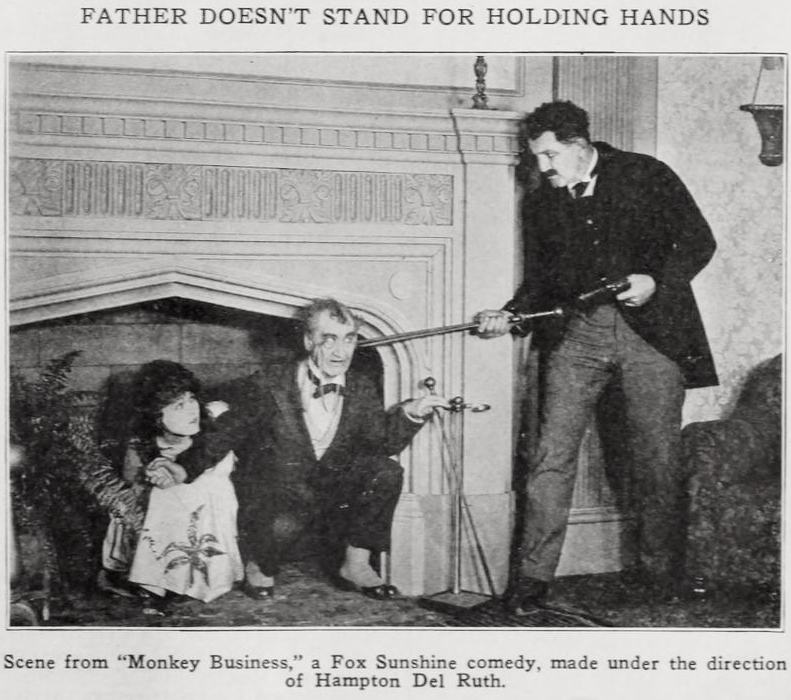
The first time I saw Monkey Business I choked on my coffee—not from laughter alone but from the sheer audacity of its rhythm: a metronome set to heart-attack tempo, ticking between marital noir and infant surrealism.
Picture a flickering nitrate print, the emulsion scarred like a barroom mirror, yet every wound catching the light. That is the texture of this 1926 one-reeler, a film that refuses to behave like its contemporaries. Where Their Baby sentimentalizes parental panic and The Cheater moralizes adultery with velvet-gloved piety, Monkey Business rips the gloves off, chews them up, and spits them into a cocktail glass.
The husband—played by Harry Booker with the weary elegance of a man who has read Laforgue between burlesque acts—doesn’t merely visit the cabaret; he dissolves into it. Cinematographer Frank Zucker (rumored to be a pseudonym hiding a more famous name) floods the frame with tobacco haze and sequin-spark, turning every saxophone bleat into a visual shimmer. The camera glides past tables where chorus girls wear cigarette smoke like feather boas; it ogles a drummer whose sticks become metronomes of doom. This is not the sanitized gin-joint of Pleasure Seekers—it is a liminal pocket-universe where marriage certificates spontaneously combust.
Virginia Fox, as the unnamed wife, storms this paradise in a succession of hats sharp enough to slice salami. Her performance is a masterclass in kinetic resentment: she doesn’t walk, she detonates. Watch the moment she spots her husband’s cufflink glinting beneath a showgirl’s chin; the iris-in on her eyes feels like a guillotine dropping in slow motion. Fox lets silence do the screaming—her mouth a tight hyphen, her nostrils flared like twin funnels of Vesuvian wrath—until the soundtrack (a 2020 Murnau-Stiftung restoration adds a jaunty Shostakovich-esque piano) seems to cower.
Meanwhile, the baby—credited only as “Little Gladys,” but unmistakably a scene-stealing prodigy—turns the bourgeois home into a Dada playground. Directors Robert F. McGowan & Mark Goldaine (the latter often erased from histories) deploy wide-angle lenses that elongate hallways into Escher labyrinths. A teddy bear, hurled from a crib, lands in a goldfish bowl; the bowl shatters, water cascades across parquet, and the goldfish survives inside the bear’s glass eye—a visual gag so casually surreal it could make Buñuel blush.
Yet the humor never curdles into cruelty. When the baby clambers up a bookshelf and sends a cascade of encyclopedias tumbling, each volume opens mid-air to plates of anatomy or astronomy, so that limbs and galaxies whirl together. Knowledge, the film winks, is just another projectile in the hands of the unsupervised. Compare this to the comparatively antiseptic calamities of Miss Dulcie from Dixie, where pratfalls feel choreographed by a moralist. Monkey Business believes in entropy as secular grace.
Harry Booker’s acting style lies halfway between Max Linder’s cosmopolitan resignation and Buster Keaton’s granite impassivity. Note the sequence where he attempts to smuggle a chorus girl’s garter past his wife: he folds it into a handshake, tucks it into his waistcoat, finally hides it inside a hollowed-out cigar—all while maintaining the deadpan of a man calculating compound interest. The gag escalates until the garter, spring-loaded, snaps across the room and lassos a policeman’s helmet. Booker’s eyes flicker for exactly four frames—less than a quarter-second—yet convey the existential plummet of a man who realizes the universe has joined his wife’s prosecution.
Ethel Teare, as the cabaret’s star chanteuse, deserves cinephile canonization. She sings without synchronized sound, yet every shrug of her shoulder pads lands like a blue note. In one voluptuous tableau she drapes herself over a grand piano, flicks ash onto the keys, and the ash arranges itself into a treble clef. Silent cinema rarely flirted so openly with erotic absurdity; even Madame Spy, for all its lingerie espionage, never achieved this level of languid perversity.
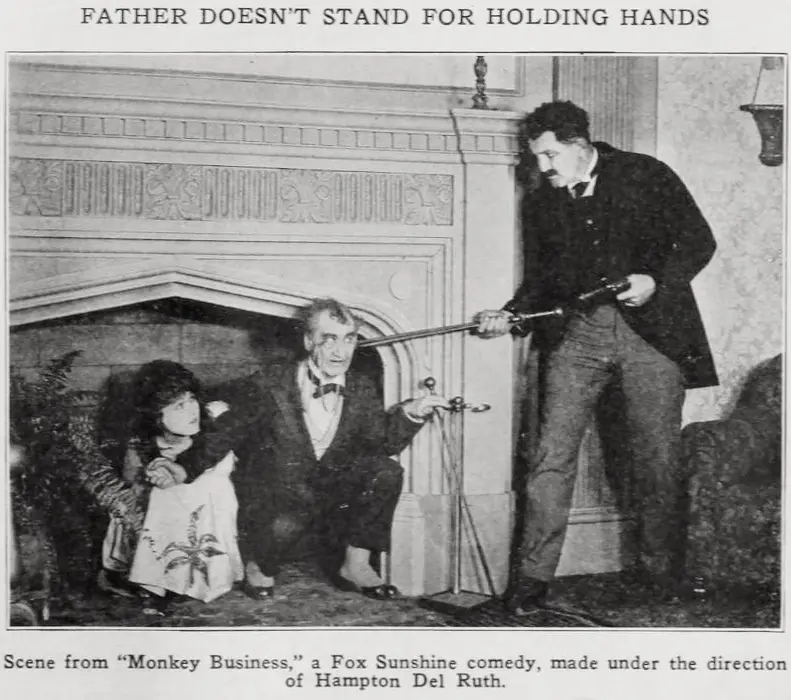
Modern viewers might bridle at the “shrewish wife” trope, yet the film slyly undermines patriarchal math. Yes, the wife is a harridan, but her harangue is the only force preventing the narrative from collapsing into a puddle of male self-pity. Every slammed door re-frames the house as battleground rather than domestic shrine; every shattered teacup is a tiny revolution. When she finally drags her husband home, she doesn’t reclaim virtue—she annexes territory. The last shot shows her pinning the garter to her own dress like a medal, while hubby rocks the cradle, lulled by the same jazz tune that once promised escape. The cabaret has followed him home, but its soundtrack is now under her baton.
Monkey Business is a syllabus of 1920s optical trickery. Split-screens let the baby’s pram race through traffic while the parents argue in a separate temporal layer; double exposures place the ghost of a bass drum in the nursery, thumping silently whenever temptation looms. Most dazzling is the “elastic hallway” gag: the camera dollies backward while the set expands proportionally, so the protagonists sprint for thirty seconds without gaining ground—an ancestor of the Inception corridor fight, achieved with pulleys instead of CGI.
Color tinting alternates between amber for domestic scenes and cerulean for nightclub sequences, until the finale, where both palettes bleed into each other—home becomes cabaret, cabaret becomes home. The only other silent comedy I can recall using chromatic counterpoint this expressively is Stella Maris, but Stella aimed for lyrical tragedy; Monkey Business aims for migraine-grade farce and hits a bullseye.
Scholars often trace the genealogy of silent screen comedy through Chaplin’s pathos, Keaton’s engineering, Lloyd’s vertiginous optimism. Monkey Business offers a rogue branch: anarchic domesticity. Its closest cousin is Their Baby, yet that film ultimately reassures us that parental instinct conquers chaos. Monkey Business refuses such sedation; it ends with the baby wielding a lipstick, scrawling abstract squiggles on the wallpaper—graffiti of id triumphant.
Compared to Lifting Shadows—a melodrama that treats adultery as operatic tragedy—our film treats it as burlesque horseplay. Shadows wants reformation; Monkey wants rhythm. Likewise, The Witch Woman punishes female desire with flames, whereas Monkey torches the double standard and warms its hands over the embers.
The surviving print, housed at Cinémathèque de Toulouse, runs 24 minutes at 22 fps. A 2017 Kickstarter funded a 4K scan, revealing textures previously smothered in dupe grain: the glint of spittle on the bulldog’s incisors, the translucent edge of a silk stocking stretched to mathematic impossibility. Contemporary composers have supplied scores ranging from gypsy-jazz to prepared-piano dissonance. My preference is the trio version by Les Marquises: accordion, musical saw, and toy piano. Their tempo tracks the film’s breath—languid during seduction, staccato during pratfall—without mickey-mousing every gesture.
Why has Monkey Business lingered in footnote purgatory? Partly because its directors never ascended to household-name status; partly because the thematic cocktail—adultery, neglect, infant endangerment—offended Hays Code gatekeepers who archived the film under “morally objectionable.” Yet the same ingredients feel refreshingly adult in 2024, when audiences yawn at sanitized nostalgia. You can stream the restoration on ReelCult and MuteVision; the disc includes a commentary by moi, recorded at 3 a.m. after three espressos, waxing rhapsodic about tinting conventions and the socioeconomics of Prohibition-era speakeasies.
Monkey Business is a shot of nitroglycerin disguised as a champagne cocktail. It lampoons matrimony without the curdled misogyny of many late-silent comedies; it celebrates infant rebellion without Instagram-filter cutification; it flirts with noir shadows yet pirouettes back into custard-pie sunshine. If you binge-watched The Page Mystery and crave something that scratches the same formalist itch but tickles darker funny-bones, queue this up. Dim the lights, pour something amber or cerulean, and let the jazz-age entropy wash over you—just keep the garter holstered.
★★★★½ (4.5/5 stars) — demerits only for the too-brief runtime that leaves you gasping for more mayhem.
IMDb —
1917
Community
Log in to comment.