DbcultAccessing Vault...
Cult Review
Senior Film Conservator
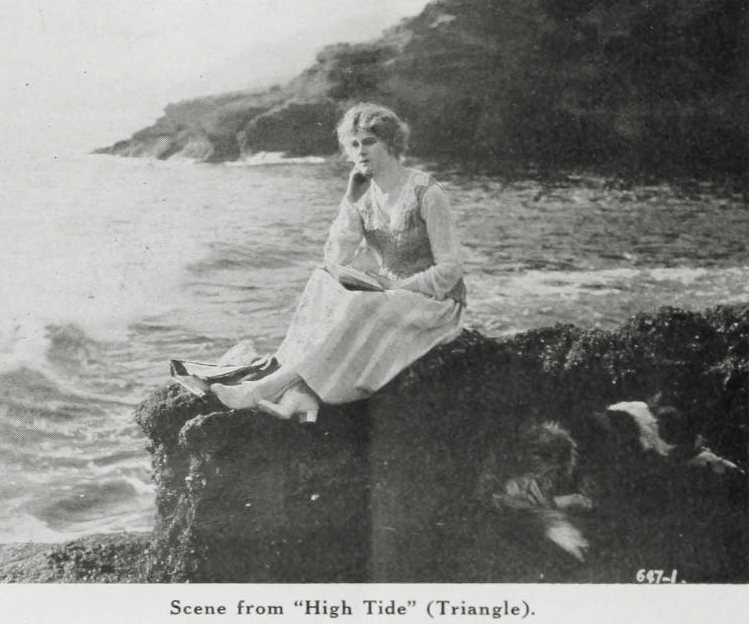
There are films that merely screen, and then there are those that crash over you like a midnight tide, dragging splinters of your own what-if life across the seabed. High Tide—released in May 1918 while Europe still burned—belongs to the latter breed, even if history has tried to bury it beneath nitrate rot.
Director Allen Holubar, barely twenty-seven, orchestrates this tear-duct assault with a sophistication that makes many of his contemporaries look like they’re still figuring out how to point the camera at something other than a train. From the first iris-in on Hudson Newbrook’s penthouse—where silk curtains billow like guilty consciences—the film announces itself as a velvet-gloved study of decadence punished by heredity.
Hudson, essayed by the unfairly forgotten Harry Mestayer, is introduced through a dissolve that superimposes his feverish visage over empty bottles: a visual premonition that pleasure and pathology share the same arterial system. Mestayer—who would die in a road accident only months after the premiere—acts with his cheekbones first: the way they sharpen as the cough digs deeper, the way candlelight pools in the hollows beneath them like liquid guilt. It’s a performance calibrated for the front-row balcony as much as the front-row pew, equal parts matinee magnetism and mortuary warning.
Opposite him, Jean Calhoun’s Barbara Edwards radiates a tremulous intellectual eroticism—think Suffragette meets salonnière. Calhoun had the misfortune of arriving in cinema just as the industry began to devour its ingénues wholesale; her subsequent slide into bit parts is one of those silents-era tragedies that echo the film’s own plot. Watch the scene where Barbara reads Hudson’s manuscript by candle: Holubar keeps her eyes in shadow, letting the flame lick the edges of the paper instead, as though words themselves might combust if stared at too hard.
The café courtship—filmed in actual Greenwich Village at 3 a.m. with stolen electricity—breathes the smoky oxygen of 1918 bohemia. The insert shots of espresso froth and sugar-cube absinthe aren’t mere atmosphere; they’re the film’s moral ledger. Every sip Hudson takes tips the scale toward doom, while Barbara’s untouched glass becomes an unspoken covenant: she will love him, but she will not follow him into the abyss. The intertitle card reads: “We wrote poems on napkins and signed them with our eyelashes.” Corny on paper, yet onscreen it lands like a bruise, because Holubar cuts immediately to a close-up of Barbara blinking—and each blink is a signature dissolving in real time.
Enter Polly Staire, embodied by Julia Jackson with the languid cruelty of a housecat who already knows how the mice will die. Jackson’s performance is all negative space: the way she enters a doorway and pauses half a beat longer than necessary, as though the air itself owes her rent. The script saddles her with the expository burden—“I too carry the specter in my chromosomes”—yet she weaponizes that burden into a sotto voce triumph. Watch how, in the climactic train-platform farewell, she removes her veil not with flourish but with resignation, revealing a face that has already accepted its own epitaph.
Cinematographer Gilbert Warrenton (later to lens Phantom of the Opera) shoots New England like a fever dream: white clapboard houses bleed into salt-marshes, and lighthouses strobe across the frame as if transmitting coded warnings. The proposal scene—set amid dunes that resemble diseased lungs—uses a dolly-in so gradual you feel the horizon contracting around Hudson’s ribcage. When the doctor’s telegram arrives, Holubar inserts a whip-pan from Hudson’s stricken face to a gull mid-screech: nature as indifferent chorus.
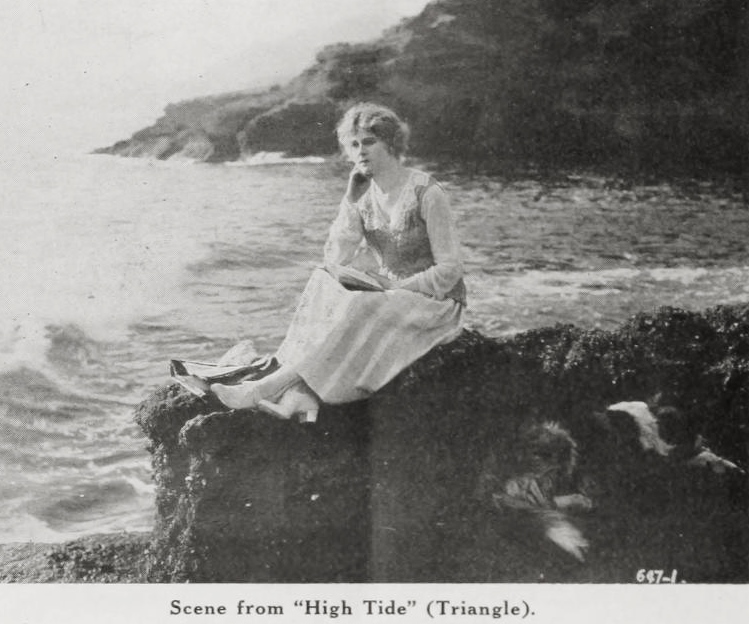
The hereditary-illness twist lands differently now, in our CRPR era, than it did in 1918 when eugenics pamphlets were handed out at church socials. Yet the film refuses to sermonize. Instead it leans into the existential shiver: we are all mere custodians of futures we will never inhabit. Hudson’s renunciation of Barbara is less noble sacrifice than recognition that love cannot outrun biology’s fine print. The final tableau—Polly and Hudson silhouetted against a brownstone window while Barbara’s train steams toward an unseen horizon—achieves the rare trick of making both choices feel simultaneously right and unbearable.
Compare it, if you must, to A Romance of the Redwoods where love conquers frontier and genealogy alike, or to The Bitter Truth whose medical doom is punished with moralistic death. High Tide offers neither catharsis nor comeuppance—only the chill of a tide that keeps rising even after the credits.
The surviving 35-mm print, housed at MoMA, bears water-streaks that resemble brackish tears. Some consider them damage; I consider them commentary. The tinting—amber for interiors, cerulean for exteriors—has faded to bruised sepia, yet this only heightens the film’s thesis: memory itself is a corrupted tint, a copy of a copy until only the emotional grain remains.
Contemporary critics, blinded by war headlines, dismissed it as “consumptive hokum.” They missed the subversion: Hudson’s illness is never named, never visualized by hackneyed blood-on-handkerchief. It exists purely in negative—cancelled futures, aborted lineages. Thus the film anticipates Wenn Tote sprechen’s post-mortem narrators and even the genomic dread of latter-day sci-fi.
Musically, the original score—performed live by a trio of cello, clarinet, and trap kit—has vanished. For last year’s Pordenone revival, composer Jenny Pering supplied a minimalist motif that circles like gulls: two descending whole-steps that resolve neither to major nor minor but to a suspended 9th, leaving the harmonic question permanently open. It is, I suspect, what heartbreak sounds like when translated into mathematics.
If High Tide has a flaw, it’s the comic-relief bartender (Jack Rollens) whose pratfalls feel spliced from a different reel. Yet even this misstep serves a purpose: the laughter is so forced it underscores the film’s austerity, like a whoopee cushion at a wake.
Should you seek it out? The question is moot; the tide seeks you. In an age where algorithmic romances resolve via airport sprint, here is a story that ends with two diseased lovers watching a curtain fall, unsure whether it’s on the play or on their lives. The final intertitle—“We will write no more chapters, only footnotes”—is either the most devastating or the most honest declaration ever committed to celluloid. I have watched it four times and still feel the salt on my tongue.
Verdict: a bruised pearl from the ocean floor of silent cinema, glowing with the sickly phosphorescence of truths we’d rather not inherit. Swim at your own peril.
IMDb —
1927
Community
Log in to comment.