DbcultAccessing Vault...
Cult Review
Senior Film Conservator
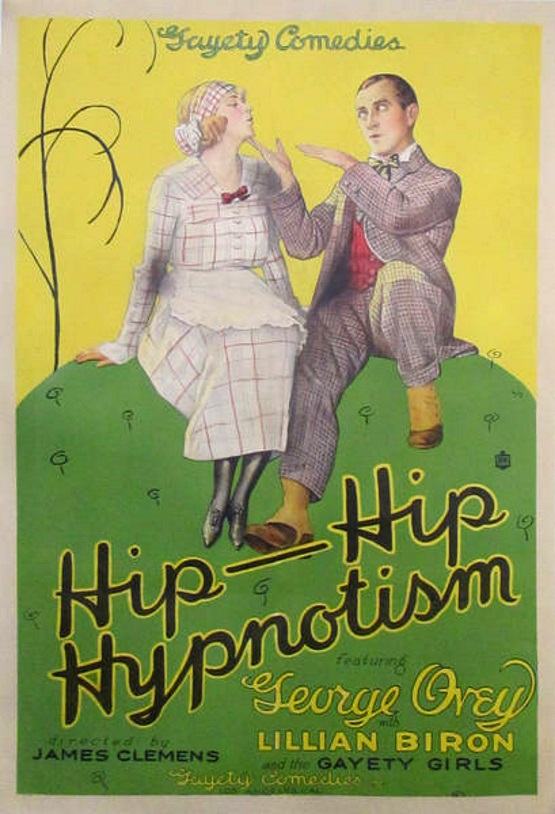
I. The Spell That Refused to Sit Still
If you’ve ever wished The Old Maid’s Baby had swapped its parlor-room prudishness for bootleg gin and a snare-drum heartbeat, Hip Hip Hypnotism is the celluloid fever dream you never knew you craved. Picture George Ovey—rubber-limbed, pop-eyed, a Charlie Chaplin who’s read too much Freud—twirling a pocket watch that ticks in 4/4 swing time. His stage is a rickety pier where salt spray sizzles on arc lamps, and his audience is a restless ocean of straw boaters and cloche hats hungry for any distraction from Prohibition’s sobriety.
Lillian Biron, all cheekbones and mischief, enters wearing a dress that looks like a lemon meringue exploded. One glance at the swinging charm and her pupils dilate into black disco balls. The camera—hungry, voyeuristic—pushes so close you can count the sequins quivering on her headband. The hypnosis isn’t polite; it’s a mugging in a dark alley of the psyche. Suddenly she believes she’s a monarch descended from saxophones. She struts, she scats, she demands caviar on the half-shell. The conjurer’s leer curdles into panic: the trick has wriggled off the leash.
II. A Plot That Somersaults Into Its Own Top Hat
Jack Jevne’s script treats narrative like taffy: stretch, snap, re-wrap. Act One is a Keystone hurricane of bowler hats sucked into cotton-candy machines. Act Two pivots into a smoky cabaret where the flapper, now self-crowned empress, holds court over a jazz trio whose brass section appears to be flirting with a fishnet chorus. Each time the conjurer tries to yank her back to reality, the world double-exposes: chorus girls become carousel horses, a sousaphone belches soap bubbles shaped like dollar signs.
The real tension isn’t whether the spell will break—it’s whether identity itself can survive such slapstick vandalism. Ovey’s character ricochets between confidence man and wounded lover, his face an ever-morphing billboard of guilt and desire. In one sublime gag he attempts to de-hypnotize her by swinging the watch counter-clockwise; the camera reverses, the band plays backwards, and a champagne bottle un-pops itself into effervescent emptiness. For a moment time hiccups, and the audience—both on-screen and off—forgets which way is sober.
III. Performances That Glitter Like Shattered Mirrorballs
George Ovey has the elastic physicality of a man whose joints are held together by rubber bands and regret. Watch how he collapses into a suitcase, then re-inflates with the astonishment of someone waking from their own funeral. His hands—those fluttering, pleading birds—deserve separate billing.
Lillian Biron is the film’s live wire, equal parts temptress and trapped canary. She never winks at the audience, which makes her hallucinated majesty terrifyingly plausible. When she sings an octave too high, every champagne flute in the joint trembles on the brink of shattering. The moment she slaps a gangster with a bouquet of feathers, you realize the film’s true hypnosis is feminine chaos weaponized into jazz-age mania.
The supporting cast arrives like vaudeville acts on a runaway carousel: a strongman whose biceps have biceps, a mind-reader who keeps predicting his own bankruptcy, and a dowager draped in enough pearls to sink the Lusitania. They orbit the central duo like deranged planets, each gravitational pull warping the hypnosis further.
IV. Visual Alchemy on a Shoestring
Shot largely on leftover sets from La La Lucille, the film repurposes gilded staircases and paper-mâché sphinx heads into a dream-logic playground. Cinematographer Frank Zucker smears petroleum jelly on the lens edges so that every frame feels dunked in gin and starlight. Double exposures aren’t gimmicks—they’re plot points. When the heroine envisions herself tap-dancing across the sky, the clouds ripple like celluloid scratched by a diamond bracelet.
Color tints flicker from amber to cyan without warning, as if the projectionist is also under hypnosis. Intertitles aren’t content to narrate; they pirouette across the screen in fonts that shimmy. One card, bathed in sea-blue, reads: “Reality is merely a post-hypnotic suggestion wearing yesterday’s corset.” You half expect the letters to leap out and demand a cigarette.
V. Sound of Silence Syncopated
Though released at the twilight of the silent era, the film pulses with musical implication. Contemporary accounts claim theaters were encouraged to accompany screenings with hot jazz instead of the usual Wurlitzer lullabies. The syncopated rhythms explain why every pratfall lands on the off-beat, why every side-eye feels like a cymbal crash. Watching it today with a live trio—preferably one that knows how to bend time like Louis Armstrong bends blue notes—turns the experience into an exorcism with a backbeat.
VI. Context: The Year That Ate Itself
1928 was a year of tipping points. Al Jolson had already yanked cinema into the talkie stratosphere, but poverty-row studios like the one behind Hip Hip Hypnotism clung to pantomime bravado. The film belongs to that twilight genus of silents that flirt with sound—literally. In a surviving reel, someone off-stage drops a metal tray, and the entire cast freezes as if they’ve heard the future slam shut.
Compare it to The Mystery of the Double Cross, another ’28 oddity that treated plot like a Rubik’s cube soaked in absinthe. Where that film relishes thriller convolutions, Hip Hip Hypnotism opts for emotional whiplash: love as a rigged carnival game. Or stack it against A Lion in the House, where childhood trauma roared under domestic gentility. Here trauma wears tap shoes and shimmies.
VII. Legacy: A Negative Printed on Moonlight
For decades the film was a ghost whispered about in collector forums: a 16mm print rumored to be floating in a Buenos Aires basement, a title card here, a lobby card there. When a nitrate reel finally surfaced—curled like a dead leaf—it was missing its final two minutes. The last surviving frame shows Ovey and Biron silhouetted inside the lighthouse lens, their outlines dissolving into over-exposure. Cinephiles have debated whether the original ending revealed the entire narrative as a stagehand’s drunken hallucination. Personally, I hope we never find it; some spells deserve to stay unbroken.
Modern comedies that attempt meta-awareness—think Eternal Sunshine meets The Naked Gun—owe a debt they don’t know they have. The film’s central gag, that identity is as malleable as taffy pulled by a prankster god, prefigures everything from Being John Malkovich to TikTok’s face-swap culture. The difference is that here the stunt is performed with analog sleight-of-hand, not pixels.
VIII. Verdict: Why You Should Let It Mess With Your Head
Seek out any underground festival foolish enough to screen it. Sit in the third row, dead center, where the beam of light can scald your retinas just enough. Let the warped piano wires and cornet wah-wahs crawl under your skin. Notice how your own laughter arrives on a delay, as if your brain needs to check whether the joke is on you.
Don’t watch it on your phone; the screen is too small to contain the chaos. Don’t binge it alone unless you enjoy questioning the stability of your own reflection. And for god’s sake, don’t expect closure—expect a hangover that hums Gershwin.
In the end, Hip Hip Hypnotism isn’t a film you review; it’s a film that reviews you, scribbling notes in the margins of your subconscious. You’ll walk out dizzy, grinning like someone who just remembered a dream they never lived. And when someone asks what it was about, the only honest answer is: “It hypnotized me into remembering I’ve been hypnotized.” Then you’ll buy another ticket, because some spells are worth falling for twice.
IMDb 6.7
1921
Community
Log in to comment.