DbcultAccessing Vault...
Cult Review
Senior Film Conservator
Cinema’s earliest funhouse mirrors already knew how to bend the human figure into a punchline, yet few distortions feel as exquisitely cruel—or as cathartic—as the one Harold Lloyd never made but Bobby Dunn survives in His Meal Ticket.
Picture the opening tableau: a noon-time artery of a nameless American city, circa 1920, where the air tastes of coal smoke and cheap taffy. Into this drifts a naïf with a face built for optimism and pockets built for lint. He trades the last vestige of selfhood for a moth-eaten monkey pelt, agreeing to impersonate a capuchin in exchange for stale bread and the privilege of gawking at Sybil Seely’s ankles as she high-kicks to the wheeze of a street organ. The transaction is framed in a single, unblinking medium shot; no iris-in, no sentimental vignette—just the blunt arithmetic of survival. Already the film has whispered its thesis: dignity is a negotiable currency, and the going rate is abysmal.
The monkey-suit itself is a marvel of thrift-shop taxidermy—buttons for eyes, frayed wool that mimics mange, a tail that curls like a question mark. When Bobby wriggles into it, the camera doesn’t cut away; we witness every indignity, the contortion of limbs, the snap of elastic at the throat. The suit is both cocoon and exoskeleton, a second skin that promises protection yet delivers persecution. It’s the first of many reversals that will ricochet through the film’s compact 12-minute lifespan.
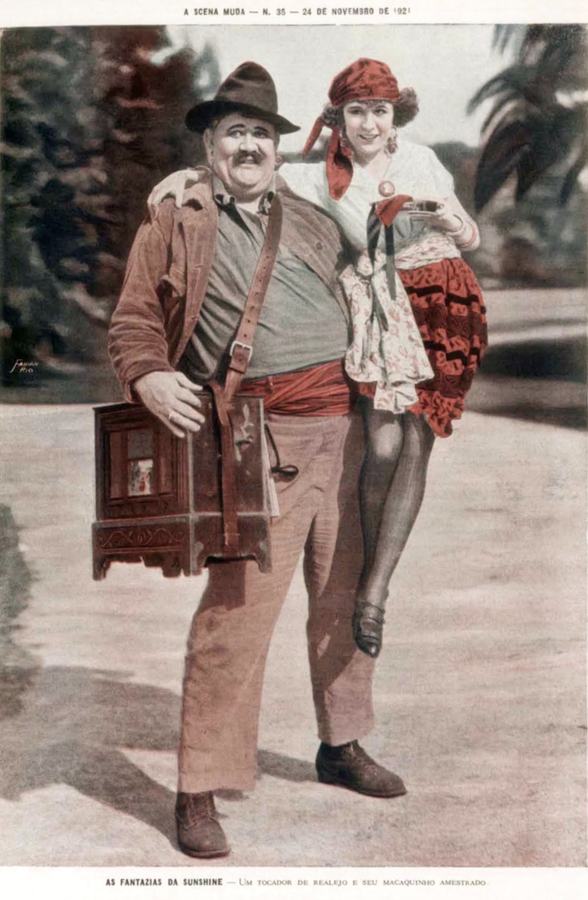
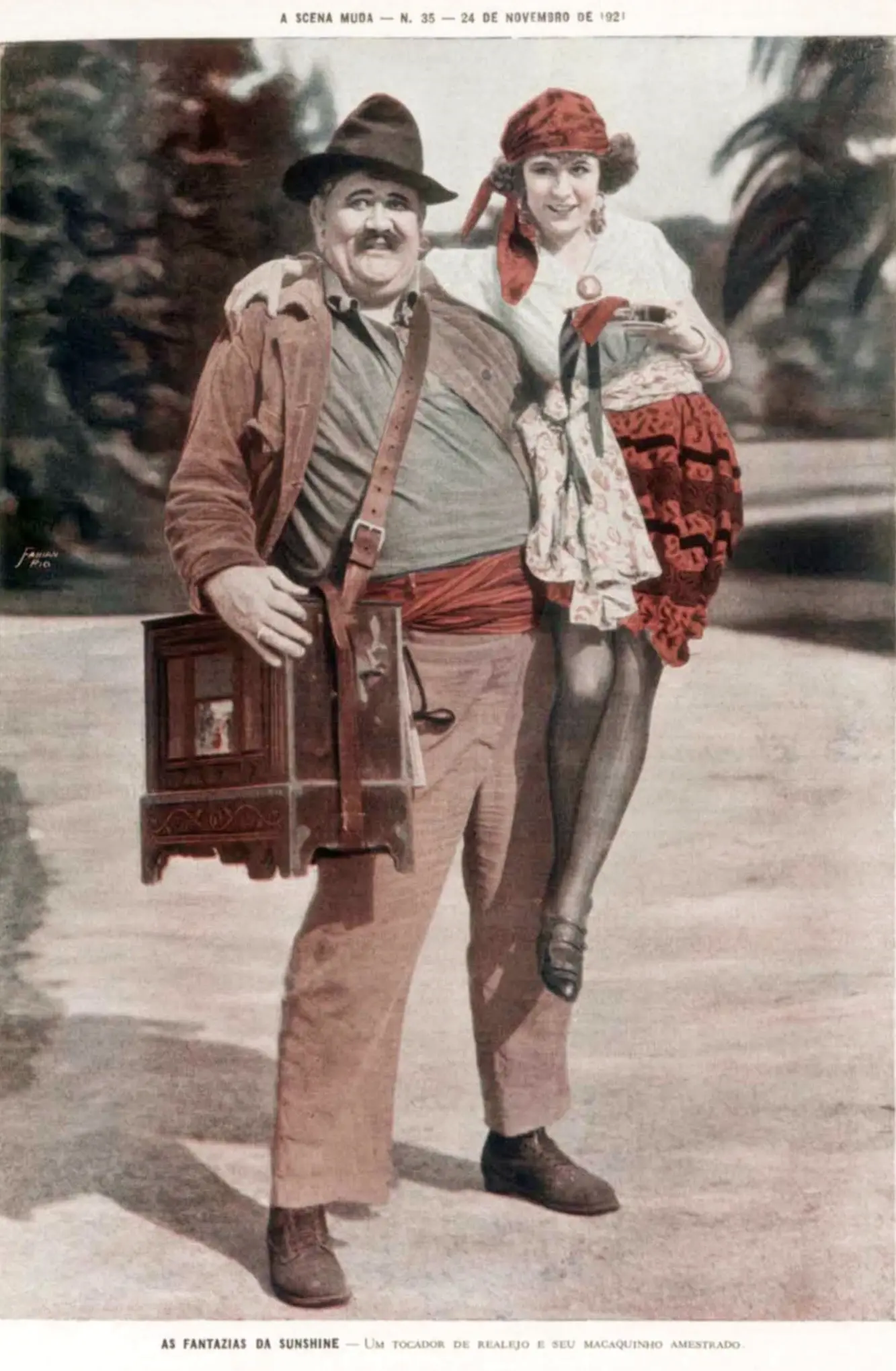
Enter the organ grinder: Joe Roberts, mountainous, face like a chipped bust of Jupiter, his fingers calloused from years of cranking out Il Trovatore for indifferent passers-by. He owns the corner, the monkey, and—by unspoken contract—the girl. Roberts plays the role of petty impresario with a leer that anticipates every studio mogul who will ever plant a casting-couch in Hollywood’s future; his grin is a nickel-plated promise of exploitation. Yet even he is merely a cog in the film’s larger mechanism, a mechanism that grinds not coffee beans but identity itself.
Seely’s dancer flickers between object and agent. In one breath she is the commodified spectacle, skirt hemmed to the knee, eyes lacquered with the enforced gaiety of the perpetually ogled. In the next she engineers micro-rebellions: a wink at Bobby that lasts one illicit frame, a pirouette that sprays dust into the grinder’s face. The choreography is Keystone-simple, but the subtext pirouettes too—she is negotiating her own meal ticket, one flirtatious battement at a time.
Then comes the inciting accident: across town, in a whitewashed ward reeking of carbolic and ether, an actual simian patient—equal to Bobby in height, weight, and uncanny aura—burrows out of its crate. The escape is filmed in a single, hand-cranked take that speeds up reality: fluorescent bulbs strobe, white coats flap like frightened egrets, the monkey scampers into civic legend. Intercut with this pandemonium are shots of city denizens scanning sensationalist broadsheets: “APE ON THE LOOSE—STAY INDOORS.” The editing rhythm foreshadows Eisenstein’s montage of attractions, but here the attraction is panic, and the punchline is still loading.
Back on the thoroughfare, Bobby—still in simian drag—scratches his faux-fur, hungry for the clink of pennies. Instead he reaps a tsunami of shrieks. Mothers yank children into doorways; a cop unholsters his service revolver with the solemnity of a priest raising the host. The film’s spatial logic flips: the same street that once nurtured communal amusement now convulses with tribal terror. Dunn’s physical comedy mutates accordingly; his pratfalls become existential. When he scampers up a lamppost, the camera tilts upward, rendering the iron column a gibbet against the sky.
What follows is a fugue of mistaken identity shot through Expressionist shadows. Buildings loom at Dutch angles; a barber’s pole spirals like a hypnotist’s disc. The urban labyrinth contracts into a single injunction: run. Bobby obliges, but every alley disgorges a new tormentor—a butcher wielding a cleaver, a society dame swinging her parasol like a mace. The gag rhythm is metronomic yet merciless, each laugh scraped from the bone of fear.
At last, breathless and cornered, Bobby spies salvation: the hospital wagon that once caged his doppelgänger stands vacant, its door ajar like a confession booth. He dives in, slamming the grate. For a beat, the soundtrack—solo piano on the surviving print—drops to a tentative trill. The cage is sanctuary and trap, a home he never knew he qualified for. Orderlies wheel him inside, oblivious. Identity, that slippery eel, has finally been nailed down: he is officially the monkey.
The operating theater is cathedral-vast, tiled in albescent ceramic that reflects the klieg lights back onto the supine “specimen.” Surgeons materialize in white masks—visages as blank as kachina dolls—scalpel blades glinting like crescent moons. The mise-en-scène channels The Cabinet of Dr. Caligari minus the overt stylization; horror is implied by fluorescent sterility rather than painted shadows. Dunn’s eyes, the only human feature still visible in his costume, dart left-right-left, negotiating a plea bargain with fate.
Salvation arrives via slapstick serendipity: an orderly, attempting to affix a nitrous oxide canister, fumbles; the glass neck snaps. Laughing gas hisses out in visible curlicues, a genie loosed from prohibition-era prohibition. The vapor drifts across the frame in superimposed wisks—an early special effect achieved by double exposure on a 1920 printer. Gigglery erupts, first from the masked surgeons, then from the camera itself, which jitters slightly as if tittering. Instruments clatter; the operation aborts; Bobby’s thorax remains unscathed.
Cut to black. No iris-out, no moral, no epilogue—only the afterglow of anesthetic absurdity. The film refuses to restore order, refuses to return Bobby to the street corner for a reassuring curtain call. He remains, for all we know, caged in bureaucratic limbo, a man whose humanity was revoked by wardrobe and reinstated by chemical fluke. The final irony: the only ticket he ever secured was punched by chaos itself, and even that was non-transferable.
Shot on orthochromatic stock that renders reds as tar-black and blues as shimmering mercury, the picture converts daylight into chiaroscuro. Dust motes become comets; Sybil Seely’s lemon frock glows like a solar flare against the asphalt. Cinematographer (uncredited, as was custom) favors deep-focus tableau, letting background gags germinate while foreground bustle distracts—a proto-Kubrickian layering that rewards frame-by-frame archaeology.
The edit cadence oscillates between languid observation and Keystone acceleration. When panic spreads, shots average 1.3 seconds; when Bobby courts pennies, the camera lingers for 5, allowing pathos to seep through the slapstick. The result is tonal whiplash, a sensation akin to toggling between Mexico’s sun-scorched lyricism and the frenetic custard-pie mania seen in Springtime.
Intertitles, sparse and utilitarian, eschew the purple prose of contemporaneous melodramas like Price of Treachery; Or, The Lighthouse Keeper's Daughter. Instead they function as drum hits: “HE’S NOT MONKEYING AROUND” or “OPERATION CANCELLED—BY ORDER OF LAUGHTER.” The brevity anticipates modern trailer one-liners; the wit, though, is bone-dry, more Beckett than Barnum.
Across the Atlantic, German Expressionism was birthing El eco del abismo, where doubles and doppelgängers stalked through labyrinths of madness. Meanwhile, Hollywood’s working-class comics mined similar anxieties but filtered them through the American promise of vertical mobility. His Meal Ticket occupies the liminal interstice: it literalizes the immigrant fear of being dehumanized—of arriving at Ellis Island a person and exiting a statistic, or worse, livestock.
Compare it to A Little Brother of the Rich, where class anxiety is draped in top-hat melodrama. Here, the critique is more savage because more intimate: the proletarian body itself is the commodity, and the marketplace is the sidewalk. The monkey suit is the uniform of the gig economy avant la lettre, a zero-hour contract stitched from faux fur.
Spiritual cousins emerge in The Faith Healer’s hucksterism and Hobbs in a Hurry’s accelerationist farce, yet none wed the corporeal gag to ontological dread so succinctly. Even the urban paranoia of Where Is Coletti? feels procedural beside this film’s carnival cacophony.
Bobby Dunn’s eyes—beleaguered, bovine—carry the weight of silent-film pathos without the angelic veneer of Chaplin or the athletic bravura of Keaton. His gait in the monkey suit is a masterclass in constrained kinesics: knees bent to 30°, arms akimbo, spine curved into simian S-curve. Watch how he negotiates a curb: the micro-stumble, the compensatory tail-swish, the flicker of self-disgust that passes across his brow at 18 fps. It’s Method acting born two decades early, filtered through vaudeville’s pratfall lexicon.
Sybil Seely, often relegated to ingenue furniture in other shorts, here imbues her danseuse with flapper rebellion. In a throwaway moment she pockets a nickel meant for the organ, slyly financing her own emancipation. The gesture lasts four frames, but it ignites the corner of the viewer’s eye like a match head. Compare her micro-insurrection to the fatalistic heroines of I sentieri della vita; Seely’s survival is smaller, sharper, and therefore more believable.
Joe Roberts, towering and slab-cheeked, weaponizes physical intimidation without verbal crutches. His organ grinder is capitalism’s carnival barker, yet Roberts injects a hint of burlesque insecurity—note how his fingers tremble when coins fail to clink. It’s a whispered premonition of the Great Depression, the moment when the grift stops printing dividends.
Surviving prints are silent, but the film begs for a contrapuntal score—maybe a string quartet scraping atonal harmonics until the laughing-gas release, where woodwinds could pirouette into a tipsy waltz. Contemporary audiences often experienced such shorts with improvised accompaniment; imagine a nickelodeon pianist slamming fists onto the bass clef to mimic the grinder’s hurdy-gurdy, then flutter-tremolo during the chase. The absence of standardized audio leaves a vacuum modern viewers can inhabit, projecting their own urban cacophony—sirens, skateboards, smartphone pings—onto Bobby’s panic.
History has filed His Meal Ticket under ephemera, yet its DNA persists. The sitcom trope of mistaken identity? Trace it back here. The Kafka-cage nexus of The Trial? Foreshadowed in Bobby’s gleeful incarceration. Even the bureaucratic absurdity of Honor Thy Name and the redemptive arc of The Convict Hero owe a debt to this compact nightmare.
Animation later literalized the human-animal swap—think Disney’s The Monkey’s Uncle—but none captured the class sting embedded in Dunn’s original ordeal. The closest echo might be the existential Chuck Jones shorts where Daffy Duck battles artist-deity erasure, yet even those favor metatextual whimsy over proletarian despair.
Is His Meal Ticket a masterpiece? If measured by narrative cohesion, no—its third act dissolves into the anesthetic haze, denying catharsis. But as a fossilized spasm of cultural anxiety, it is indispensable. The film exposes the transactional farce underpinning the American dream: wear the fur, dance for coins, pray the anesthesia holds. When the gas clears, the cage is still there, and the organ grinder cranks on, indifferent.
Watch it at 3 a.m. when insomnia has sanded your nerves to raw wire. Let the flicker of Dunn’s eyes mirror your own precarity in the gig economy. Notice how the laughter catches in your throat, fermented into a dry cackle. That aftertaste—part helium, part cyanide—is the bouquet of vintage 1920 nihilism, bottled and corked for posterity.
Rating: 8.5/10—a brittle jewel of silent-era cynicism, sharp enough to slice the velvet glove of nostalgia and draw blood.
IMDb 5.6
1928
Community
Log in to comment.