DbcultAccessing Vault...
Cult Review
Senior Film Conservator
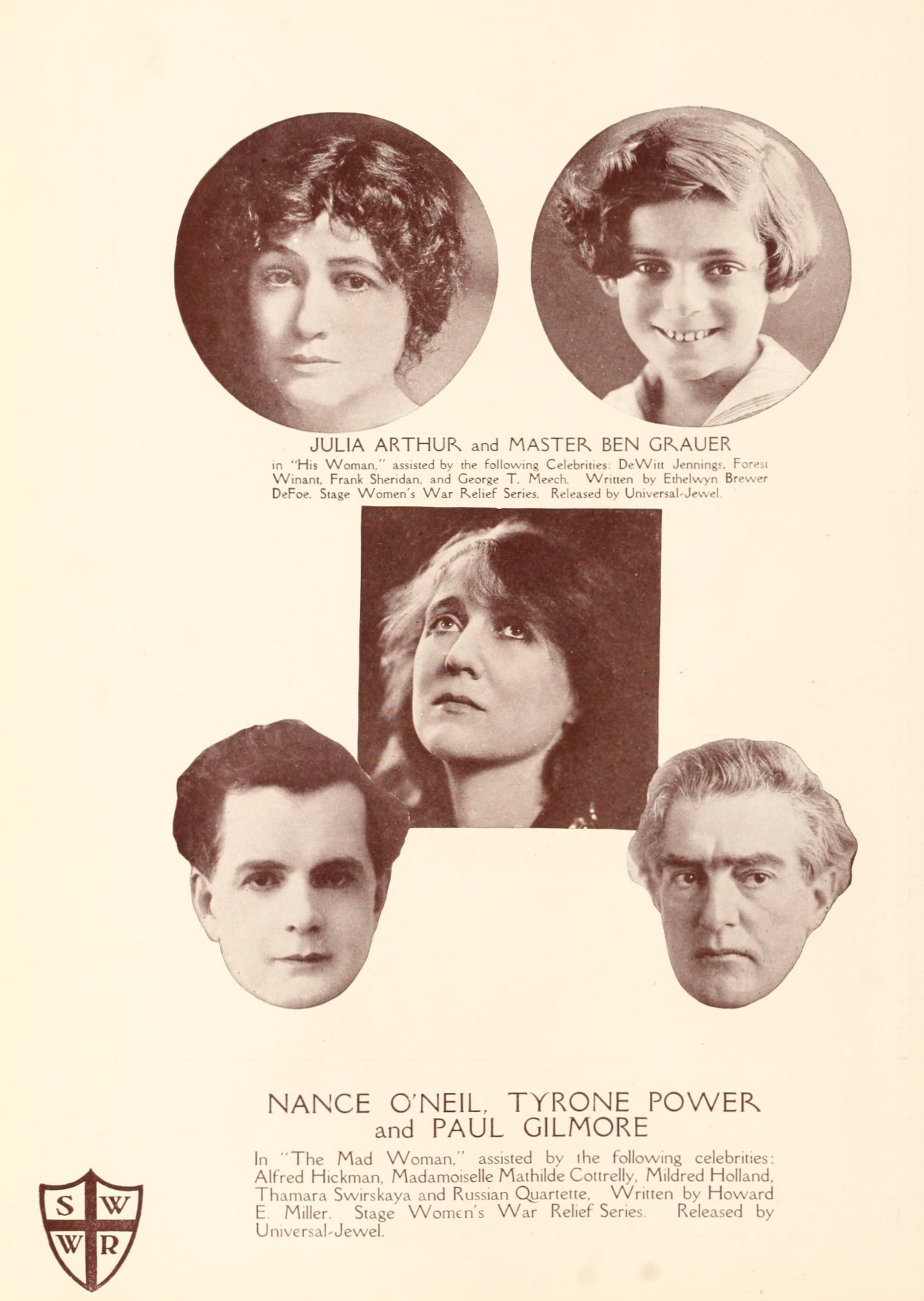
In the annals of early cinema, certain films, even those whose original prints may now be lost to time or exist only in tantalizing fragments, leave an indelible mark through their narrative ambition and the sheer force of their thematic resonance. 'His Woman,' a compelling drama penned by Calder Johnstone and Ethellyn Belwer De Foe, with a stellar ensemble featuring Julia Arthur, Ben Grauer, and Forrest Winant, stands as a testament to the era's capacity for profound storytelling. This particular cinematic endeavor, if one were to resurrect its full grandeur, would undoubtedly reveal itself as a potent examination of agency, possessiveness, and the arduous journey toward self-determination.
The film, as imagined through its evocative title and the dramatic context of its time, plunges us into the tumultuous world of Mary, a character brought to life with an exquisite blend of vulnerability and nascent strength by Julia Arthur. Arthur, a performer celebrated for her nuanced portrayals, would have imbued Mary with a quiet intensity, a palpable weariness born from a past shrouded in menace. Her flight from the clutches of Richard, a figure of formidable power and chilling proprietorial intent, sets the stage for a narrative steeped in the classic melodramatic tradition yet infused with a surprisingly modern sensibility regarding female independence. Richard, perhaps portrayed by the commanding presence of Ben Grauer or the subtly menacing Forrest Winant, would embody the era's patriarchal dominance, his sense of entitlement an almost tangible force.
Mary's escape is not merely a physical journey but a profound psychological one, a desperate quest for an existence unburdened by the shadow of another's will. She seeks anonymity not in bustling metropolises but in the elemental simplicity of a fishing village, a choice that immediately signifies her yearning for authenticity and a life connected to fundamental truths. This setting, with its rugged coastlines and the relentless rhythm of the tides, would provide a powerful visual metaphor for Mary's internal struggle and her eventual resilience. The cinematography, even in the nascent stages of the art form, could have masterfully captured the stark beauty and isolation of this new environment, contrasting it sharply with the opulent yet suffocating world she left behind.
It is in this sanctuary that Mary encounters John, a character likely portrayed with earnest sincerity by an actor like Forrest Winant or even George T. Meech, bringing a grounding presence to the narrative. John, a fisherman whose hands are calloused by honest labor and whose heart is open, represents a radical departure from Richard. His love for Mary is not possessive but liberating, built on respect and genuine affection. This burgeoning romance forms the emotional core of the film, offering a beacon of hope against the encroaching darkness of Mary's past. The silent film medium, reliant on visual storytelling and the expressive power of its actors, would have excelled in conveying the tender nuances of their developing relationship, perhaps through lingering glances, shared smiles, and the unspoken language of touch.
However, the tranquility is, as always in such compelling narratives, ephemeral. Richard's malevolent determination to reclaim what he perceives as 'his' shatters Mary's fragile peace. This dramatic intrusion necessitates a confrontation that forces Mary to shed her adopted anonymity and confront her past head-on. The title, 'His Woman,' takes on a chilling irony here, reflecting Richard's archaic claim of ownership rather than John's respectful partnership. This central conflict elevates the film beyond a simple romance into a potent social commentary, questioning the very definitions of love, possession, and freedom prevalent in society, particularly concerning women's roles.
The screenplay by Calder Johnstone and Ethellyn Belwer De Foe, given the intricate emotional landscape it navigates, must have been a masterclass in building suspense and character depth without relying on extensive dialogue. Their ability to craft a narrative that allows actors like Julia Arthur to convey profound inner turmoil and unwavering resolve through gesture and expression alone speaks volumes of their understanding of the cinematic language of the era. The unfolding drama would have been meticulously paced, escalating from quiet apprehension to climactic confrontation, ensuring that every visual beat contributed to the overarching emotional arc. The writers would have expertly woven in moments of quiet reflection for Mary, allowing the audience to glimpse her evolving strength, juxtaposed with the escalating tension of Richard's relentless pursuit.
Comparatively, 'His Woman' might echo the powerful themes of female endurance seen in films like The Woman Who Dared, where protagonists similarly defy societal or personal oppressors. The raw emotionality and the struggle for agency within a constrained world could also draw parallels to the intense melodramas exemplified by works such as Maria Magdalena, which often explored moral quandaries and societal judgment. The film's strength lies not just in its dramatic confrontations but also in its nuanced portrayal of Mary's journey from a hunted woman to a self-possessed individual. This transformation, central to the film's enduring appeal, would have been skillfully orchestrated by the performances and the narrative structure.
The casting choices for 'His Woman' were undoubtedly pivotal. Julia Arthur, known for her stage presence and later her impactful film roles, would have brought an unparalleled gravitas to Mary. Her ability to convey complex emotions without uttering a single word, relying on the subtle shifts of her gaze or the eloquence of her body language, would have been crucial in capturing the audience's empathy and admiration. Ben Grauer and Forrest Winant, both seasoned performers of the era, would have provided compelling foils. Grauer might have embodied Richard with a cold, calculating ruthlessness, while Winant, if cast as John, would have radiated warmth and steadfast devotion, creating a stark and effective contrast. The supporting roles, featuring talents like George T. Meech and DeWitt Jennings, would have further enriched the narrative tapestry, providing the societal framework and additional dramatic texture against which Mary's personal struggle unfolds. Frank Sherman's contribution, too, would have been integral to the film's overall fabric, ensuring a cohesive and engaging dramatic experience.
The climax of 'His Woman' would undoubtedly involve a powerful confrontation, likely exposing Richard's true character and his nefarious machinations. This revelation would not only vindicate Mary but also solidify her newfound freedom. The resolution would be less about a man 'saving' her and more about Mary actively claiming her own destiny, a theme that resonates powerfully even today. The final scenes, perhaps depicting Mary and John embarking on a future built on mutual respect and genuine affection, would have offered a satisfying emotional catharsis, affirming the triumph of authentic love over possessive control. This narrative arc, while seemingly conventional, would have been elevated by the film's commitment to portraying Mary's internal struggle and her agency in shaping her own life, a progressive stance for the period.
The film's enduring message, even without a preserved print, can be extrapolated from its premise: the fundamental human right to self-determination. It challenges the notion that any individual can lay claim to another, especially in matters of the heart and personal liberty. The title itself serves as a provocative question, forcing the audience to consider whose 'woman' Mary truly is – a possessive claim, or a woman who belongs only to herself and to a love freely given. This intellectual engagement, alongside the visceral drama, would have distinguished 'His Woman' as a significant contribution to the early cinematic landscape.
The artistry of silent film, particularly in its capacity for visual storytelling, would have been fully leveraged in 'His Woman.' The use of intertitles, while sparse, would have been impactful, delivering crucial dialogue or narrative exposition with poetic brevity. The musical accompaniment, an often-overlooked but vital component of the silent film experience, would have underscored the emotional beats, from the melancholic strains accompanying Mary's flight to the triumphant fanfares marking her eventual liberation. The interplay of light and shadow, a hallmark of early cinematography, would have been employed to great effect, enhancing the dramatic tension and highlighting the emotional states of the characters. Imagine the stark contrast between the shadowed corridors of Richard's world and the sun-drenched, open spaces of the fishing village, visually reinforcing the thematic dichotomy.
Reflecting on the film's potential impact, 'His Woman' would have left audiences with a profound sense of justice and hope. It is a narrative that celebrates resilience and the power of individual choice. The character of Mary, as crafted by Johnstone and De Foe and embodied by Julia Arthur, would have resonated deeply with viewers, particularly women, who were navigating their own evolving roles in a rapidly changing world. The film would have served as both entertainment and a subtle commentary on societal norms, urging a re-evaluation of patriarchal assumptions. It reminds us that even in an era often dismissed as primitive in cinematic terms, storytellers were grappling with complex human experiences, crafting narratives that explored timeless themes of love, loss, freedom, and the inherent dignity of the individual.
In conclusion, 'His Woman' stands as an imagined masterpiece of early cinema, a film that would have transcended its period to offer a compelling and emotionally resonant narrative. Its exploration of a woman's struggle for autonomy against a possessive past, brought to life by a talented cast and insightful writers, would have solidified its place as a significant work. It is a testament to the power of storytelling to challenge, inspire, and entertain, leaving an indelible impression long after the final frame. The film's enduring relevance lies in its unwavering belief in the human spirit's capacity to overcome adversity and claim its rightful place in the world, a narrative thread that continues to captivate and move audiences across generations.
The sheer ambition of the narrative, encompassing themes that remain pertinent today, underscores the visionary nature of its creators. Calder Johnstone and Ethellyn Belwer De Foe, through their collaborative efforts, would have demonstrated an acute understanding of human psychology and societal dynamics. Their ability to craft characters whose motivations are clear yet complex, whose struggles are personal yet universal, is the hallmark of truly great storytelling. The trajectory of Mary's character, from a figure of flight to one of defiant assertion, is a testament to the writers' skill in portraying evolution and growth. This profound character development, coupled with the dramatic tension of Richard's pursuit, would have ensured that 'His Woman' was not just a film, but an experience that lingered in the viewer's mind, prompting reflection on themes of freedom and control.
The film's impact would also have been magnified by the evocative power of the silent medium itself. Without spoken dialogue, every gesture, every facial expression, every visual composition carried immense weight. Julia Arthur's performance, therefore, would have been a masterclass in non-verbal communication, her eyes conveying volumes of unspoken pain, hope, and determination. The supporting cast, including the steady presence of DeWitt Jennings and the nuanced contributions of Frank Sherman, would have further anchored the narrative, creating a believable world for Mary's struggle. The visual language of 'His Woman' would have been its primary lexicon, speaking directly to the emotions and intellect of the audience without the filter of spoken words, a purity of cinematic expression that is often celebrated in retrospectives of the silent era.
The social commentary embedded within 'His Woman' is also noteworthy. While presented as a gripping drama, the film subtly critiques the societal structures that allowed men like Richard to exert such control over women. It implicitly champions the burgeoning movement for women's rights and autonomy, mirroring real-world shifts in gender roles and expectations. In this regard, it aligns with other progressive narratives of the time, offering a cinematic space for discussions on independence and equality. The film’s resolution, where Mary actively reclaims her life, would have been a powerful statement, reinforcing the idea that true love is built on partnership, not possession. This message, delivered through a captivating story, would have resonated deeply with contemporary audiences and continues to hold relevance in modern discourse on relationships and personal freedom.
Moreover, the film's potential for visual spectacle, even within the constraints of early filmmaking, should not be underestimated. Imagine the dramatic chase sequences along the rugged coastline, the emotional intensity of close-ups on Julia Arthur’s expressive face, or the symbolic imagery of the turbulent sea reflecting Mary's inner turmoil. These elements, combined with the compelling performances and a tightly woven plot, would have ensured 'His Woman' was a cinematic experience both thrilling and thought-provoking. It would have been a film that not only entertained but also contributed to the evolving language of cinema, demonstrating the medium's capacity for sophisticated storytelling and profound thematic exploration. The legacy of such a film, even if largely unpreserved, speaks to the creative vitality of its era and the timeless power of its narrative.
IMDb 5.6
1922
Community
Log in to comment.