DbcultAccessing Vault...
Cult Review
Senior Film Conservator
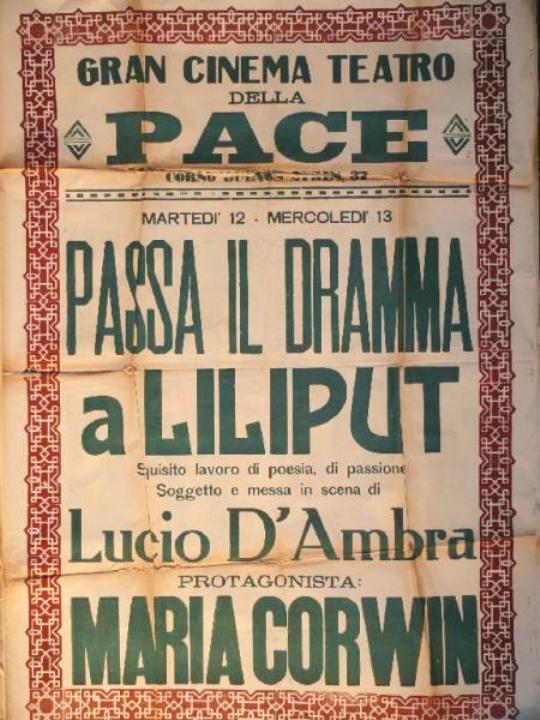
The year 1919 stood as a precipice in the history of Italian cinema, a moment where the grandiosity of the historical epic began to yield to the intimate nuances of psychological realism. Passa il dramma a Lilliput is a quintessential artifact of this transition, a film that leverages the idiosyncratic setting of a performer troupe to dissect the universal mechanics of human sorrow. It is a work that demands a sophisticated gaze, one capable of looking past the artifice of the era to find the raw, pulsing veins of emotion beneath the greasepaint.
In the silent era, the concept of the 'troupe' often served as a microcosm for society. While films like The Dumb Girl of Portici utilized massive scales and sweeping choreography to convey their narratives, Passa il dramma a Lilliput opts for a compressed, almost claustrophobic intensity. The 'Lilliput' of the title refers not merely to the stature of the characters but to the hermetic seal of their environment. The cinematography, characterized by the soft-focus lenses and meticulous tinting typical of the Cines studio, creates an atmosphere that feels both dreamlike and agonizingly real.
The visual grammar of the film is built upon the contrast between the performers' public personas and their private despairs. We see the bright, yellow-hued stage lights of their circus-like existence, which quickly fade into the sea blue shadows of the wings where the true drama—the 'dramma'—unfolds. Unlike the industrial grit found in The Iron Strain, the conflict here is purely of the spirit, a metaphysical struggle against the roles that fate and biology have assigned.
Romano Calò, a titan of the Italian silent screen, delivers a performance that is a masterclass in restraint. In an era often criticized for its histrionics, Calò utilizes his eyes to convey a depth of longing that words would only diminish. His character acts as the emotional fulcrum of the film, a man caught between his responsibilities to the troupe and his own burgeoning disillusionment. There is a specific scene, framed in a tight medium shot, where Calò’s face undergoes a glacial transformation from professional mask to personal ruin—it is as haunting as any sequence in Det gamle fyrtaarn.
The chemistry between Calò and Elena Lunda is palpable, even through the veil of a century-old celluloid. Lunda, a diva of considerable magnetism, avoids the stereotypical tropes of the 'femme fatale' or the 'ingenue.' Instead, she portrays a woman of agency and complexity, navigating the treacherous waters of the troupe’s internal politics with a sharp intelligence. Her presence provides the film with its most poignant moments, particularly in her interactions with the younger members of the cast, such as the enigmatic Mimi.
When analyzing the narrative arc of Passa il dramma a Lilliput, one cannot help but draw parallels to other contemporary works. While Slægternes Kamp deals with the macro-clashes of lineage and heritage, this film focuses on the micro-clashes of the soul. There is a shared DNA with My Wife, the Movie Star in its exploration of the performative nature of existence, yet Lilliput lacks the satirical bite of the latter, preferring instead a somber, almost liturgical tone.
The film’s pacing is deliberate, eschewing the frantic action of Kidnapped for a more ruminative flow. This allows the audience to inhabit the space of the characters, to feel the weight of the silence in the dressing rooms and the hollow echo of the applause. It is a cinematic experience that mirrors the slow-burn tension of The World's Great Snare, where the true danger is not a physical threat but the erosion of one’s identity.
The production design of Passa il dramma a Lilliput reflects the high standards of the Italian film industry before its mid-1920s decline. The sets are marvels of forced perspective and intricate detail, designed to emphasize the unique scale of the narrative. The lighting, often utilizing single sources to create sharp, expressionistic shadows, predates the German Expressionist movement in its ability to externalize internal turmoil. In many ways, the visual sophistication here rivals the high-budget productions of Australia Calls or the atmospheric dread of Fangen fra Erie Country Tugthus.
One must also credit the writers and the director (whose vision remains palpable despite the passage of time) for their refusal to treat the protagonists as spectacles. In a period where 'Lilliputian' troupes were often relegated to comedic relief or curiosities, this film accords them a profound dignity. Their struggles with love and betrayal are treated with the same weight as the high-society dramas in Other Men's Wives or the moral dilemmas of The Inner Shrine.
Beyond its aesthetic merits, Passa il dramma a Lilliput serves as a poignant commentary on the post-war Italian psyche. The 'troupe' is a family of choice, a community forged in the fires of shared exclusion. This theme of finding belonging in the margins is a recurring motif in the era’s cinema, visible in works like Nobody Home or the rural struggles of Meddlers and Moonshiners. However, Lilliput elevates this theme through its poetic symbolism—the idea that we are all, in some sense, small players in a drama far larger than ourselves.
The film also touches upon the concept of 'passing'—not just in the sense of the title, but in the sense of the characters passing through different emotional states and social expectations. It shares a thematic kinship with Passing the Buck, though it trades that film's lightness for a heavy, operatic sense of destiny. The final act of the film, which I will not spoil for the uninitiated, is a crescendo of tragic irony that rivals the most celebrated works of the period, including A Man and His Money.
To watch Passa il dramma a Lilliput today is to engage in a form of cinematic archaeology. It is a film that rewards the patient viewer, offering a richness of detail and a depth of feeling that are rare in any era. The performances of Romano Calò, Achille Vitti, and Mary Corwyn create a vivid, breathing world that lingers in the mind long after the final iris-out. It is a testament to the power of the silent image to communicate the most complex of human experiences.
In the grand pantheon of Italian cinema, this film deserves a place of honor. It is not merely a curiosity or a relic of a bygone age; it is a vital, moving piece of art that speaks to the enduring nature of the human spirit. Whether you are a scholar of the silent era or a casual cinephile, Passa il dramma a Lilliput is a journey worth taking—a reminder that no matter how small the stage, the drama of life is always of epic proportions.
Review by the Cine-Aesthete. All rights reserved.
IMDb 6.8
1934
Community
Log in to comment.