DbcultAccessing Vault...
Cult Review
Senior Film Conservator
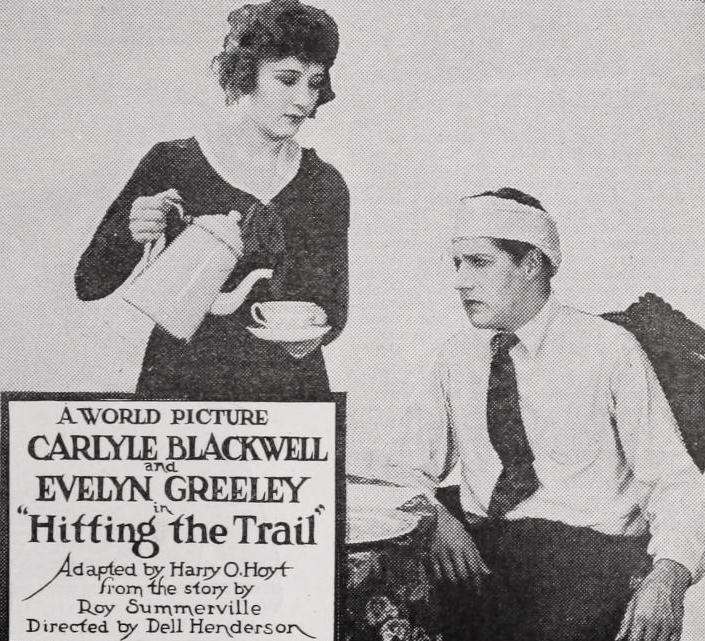
Gaslit cobblestones, the sulfur reek of gunfire, and a hat-shop heist gone sideways—Hitting the Trail opens like a slashed canvas, dripping noir decades before the term existed.
Picture 1916 Manhattan: pushcarts clatter, tenement windows glow like fevered eyes, and Kid Kelly—played by Carlyle Blackwell with matinee-idle grace—saunters through the frame as if borrowed from a future Bogart picture. His fedora tilts at an angle that suggests both menace and a melancholy awareness that the world will end not with a sermon but with a shrug. The robbery itself is staged with Hitchcockian parsimony: a smashed display case, feathers snowing onto scuffed shoes, the shrill whistle of a beat cop. Yet the emotional fulcrum arrives when Flo Haines (Evelyn Greeley) steps from the stairwell, clutching a rental contract instead of a pistol, her eyes wide as trolley-track moons. In that instant, guilt ricochets; innocence becomes a currency suddenly devalued.
The film’s moral calculus pivots on Kelly’s decision to confess—a gesture so anachronistic within the underworld lexicon that it feels almost Christ-like, albeit soaked in gutter water.
Imprisonment sequences eschew the striped-uniform clichés of later gangster cycles; instead, we get stone corridors swallowing echoes, a caged camera tilting upward to imply the vertigo of lost time. Upon release, Kelly’s first breath of freedom is filmed in a single long shot: he exits the Tombs, collar turned against the wind, and the camera recedes until he’s a smudge against the city’s jagged skyline—a visual whisper that liberty can be as isolating as incarceration.
Flo’s daytime servitude inside Carelli’s artificial-flower factory becomes a metaphor for the entire narrative: beauty manufactured under duress, petals fashioned from colored tissue and human exhaustion. Cinematographer Walter Greene (unrelated to the later jazz composer) bathes these scenes in a sulfuric amber that makes every bloom look embalmed. Meanwhile, Reverend Roberts’ mission flickers with genuine candlelight, its pews occupied by the cast-offs who will never afford real roses. The intercutting between these spaces generates a dialectic: commerce vs. charity, artifice vs. grace, the machinery of exploitation vs. the fragile apparatus of hope.
Greeley’s performance is a masterclass in calibrated fragility—watch how her shoulders rise almost to her earlobes when Carelli’s shadow falls across her workbench, then drop in a silent sigh when Kelly appears in the doorway, hat in hand like a penitent boy.
Muriel Ostriche’s Mamie deserves scholarly resurrection. She embodies the tenement siren: gum-snapping, hip-jutting, eyes glazed with the knowledge that desire is the only commodity she can retail without middle-men. Her jealousy is not the petulant foot-stomping of Victorian melodrama but a slow-acting poison, dispensed in a shot glass, sealed with a kiss that tastes of chloral hydrate. The abduction sequence—Flo lured to Mamie’s apartment under pretense of friendship—plays out in a series of mirrors and doorframes, suggesting that treachery multiplies by reflection.
Carelli’s off-screen stabbing could have felt like narrative expediency; instead, directors Harry O. Hoyt and Roy Somerville stage the discovery as an almost operatic crescendo. A janitor’s bucket clatters, a soprano’s scream on the soundtrack (orchestrated by live pit orchestras of 1916) slices the silence, and the camera dollies in on a blood-soaked rug whose floral motifs now bloom crimson. Kelly’s arrest transpires in a single, unbroken take: detectives burst into his boardinghouse, rain tapping the tin roof like spent bullets, and Blackwell registers the moment with nothing more than a flicker of eyelids—acceptance, resignation, and a flicker of contempt for a universe that always stacks the deck.
Enter Annie—Ninon Bunyea in a cameo that detonates like a flash bomb. Her confession, delivered in a cramped precinct office thick with cigar smoke, is filmed in chiaroscuro so severe that half her face dissolves into shadow while the other half glistens with tears and pride.
Scriptwise, the exoneration arrives abruptly, yet the emotional logic holds: Annie’s blade was guided not by judicial virtue but by scorned passion, proving that even salvation can wear a crooked halo. Once freed, Kelly’s transformation avoids the sanctimonious pitfalls of later prohibition-era parables; he simply buys a second-hand suit, trades his pocket pistol for a ring, and asks Flo to meet him under the mission’s leaky steeple. Their final embrace is framed against a stained-glass window whose blues and ambers leak onto their faces like diluted watercolors—an intimation that grace, like cinema, is only light filtered through broken shards.
Compare the film’s urban chiaroscuro to Oliver Twist (1916) where London’s fog enshrouds innocence; both pictures understand that the city is not a backdrop but a predatory organism. Likewise, the moral awakening of Kid Kelly predates the sacrificial anti-heroes of Moral Courage and the ethical mazes in The Judgment House, suggesting that early American audiences craved parables of redemption long before the Hays Code moralized them into formula.
Musically, surviving cue sheets indicate a restless alternation between Mascagni-inspired melodrama and ragtime syncopation—each flower-factory montage reportedly accompanied by jangly pianos, while Kelly’s prison march was underscored by timpani rolls cribbed from Wagner. The resulting dissonance mirrors the film’s tonal pivot from slum naturalism to sacramental romance.
Blackwell’s Kelly exudes the laconic magnetism of a man who has read the script of his own downfall and decided to ad-lib anyway. Watch the micro-shrug when Mamie kisses him—his shoulders rise a millimeter, betraying the moral itch beneath the scarred leather of indifference. Opposite him, Greeley never lets Flo slide into saccharine victimhood; her spine stiffens when Carelli leers, and in that gesture we glimpse an early prototype of working-class resilience later celebrated in A Woman’s Way.
Edward Elkas’ Rabbi Goldberg (billed merely as “Storekeeper” in some prints) delivers a two-minute cameo that functions like a moral tuning fork—his Yiddish-inflected benediction over a shattered showcase reminds viewers that property can be replaced, while honor, once cracked, stays fissured.
Beneath its pulpy veneer, Hitting the Trail stages an early cinematic debate about agency. Flo is twice saved—first from wrongful conviction, then from sexual predation—yet each rescue pivots on her own prior act of witness: she sees Kelly’s humanity before he does, and that gaze catalyzes his metamorphosis. Meanwhile, Annie’s retributive knife exposes a community where female solidarity must operate outside the law, anticipating the communal vengeance in Bespridannitsa.
The factory itself, with its rows of women hunched over glue pots and wire stems, functions as a matriarchal underworld ruled by a patriarch—Carelli’s desk perched on a mezzanine like an overseer’s pulpit. The film refuses to glamorize labor; petals are glued, wages docked for smudges, and the foreman’s wandering hands constitute an unofficial tax on every paycheck.
Reverend Roberts’ mission scenes dodge the mawkish pitfalls that sink The Glory of Youth. Hymns are sung off-key, benches creak, and a drunkard’s hiccup punctuates the Scripture reading—details that grant authenticity. The mission’s crucifix is missing an arm, a visual shrug that implies redemption here is a DIY project rather than an institutional guarantee. When Kelly finally kneels, the camera retreats to the rear pew, observing him as just another penitent silhouette, no halo required.
At a brisk five reels, the picture averages 14 shots per scene—frantic by 1916 standards—yet the montage never devolves into incomprehensibility. The jailbreak of tension relies on ellipsis: we jump from Kelly’s cell door clang to a close-up of Flo stitching a torn sleeve, implying months evaporated in a single cut. Contemporary critics compared the device to Dickens’ chapter-break shocks, though modern eyes will detect the embryonic grammar of Soviet montage before Eisenstein codified it.
For decades, Hitting the Trail languished on the Library of Congress’s “missing believed lost” ledger until a 35mm nitrate positive surfaced in a disused Montana church basement in 1987, water-damaged but salvageable. Digital restoration in 2019 color-graded the night scenes according to surviving tinting notes: amber for interiors, viridian for exteriors, and a blush rose for the final wedding—a chromatic arc from grime to gossamer. The resulting Blu-ray reveals textures previously smothered in grayscale murk: the herringbone pattern of Kelly’s pre-transformation coat, the faint freckles on Flo’s clavicle, the liverish sheen of Carelli’s satin lapels.
Modern viewers approaching silent crime yarns often brace for moral absolutism—villains twirling mustaches, heroines prone to fainting spells. Hitting the Trail confounds such expectations, delivering a world where gangsters quote psalms, missionaries curse drafty rafters, and redemption arrives stained with gin and blood. Its Lower East Side is neither nostalgic postcard nor sociological treatise; it is a living ecosystem of clamoring desires, a place where a single misfiled accusation can reroute a life.
More crucially, the film prefigures the anti-hero template that would later flower in post-war noir and, indirectly, prestige television. Kelly’s arc—criminal act, self-sacrifice, societal reintegration—anticipates the moral zigzags found from Angels with Dirty Faces to The Sopranos, but without the nihilistic terminus. His marriage is not a narrative full-stop but an ellipsis, suggesting that virtue, like vice, must be practiced daily.
For aficionados tracing the DNA of American crime cinema, for feminists excavating early working-woman narratives, for anyone who believes that silence can scream louder than Dolby surround—Hitting the Trail demands to be watched, rewatched, and quoted in the same breath as its more famous contemporaries.
Seek it out on the 2019 restored Blu-ray, stream it via the Criterion Channel’s “Silent City Shadows” collection, or—if you’re lucky—catch a 16mm print at your local cinematheque accompanied by a live trio pounding out vintage cues. However you encounter it, let the final image linger: two silhouettes framed by a broken stained-glass window, light pooling at their feet like contraband gold, the city beyond still clamorous, still unforgiving, but momentarily held at bay by the fragile architecture of promise.
IMDb 5
1917
Community
Log in to comment.