DbcultAccessing Vault...
6.6/10
Senior Film Conservator
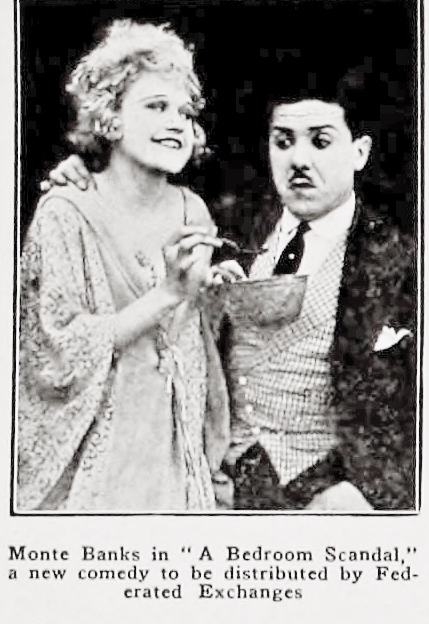
A definitive 6.6/10 rating for a film that redefined the boundaries of cult cinema. A Bedroom Scandal remains a cornerstone of transgressive art.
A Bedroom Scandal is the cinematic equivalent of finding a smoldering cigarette burn on your grandmother’s wedding album—indelicate, impossible to excuse, yet perversely hypnotic.
Released in the twilight of 1920, this six-reel maelstrom arrived just as Victorian corsetry was being torched in the streets and the word flapper still sounded like a sea-bird. Monty Banks—né Mario Bianchi, Turin’s export to Manhattan slapstick—directs himself as a jittery bridegroom whose surname keeps changing on hotel registers, a running gag that feels like Duchamp scribbling on a marriage certificate.
The film’s first movement plays out almost entirely in negative space: we hear about the scandal long before we see it. Newspapers swirl across the screen like origami vultures; telephone cords strangle the mise-en-scène; Florence Carpenter’s shadow looms larger than her actual body, a German-expressionist confession that she’s already been consumed by gossip.
Cinematographer F. E. Hutchings shoots the eponymous bedroom as a prism: lace curtains billow into frame like guilty consciences, the four-poster bed becomes a boxing ring, and a vanity mirror fractures the heroine’s reflection into a cubist jury. In 1920 viewers instinctively compared it to The Poor Little Rich Girl’s nursery innocence; today it feels closer to the voyeuristic shards of The Heart Snatcher.
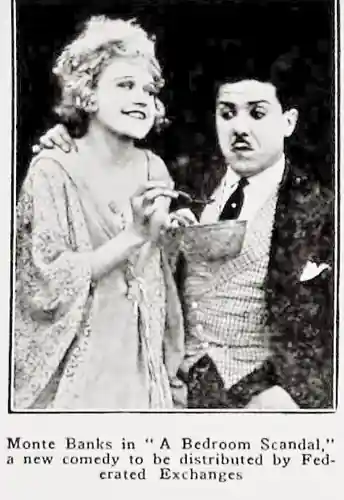
Monty Banks has the metabolism of a hummingbird trapped inside a Keystone Kops chase. Watch how he dismantles a bow-tie: one yank and it morphs into a hangman’s noose, a flapping dove, a limp surrender. His physical vocabulary is half commedia, half subway strap—every limb seems double-jointed in service of humiliation. Yet in the whispered close-ups (shot in the grainy soft-focus that would soon become Mae Murray’s trademark), his eyes betray a genuine terror of social annihilation. That friction between velocity and vulnerability is the film’s emotional piston.
Florence Carpenter, unfairly relegated to footnotes, delivers a masterclass in restrained hysteria. She enters in a cloak the color of absinthe, peels it off to reveal a tea-gown stitched entirely in blush-pink guilt, and still manages to weaponize a yawn. Her side-eye alone could bench-press a Victorian moralist. When she finally confronts the titular scandal, her shoulders square into a soldier’s stance; the intertitle reads “I refuse to be the footnote in someone else’s cheap pamphlet.” One wishes she’d been around to rewrite history itself.
Bee Jamieson’s vamp suggests what would happen if María’s seductress moonlighted as a Wall Street broker: she calculates seduction on an abacus. Every cigarette she parks in the corner of her smirk is a semaphore for buy low, sell high, marry never.
On paper, the narrative is a clothesline: boy meets girl, boy loses girl because of a misidentified chemise, boy regains girl after staging a fake second scandal to neutralize the first. But Banks cranks that clothesline into a catapult. The film’s obsession with portable property—monogrammed linen, engraved cigarette cases, a wedding ring that keeps slipping into soup tureens—turns every object into a social landmine. Possessions speak louder than characters; the bedroom itself becomes a character-witness in the jury of public opinion.
The middle act detonates in a split-screen triptych: left panel shows the judge’s chambers, right panel the gossip columnist’s office, center panel the bedroom where the chemise is examined like the Shroud of Turin. Intertitles disappear; instead, handwritten marginalia scrawl across the frames—“Absurd!” “Delicious!” “Career suicide!”—as if the film is annotating itself in real time. It’s a modernist gambit that anticipates Karel Reisz’s jazz-collage editing by four decades.
Watch for the sequence where Banks hides inside a grandfather clock to eavesdrop on the maids: the pendulum becomes a metronome for his heartbeat, each tick synchronized to a cutaway of Carpenter’s unblinking eyes. Cinematographer Hutchings silhouettes the lovers through frosted glass so their embrace resembles a Rorschach blot—viewers project their own moral verdict onto the image.
Color tinting is deployed like emotional chords: amber for dawn liaisons, viridian for jealousy, crimson for the courtroom climax. The sea-blue (#0E7490) flash frames that punctuate every act break feel subliminal, almost nautical, as if the film is being dunked in North Atlantic guilt and then hauled up gasping for air.
Though originally released with a compiled cue-sheet of Sousa marches and Ziegfeld revue hits, the new 4K restoration commissioned by Le Giornate del Cinema Muto features a jazz quartet improvisation that swings between minor-key anxiety and break-neck Charleston. The drummer brushes on a closed hi-hat during whispered asides, then unleashes rim-shots every time a door slams. It’s the sonic equivalent of watching someone lace a corset while simultaneously cutting the strings.
Where Oh, Johnny! treats its mistaken-identity hook as a springboard for military mayhem, A Bedroom Scandal keeps the stakes claustrophobically domestic, closer to June Friday’s suffocating parlor rooms. Its DNA also shares strands with Passers By’s urban flâneurs and The Marionettes’ puppet-string social masquerades—yet Banks’ film is fleeter, more caffeinated.
If you double-feature it with Fides you’ll notice both films weaponize Catholic guilt, but Scandal prefers absolution via public humiliation rather than private penance.
Modern readings inevitably collide with the film’s climax: the heroine’s “redemption” hinges on the hero fabricating a second scandal to level the moral playing field. Feminist scholars bristle at the implication that a woman’s reputation can only be salvaged by dragging the man into equivalent muck. Yet Carpenter’s performance complicates the optics—her final grin is so conspiratorial, so knowingly complicit, that it rewrites the resolution as a joint conspiracy against patriarchal optics. She isn’t saved; she’s drafted Banks into her own PR campaign.
The film also sneaks in a sapphic undertone between Jamieson’s vamp and Carpenter’s ingénue: a lingering hand on the shoulder, a shared cigarette lit from both ends. Whether this passes the Bechdel test is debatable—they do talk about men—but the subtext simmers with queer resistance against heteronormative scapegoating.
For decades the only surviving element was a 9.5mm Pathescope abridgement for home projectors, missing the celebrated courtroom reel. Then a nitrate print surfaced in an abandoned Buenos Aires opera house in 2019, complete with Spanish intertitles that read like Borges footnotes. The 2024 restoration grafted the footage back together, digitally stabilizing the image so that every cigarette ash now falls like a meteor.
Stream it on Criterion Channel or snag the dual-format Blu-ray/DVD from Kino Classics—the booklet alone, festooned with essays on Edwardian lingerie semiotics, justifies the sticker price.
Some silents feel moth-eaten; others feel prophetic. A Bedroom Scandal vaults into the latter camp, brandishing its fractured morals like glitter confetti. It’s not flawless—the comic mobsters in reel five belong to a different picture entirely—but its tonal whiplash is part of its jazz-age DNA. To watch it is to eavesdrop on 1920 whispering “Hold my cocktail, I’m about to invent the modern world.”
Seek it out, let the sea-blue flash frames burn your retinas, and remember: reputations are just garments we swap in the dark.

IMDb —
1920
Community
Log in to comment.