DbcultAccessing Vault...
Cult Review
Senior Film Conservator
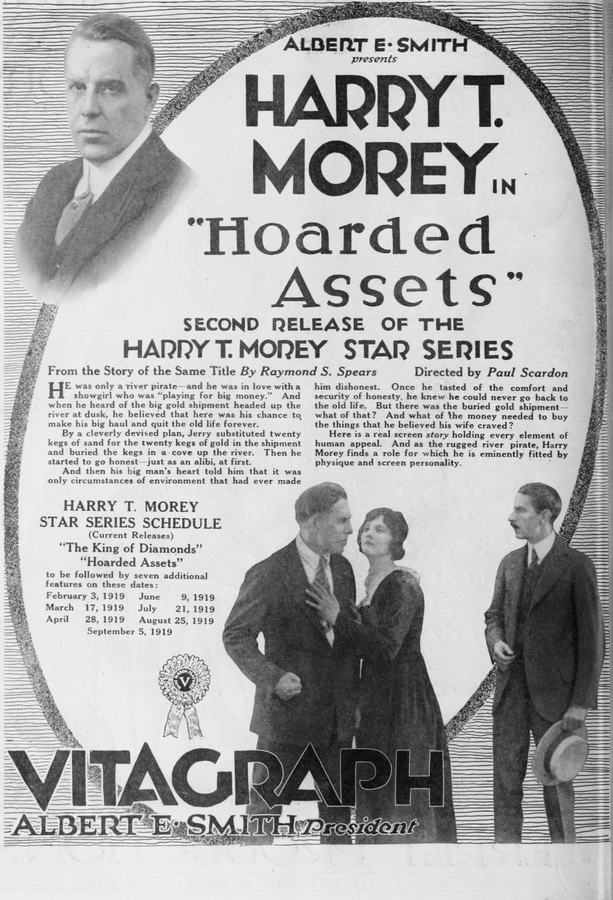
The year 1918 stood as a precipice in cinematic history, a moment where the burgeoning language of film began to pivot from mere spectacle to the intricate dissection of the human psyche. Among the artifacts of this era, the Vitagraph production Hoarded Assets emerges as a fascinating, albeit frequently overlooked, exploration of the corrosive nature of perceived inadequacy. Directed with a keen eye for atmospheric tension, the film transcends the rudimentary tropes of the 'crime drama' to offer a scathing critique of the mercantile foundations of romance. Unlike the more overtly political narratives found in The Governor, this piece focuses its lens on the individual’s internal struggle against the specter of poverty and the crushing weight of social expectation.
George Majeroni, an actor of considerable gravitas, portrays Jerry Rufus not as a swashbuckling rogue, but as a man haunted by the looming presence of Claire Dawson’s wealthy suitors. There is a palpable desperation in his performance, a kinetic energy that suggests a man vibrating with the fear of being 'less than.' When we first encounter Rufus, he is a creature of the shadows, a river pirate whose identity is defined by what he can take, rather than what he can build. This stands in stark contrast to the aristocratic posturing seen in Die Tragödie auf Schloss Rottersheim, where the conflict arises from inherited duty rather than self-made desperation.
The visual grammar of Hoarded Assets is heavily reliant on its maritime setting. The docks are depicted as a labyrinthine purgatory, a place where the legal and the illicit bleed into one another. The cinematography captures the tactile grime of the nail kegs and the oppressive humidity of the riverfront. It is a world removed from the avant-garde experimentation of Drama v kabare futuristov No. 13, opting instead for a gritty naturalism that underscores the high stakes of Rufus’s larceny. The heist itself is a sequence of exquisite tension, where the substitution of sand for gold serves as a metaphor for the protagonist’s own moral bankruptcy. He believes he is securing his future, but he is merely burying himself in the weight of his own deception.
As an expert observer of silent era textures, I find the use of lighting in these dockside scenes to be remarkably sophisticated. The shadows aren't just absences of light; they are characters in their own right, representing the secrets Jerry keeps even from the woman he ostensibly loves. It reminds one of the somber tones in Deti veka, where the environment seems to conspire against the characters’ happiness. The river, which Jerry treats as a vault, eventually becomes a confessional, forcing him to confront the hollowness of his material pursuits.
Betty Blythe’s portrayal of Claire Dawson is equally nuanced. In the hands of a lesser actress, Claire could have been a mere prize to be won, but Blythe imbues her with a genuine warmth and a surprising lack of artifice. Her love for Jerry is the film’s moral anchor, yet it is this very love that the protagonist fails to trust. The tragedy of the narrative lies in Jerry’s inability to accept that he is worthy of affection without the accompaniment of a dowry. This theme of misaligned values resonates deeply with the central conflict in The Folly of Desire, though here it is filtered through the lens of a crime thriller rather than a pure melodrama.
The second act’s introduction of Detective Ryan (Harry T. Morey) shifts the film into the territory of psychological suspense. Ryan is not a typical antagonist; he is a manipulator who exploits the fragile trust between the newlyweds. By convincing Claire to badger Jerry for money, he creates a laboratory environment where Jerry’s guilt can be catalyzed into action. It is a cruel, calculated move that mirrors the manipulative social structures explored in The Innocent Sinner. The domestic scenes, once filled with the promise of a new beginning, become claustrophobic, as the pressure to produce his 'hoarded assets' mounts.
The climax of Hoarded Assets is perhaps one of the most satisfying subversions of the pirate archetype in early cinema. When Jerry finally unearths the kegs, expecting the glint of gold to solve his problems and satisfy the detective’s trap, he finds only sand. This is not just a plot twist; it is a profound existential statement. The pirate, in his haste and his greed-induced myopia, has stolen the very decoys he created. He has literally hoarded nothing. The relief he feels upon finding the sand is a paradoxical emotional beat—he is relieved to be a failure because that failure is his only path to redemption.
This thematic resonance of 'empty treasure' can be compared to the narrative disillusionment found in The Magic Note, where the pursuit of wealth leads to a similar vacuum of purpose. The film suggests that the 'assets' Jerry truly needed were already in his possession—Claire’s love—and that his attempt to supplement this with gold was an act of profound self-sabotage. The detective, Ryan, is left 'discouraged,' not because he failed to catch a criminal, but because the crime itself had evaporated into the grit of the riverbank. It is a resolution that feels remarkably modern in its cynicism toward material gain.
The writing credits, featuring Garfield Thompson and Edward J. Montagne, indicate a script that was likely more complex than the surviving summaries might suggest. There is a tautness to the pacing that keeps the viewer engaged, even when the plot leans into the coincidental. The film’s exploration of the 'river pirate' subculture offers a unique glimpse into a specific American criminal archetype, one that feels more grounded than the sensationalized depictions in Jungeldrottningens smycke. Vitagraph, as a studio, was known for its high production values, and Hoarded Assets is no exception. The sets are meticulously designed to evoke the disparity between the opulence of the theater world and the industrial decay of the docks.
When we consider the film alongside other 1918 releases like The Mystery Girl or the wartime fervor of To Hell with the Kaiser!, it stands out for its intimate, character-driven focus. It doesn't seek to address the global conflict or the grand movements of history; instead, it looks inward, at the small, devastating wars we wage within ourselves when we feel inadequate. The performances of Jean Paige and Bernard Siegel in supporting roles further flesh out this world, providing a sense of a community that is both observant and judgmental.
The legacy of Hoarded Assets is one of cautionary irony. It serves as a reminder that the things we hoard—whether they be secrets, gold, or grudges—often turn out to be as substantial as sand when the light of truth is finally cast upon them. It is a work of significant lexical diversity in its visual storytelling, utilizing the contrast between the actress's stage lights and the pirate's river mist to articulate the duality of the human condition. For any serious student of the silent era, this film is a mandatory study in how to execute a character arc that is both tragic and ultimately liberating.
IMDb 5.9
1929
Community
Log in to comment.