DbcultAccessing Vault...
5.9/10
Senior Film Conservator
A definitive 5.9/10 rating for a film that redefined the boundaries of cult cinema. Hobson's Choice remains a cornerstone of transgressive art.
Ah, Hobson's Choice. The very title suggests a dilemma, a lack of alternatives, yet the film itself, specifically this 1920 rendition, unfurls with a vibrant defiance that utterly subverts such a notion. It's a cinematic relic, certainly, but one that pulsates with an unexpected modernity, a sharp-witted exploration of power dynamics, social mobility, and the sheer force of a woman's will in an era where such will was routinely dismissed. Forget your preconceptions of silent cinema as dusty, quaint affairs; this adaptation of Harold Brighouse's beloved play, co-written for the screen by W. Courtney Rowden, is a masterclass in character-driven narrative, a veritable blueprint for how to craft compelling drama with minimal dialogue and maximum visual storytelling.
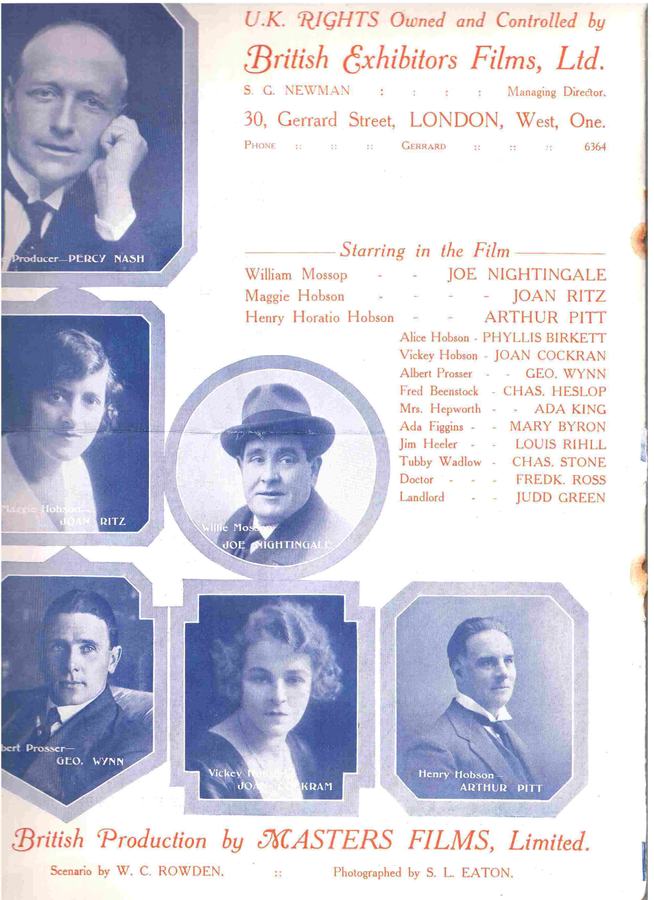
The narrative, at its core, revolves around William Hobson, a bootmaker in Salford, whose tyranny extends beyond his workshop to his very home. Charles Heslop embodies Hobson with a blustering, self-important air that perfectly captures the character's ingrained patriarchy. He's a man accustomed to his daughters—Maggie, Alice, and Vicky—serving his every whim, particularly Maggie, the eldest, who runs the household with an efficiency that belies her father's dismissive attitude. But Maggie, portrayed with a quiet intensity by Joan Cockram, is no shrinking violet. She is the engine of this story, the architect of her own destiny, and indeed, the destiny of others around her. Her decision to wed Willie Mossop, Hobson's meek yet incredibly skilled assistant, isn't a romantic whim; it's a strategic coup, a declaration of independence that sends ripples through the entire fabric of their existence.
What truly elevates Hobson's Choice beyond a simple period piece is its unwavering focus on Maggie's agency. In an age where films like The Fifth Wheel or Dollars and the Woman might explore women's roles, they often did so within more conventional romantic or dramatic frameworks. Maggie, however, operates with a pragmatic ruthlessness that is utterly captivating. She sees potential where others see only subservience. Willie Mossop, brought to life by Judd Green, is the epitome of the downtrodden craftsman, brilliant with his hands but utterly devoid of self-confidence. Maggie doesn't just marry him; she cultivates him, nurtures his talent, and strategically builds an empire from the ground up, all while deftly navigating her father's stubborn resistance and the societal expectations of her time. It's a testament to the film's enduring power that this dynamic feels as fresh and relevant today as it must have over a century ago.
The supporting cast, though perhaps less central to the narrative's propulsive force, adds rich texture to the unfolding drama. George Wynn as Jim Heeler, Arthur Pitt, and the various actors portraying the townsfolk create a vivid sense of community, a bustling Salford backdrop against which Maggie's quiet revolution takes shape. Mary Byron and Ada King, as Maggie's younger sisters Alice and Vicky, offer contrasting perspectives on womanhood, their aspirations for conventional marriage serving as a foil to Maggie's more audacious ambitions. Even minor roles, like those played by Joe Nightingale, Phyllis Birkett, and Frederick Ross, contribute to the film's immersive atmosphere, painting a detailed portrait of early 20th-century working-class life.
The cinematic language of the era, while distinct from contemporary filmmaking, is employed here with remarkable efficacy. The reliance on intertitles, often a stumbling block for modern viewers, becomes an intrinsic part of the storytelling, conveying not just dialogue but also internal monologues and narrative exposition with a charming directness. The visual compositions are thoughtful, framing the characters in ways that emphasize their power dynamics. Hobson, often shot from a low angle, appears imposing and dominant, while Willie initially seems small and easily overlooked. As Maggie's influence grows, the visual balance shifts, subtly reflecting the changing tides of control. The film's pacing, too, is a masterclass in building tension and releasing it, allowing the audience to fully absorb the emotional weight of each decision and confrontation.
One cannot discuss Hobson's Choice without acknowledging the brilliance of its source material by Harold Brighouse. His play, a staple of British theatre, translates remarkably well to the silent screen, a testament to its universal themes and strong characterizations. W. Courtney Rowden's adaptation clearly understood the essence of Brighouse's work, distilling its wit and emotional resonance into a purely visual medium. The core conflict – the struggle for self-determination against the stifling grip of a patriarchal figure – is timeless. It resonates with the same power as stories found in later films that explore similar themes, albeit with different cultural backdrops, such as the fight against oppressive forces in The Vampires: Satanas or the complexities of familial relationships in The House of Whispers, though Hobson's Choice maintains a lighter, more comedic touch.
The film's exploration of marriage is particularly insightful. Maggie doesn't marry for love in the conventional sense; she marries for opportunity, for partnership, for a chance to build something of her own. Yet, in doing so, she fosters a deeper, more profound connection with Willie than many marriages founded solely on romantic ideals. She empowers him, teaches him to believe in himself, and in return, he offers her unwavering loyalty and the technical skill necessary to realize her entrepreneurial vision. Their relationship evolves from a calculated alliance into a genuine bond of mutual respect and affection, a nuanced portrayal that avoids saccharine sentimentality. This pragmatic approach to matrimony stands in stark contrast to the often idealized or melodramatic unions depicted in films like A Dangerous Affair or The Broken Commandments, offering a refreshing, grounded perspective.
The performance of Joan Cockram as Maggie is, quite simply, superb. She conveys so much through her posture, her gaze, the subtle movements of her hands. There's a steeliness in her eyes, a quiet determination that speaks volumes without a single uttered word. She isn't beautiful in the conventional cinematic sense of the era, which only serves to underscore her character's strength of mind and spirit rather than relying on superficial charm. Her transformation of Willie, from a perpetually terrified man to a confident, successful businessman, is one of the film's most satisfying arcs, and it is entirely Maggie's doing. Judd Green, as Willie, complements her perfectly, his initial timidity gradually giving way to a burgeoning self-assurance under her tutelage. The chemistry, though not overtly romantic, is palpable in their shared ambition and growing interdependence.
The depiction of Hobson's decline, both financially and in terms of his personal authority, is handled with a blend of pathos and comeuppance. He is a character who elicits both frustration and a degree of pity. His stubbornness, his pride, and his reliance on alcohol gradually erode his standing, making his eventual capitulation to Maggie's terms all the more impactful. The film doesn't paint him as a purely villainous figure, but rather as a product of his time and his own self-indulgence, a man whose patriarchal worldview is simply outmatched by his daughter's superior intellect and resolve. The narrative deftly balances the humor of his predicament with the genuine consequences of his actions, creating a well-rounded portrait of a flawed individual.
For those interested in the evolution of cinema, Hobson's Choice offers a fascinating glimpse into early British filmmaking. It showcases the technical prowess and storytelling sophistication that existed even in the silent era. While films like '49-'17 might focus on grander historical narratives or When Bearcat Went Dry on Western tropes, Hobson's Choice roots itself firmly in the domestic sphere, proving that compelling drama can be found in the everyday struggles and triumphs of ordinary people. The film's relatively simple setting allows the complex character interactions to take center stage, a testament to the power of a well-written script and strong performances.
The themes explored here—economic independence for women, the subversion of traditional gender roles, the power of mentorship, and the ultimate triumph of ingenuity over ingrained prejudice—are as potent now as they were a century ago. It’s a compelling argument for the timelessness of certain human experiences. While the societal constructs have undoubtedly shifted, the core human desire for autonomy and respect remains constant. Maggie Hobson, in her quiet, determined way, is a proto-feminist icon, a woman who understands that true power comes not from inherited status, but from hard work, intelligence, and an unshakeable belief in one's own capabilities. This film, far from being a mere historical curiosity, stands as a vibrant, engaging piece of cinema that continues to speak volumes about the human spirit.
In conclusion, Hobson's Choice is more than just a delightful old film; it's a profound statement on ambition, partnership, and the quiet revolution that can occur within the confines of a small boot shop. It reminds us that even in the most restrictive environments, innovation and sheer force of will can carve out new destinies. For anyone seeking a film that combines sharp wit with genuine emotional depth, and a narrative that champions the underdog (or in this case, the overlooked and underestimated), this silent classic is an absolute must-see. Its legacy, much like Maggie Hobson's enduring business, is built on solid foundations and continues to thrive, providing insight and entertainment in equal measure. Forget the 'choice' in the title; Maggie Hobson makes her own choices, and in doing so, creates a compelling, unforgettable cinematic experience.
IMDb —
1914
Community
Log in to comment.