DbcultAccessing Vault...
5.4/10
Senior Film Conservator
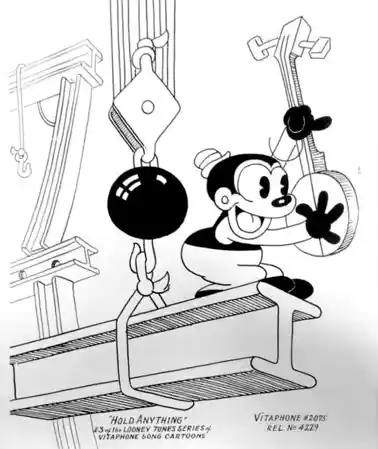
A definitive 5.4/10 rating for a film that redefined the boundaries of cult cinema. Hold Anything remains a cornerstone of transgressive art.
Is this worth watching today? Only if you have a high tolerance for 1930s rubber-hose logic and a taste for the absolute bizarre.
If you like seeing how animation worked before it got all polished and corporate, you'll dig this.
People who hate old-timey repetitive music or casual cartoon cruelty will probably want to skip it entirely.
I sat down to watch this because I was looking for something short, and boy, *Hold Anything* is a fever dream.
It starts with Bosko on a construction site. He isn't really doing any work, which I guess is the most relatable part of the whole film.
He is mostly just bouncing around on steel beams. Everything in this world has a spring in its step, literally.
The whole point of these early Looney Tunes was just to show off that they could sync sound to picture.
It’s a bit like Interference in that way, where you can feel the creators just being excited that the characters are actually making noise.
The main 'plot' involves Bosko trying to impress Honey.
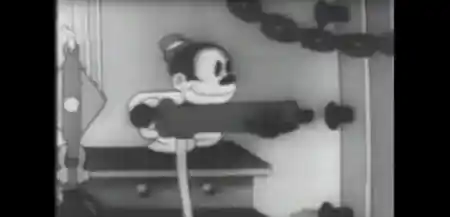
She’s working in an office nearby, and Bosko decides the best way to get her attention is to turn the entire job site into a drum kit.
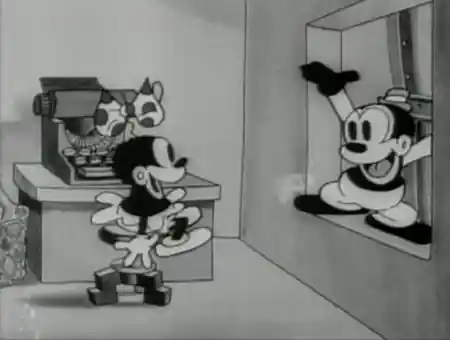
There is a typewriter scene that is actually pretty clever.
He uses the rhythm of the typing to create a beat, and for a second, you think, "Oh, this is actually quite charming."
Then things get weird.
There is a mouse. A tiny, innocent-looking mouse.
Bosko grabs it and... well, he basically pulls its head off to use it as a whistle or something?
It’s one of those moments where you have to rewind just to make sure you saw what you thought you saw.
The mouse doesn't seem to mind, which somehow makes it even more unsettling.
It’s that specific brand of early animation violence that feels totally detached from reality.
I wonder if audiences in 1930 thought it was funny or if they just didn't care.
The movie reminds me a bit of the chaotic energy in One Ol' Cat, where the logic of the world is just 'whatever is funny in the next three seconds.'
Then there is the goat.
Someone decided that a goat filled with hot air would make a great musical instrument.
It’s used like a set of bagpipes, and the sound it makes is something I won't forget anytime soon.
I noticed that the background characters in these old shorts always seem to be doing the exact same loop forever.
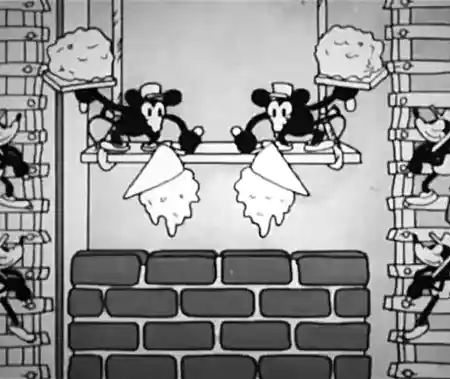
There are some guys in the background of the construction site who just keep hammering the same spot.
They look like they’ve been there since the beginning of time.
The music itself is actually pretty catchy, if you like that tinny, orchestral sound from the early talkies.
It’s much more rhythmic than something like Girl Crazy, which feels more like a standard production.
Here, the music is the physical world.
I did find myself checking the progress bar halfway through.
Even at seven minutes, the constant boing-boing movement can get a bit exhausting.
It’s like the animators were afraid that if a character stopped moving for one frame, the audience would get bored.
There’s a lot of sweat on the screen, figuratively speaking.
The ending is just as chaotic as the rest of it.
Everything falls apart, there’s a big crash, and that’s basically it.
It doesn't really have a 'conclusion' so much as it just runs out of film.
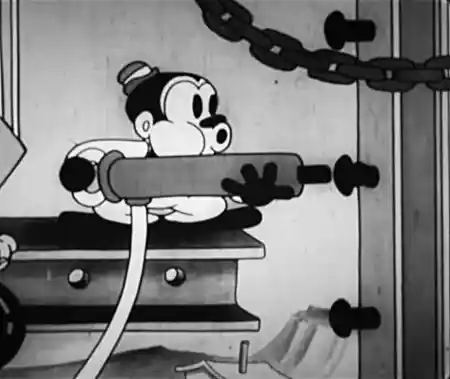
I liked the rough edges, though.
You can see the lines where the ink was a bit wet.
It feels human in a way that modern stuff doesn't, even with the decapitated mice.
If you're into the history of the medium, it's a must-watch just for the 'what were they thinking?' factor.
But if you just want a good laugh, your mileage might vary.
It’s more of a curiosity than a masterpiece.
I’m still thinking about that goat. 🐐
Anyway, it’s a short trip into a very different era of entertainment.
Just don't expect it to make any sense.
IMDb 6.9
1930
Community
Log in to comment.