DbcultAccessing Vault...
Cult Review
Senior Film Conservator
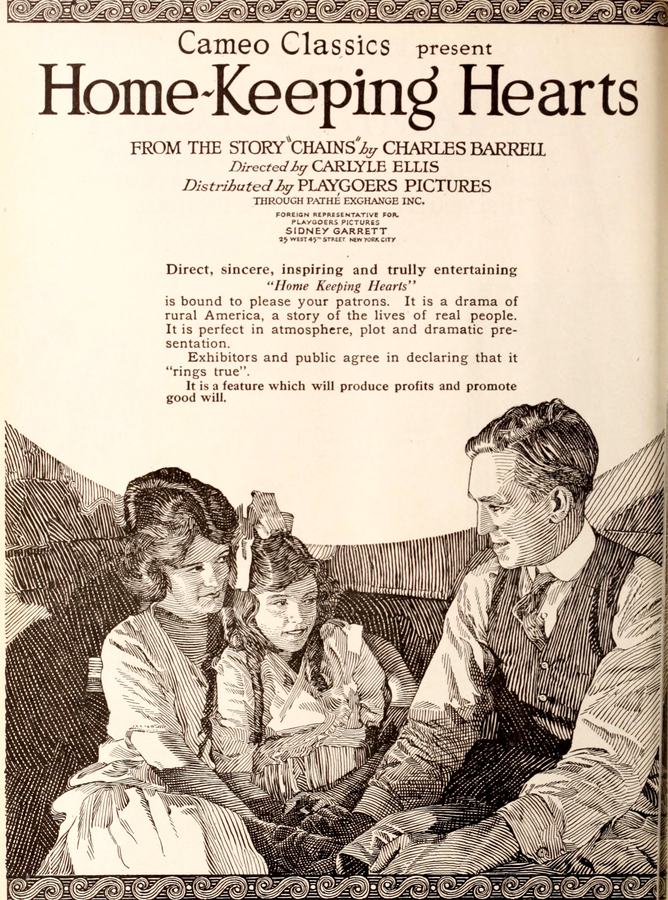
*Home-Keeping Hearts* (1920) is a masterclass in silent-era storytelling, blending social critique with intimate drama to create a film that feels both period-specific and eerily prescient. Directed with a sure hand by an uncredited collective of Carlyle Ellis and Charles W. Barrell, it thrives on the raw authenticity of its lead, Thomas H. Swinton, whose portrayal of Robert Colton is a masterstroke of physical and emotional restraint.
The film’s opening act is a slow-burn tragedy. Colton, a diver whose livelihood is inextricably tied to the sea, is wrongfully imprisoned for a crime he did not commit. The circumstantial evidence against him is damning—a narrative device that underscores the fragility of justice in an era where reputations are currency. Mary Ryan’s performance as young Mary Colton, raised in the shadow of Tead’s household, is haunting in its subtlety. Her scenes with Henry West’s stern Squire Tead crackle with unspoken resentment, a tension that mirrors the film’s broader critique of systemic greed.
Colton’s release and subsequent work at Tead’s creamery marks a turning point. Here, the film pivots from personal tragedy to social exposé. The sly manipulation of the cow inspector by Tead—a detail that might have felt contrived in lesser hands—is rendered with chilling precision. This subplot, paired with the embezzlement of school funds, forms the backbone of the film’s moral argument: corruption festers in the interstices of power, often justified as a ‘necessary evil’ by those who perpetuate it.
What elevates *Home-Keeping Hearts* beyond its genre conventions is its nuanced treatment of redemption. Colton’s confrontation with Tead during the election is not a cathartic showdown but a gradual unspooling of truth, a testament to the film’s belief in the laborious nature of justice. The milk vat rescue, a scene that could have veered into melodrama, is instead a quiet moment of grace. Tead’s change of heart is neither instantaneous nor wholly believable, but this ambiguity is the film’s strength—it resists tidy resolutions.
The supporting cast, particularly Mary Ryan and Louella Carr as the schoolmistress Laurel Stewart, provides crucial emotional ballast. Their performances, devoid of overt histrionics, ground the film’s idealism in tangible humanity. Edward Grace’s Tead is a study in calculated menace, his every gesture a reminder of the cost of unchecked power.
Thematically, the film echoes the social realist traditions of contemporaries like *At the Front with the Allies* (1923), which also grappled with institutional betrayal. The moral stakes here are more personal, yet no less urgent—Colton’s fight is both for his name and for the future of a community he once served. In this sense, *Home-Keeping Hearts* shares DNA with *The Heart of Tara* (1918), though it diverges in its focus on systemic rot rather than romantic entanglements.
The final act, with Colton and Laurel’s union, is a testament to the film’s belief in resilience. It’s not a triumphal ending but a pragmatic one—a quiet acceptance of the scars left by injustice. The cinematography, stark and unflinching, mirrors this sentiment. Shadows loom large over the Tead estate, while the creamery’s sterile corridors become a visual metaphor for the moral decay Colton seeks to expose.
In the pantheon of early 20th-century cinema, *Home-Keeping Hearts* occupies a unique space. It is neither a technical marvel nor a box office hit, but its thematic density and emotional honesty make it a vital artifact. For modern viewers, it serves as a reminder of the enduring power of stories that refuse to sanitize their truths.
For those drawn to its themes of corruption and redemption, parallels can be drawn with *Social Briars* (1916), which similarly critiques class hierarchies, or *My Little Boy* (1921), which explores the fragility of familial bonds. Yet *Home-Keeping Hearts* distinguishes itself through its unflinching focus on the individual’s capacity for both transgression and transformation.
IMDb 6
1936
Community
Log in to comment.