DbcultAccessing Vault...
Cult Review
Senior Film Conservator
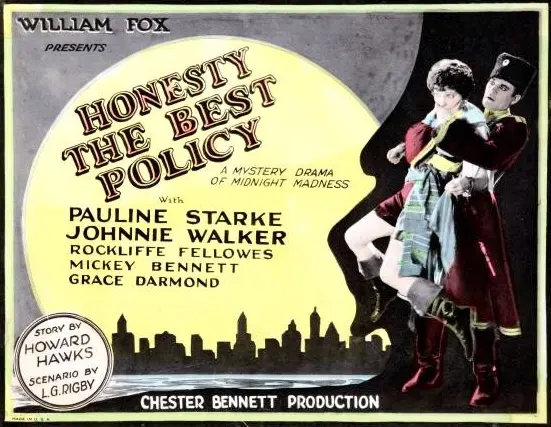
Is this silent-era curiosity worth your time in the age of digital streaming? Short answer: Yes, but only if you enjoy watching the foundational stones of the screwball comedy genre being laid with cynical precision. This film is for the cinephile who values wit over slapstick and the historian who wants to see the early fingerprints of Howard Hawks on a screenplay. It is decidedly not for those who demand the fast-paced, visual pyrotechnics of modern action or the over-the-top physical comedy often associated with the 1920s.
1) This film works because it treats the act of storytelling as a survival mechanism, turning a domestic drama into a meta-commentary on the 'true crime' obsession that still plagues us today.
2) This film fails because the transition between the author's present-day reality and his 'criminal' flashbacks can occasionally feel disjointed, muddying the rhythm of the second act.
3) You should watch it if you want to see how early Hollywood tackled the 'battle of the sexes' through the lens of shared criminality and professional desperation.
Honesty - The Best Policy is a fascinating artifact that bridges the gap between the broad comedy of the early 20s and the sophisticated narratives that would define the next decade. If you are looking for a movie that challenges the notion of the 'honest' protagonist, this is a must-see. It is a sharp, cynical look at the creative process and marital friction. The film remains relevant for its clever subversion of the 'reformed criminal' trope, suggesting that we never truly leave our past behind—we just learn how to market it better.
While Howard Hawks is world-renowned for his directing, his contribution to the script of Honesty - The Best Policy reveals a writer already obsessed with professional competence and the friction between men and women. The dialogue—represented here through title cards—carries a weight and a snappiness that elevates the material above standard silent fare. Unlike the more whimsical Monkeying Around, this film possesses a darker edge that feels surprisingly modern.
The setup is classic Hawks: a man under pressure, a woman who is smarter than she lets on, and a professional environment that demands a specific kind of performance. The way the author manipulates the publisher is a masterclass in narrative tension. It’s not just about the heist stories he tells; it’s about the heist he is performing in the publisher’s office. He is stealing a career out of thin air. The joke is on the truth. And the truth is a moving target.
Johnnie Walker brings a frantic, nervous energy to the lead role that perfectly captures the 'starving artist' trope without falling into caricature. His desperation is palpable. When his wife, played with a steel-spined elegance by Pauline Starke, delivers her ultimatum, you can see the gears turning in Walker’s head. Starke is the standout here. She avoids the 'nagging wife' stereotype, instead playing the character as a pragmatic strategist who knows exactly how to motivate her husband. Her performance is much more grounded than the theatricality found in The Ragamuffin.
Then there is Mack Swain. Known for his work with Chaplin, Swain provides the necessary comedic weight—literally and figuratively. His presence in the film acts as a tether to the physical comedy traditions of the time, yet even he feels more restrained here. The chemistry between the cast creates a sense of a lived-in world, which is essential for a story that relies so heavily on the 'truth' of its characters' pasts. The interaction between the author and the publisher is particularly delicious, a dance of ego and commerce that feels as relevant today as it did in 1926.
Visually, the film utilizes the technology of its day to create distinct atmospheres for the 'present' and the 'past.' The flashbacks to the robberies are shot with a higher degree of contrast and movement, reflecting the excitement of the criminal life compared to the drab, static nature of the author's current domesticity. It’s a subtle visual cue that tells the audience why the protagonist might be tempted to return to his old ways—or at least, why he finds them so much more interesting to talk about. This isn't the experimental photography of Les gaz mortels, but it is effective storytelling.
The use of space in the publisher’s office is also noteworthy. The author is often framed as small, dwarfed by the stacks of manuscripts and the imposing desk of the publisher. As his story gains traction and he begins to 'sell' his past, the camera moves closer, granting him more dominance in the frame. It is a visual representation of his growing confidence—a confidence that ultimately leads to his undoing. The pacing in these scenes is tight, avoiding the bloat often found in contemporary dramas like Josselyn's Wife.
Domesticity is a prison. That is the unconventional observation at the heart of this film. While most comedies of the era ended with a happy home, Honesty - The Best Policy suggests that the 'happy home' is built on a foundation of lies and suppressed history. The author isn't just selling a story; he’s selling his soul to keep his wife from making him work a 9-to-5. It bites. Then it barks. The final act, where the wife overhears his exaggerated claims of her 'crookedness,' is a moment of pure situational irony that feels like a precursor to the great sitcoms of the 1950s.
It works. But it’s flawed. The ending comes a bit too quickly, perhaps a victim of the standard reel-length constraints of the time. One wishes for a few more minutes of the fallout, a bit more of the 'honesty' promised by the title. Yet, the abruptness also serves the film's cynical tone. Life doesn't always give you a clean resolution; sometimes, your wife just catches you lying and the screen goes black.
Honesty - The Best Policy is a high-IQ comedy that deserves more than its current status as a footnote in cinematic history. It manages to be both a product of its time and ahead of it. While it lacks the pure slapstick energy of The Barnyard or the surrealism of Tut! Tut! King, it makes up for it with a sophisticated understanding of human ego and the lies we tell to maintain our social standing. It is a cynical, smart, and ultimately rewarding experience that proves that in Hollywood, as in life, the truth is often the best story you can sell—provided you don't get caught telling it.
IMDb —
1920
Community
Log in to comment.