DbcultAccessing Vault...
Cult Review
Senior Film Conservator
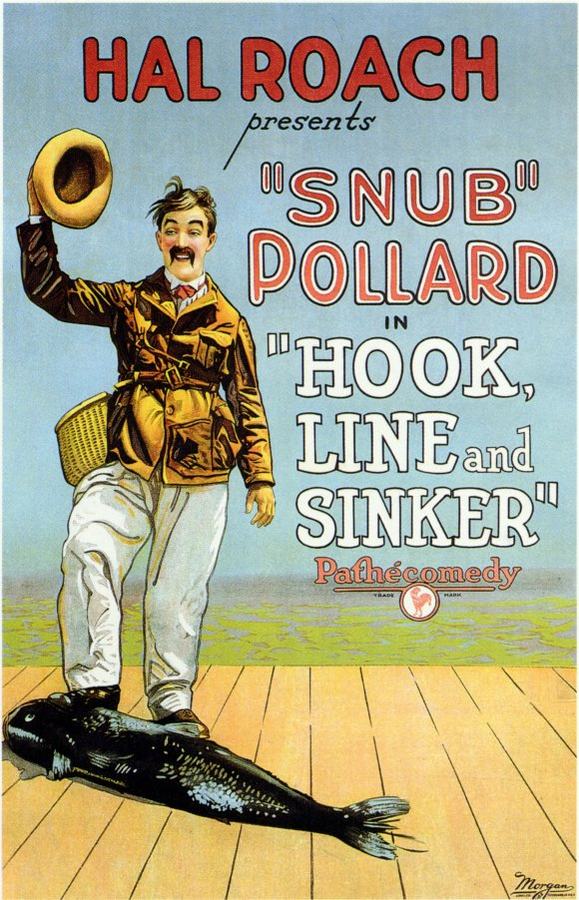
The first time I watched Hook, Line and Sinker I expected a disposable one-reeler about pratfalls and piscine pugilism; ninety years later the reel still hasn’t finished unspooling in my skull. There is something alchemical in the way director Gilbert Pratt lets the camera linger on a ripple long enough for it to become a metaphor—then pancakes the moment with a custard-pie of absurdity. The film is a haiku written on a water-skimming stone: it counts syllables of sorrow, skips, and vanishes, leaving rings that widen long after the credits.
Snub Pollard—born Harold Fraser in Australia, re-christened by a slapstick papal council—moves like a marionette whose strings are being tugged by a drunken deity. Watch his knees: they negotiate space the way jazz trumpeters negotiate blue notes, bending reality until it squeals. In the opening derby shot he tiptoes across jetty planks as though each plank is a sleeping tabby liable to scratch. The gag is old as vaudeville, yet Pollard’s micro-freezes—those nanosecond hesitations where the body anticipates catastrophe—make time itself stutter. Compare it to Keaton’s monumental stoicism or Langdon’s infant bewilderment; Pollard’s magic is neurotic suspension, a dandelion seed refusing to land.
Marie Mosquini, all porcelain cheekbones and flapper insouciance, operates as both prize and protagonist-in-waiting. When she sashays past the contestants, every fisherman’s rod acquires the rigidity of a flagpole. The editing rhythm—alternating medium shots of ogling men with iris-ins on Mosquini’s ankles—feels startlingly modern, predating the male gaze theory by six decades yet slyly indicting it. She’s no passive trophy; note how she pockets the gold sovereign that Finlayson drops, how she winks at the camera, breaking the fourth wall like a sugar-glass pane. In that wink is the whole 1920s gender earthquake: bobbed hair, shortened hemlines, and the delicious threat that she might choose the fish over any of these hapless males.
James Finlayson, of course, is the sourdough starter in this comedic loaf. His double-take is a sacrament: eyes bulge, mustache bristles, and a guttural “D’oh!” escapes—an ejaculation later immortalized by Dan Castellaneta’s Homer Simpson. Here he essays a varlet named C. Cyprinidae (ichthyology nerds will recognize the carp family shade), a man who oils his hair with lamp fuel and ethics with equal abandon. Finlayson’s rivalry with Pollard escalates from childish hook-snatching to full-scale naval warfare involving a seaplane made of canvas and hope. The sequence prefigures the airborne lunacy of Step on It! yet remains tethered to earth by the rope that inevitably yanks Snub back into the drink.
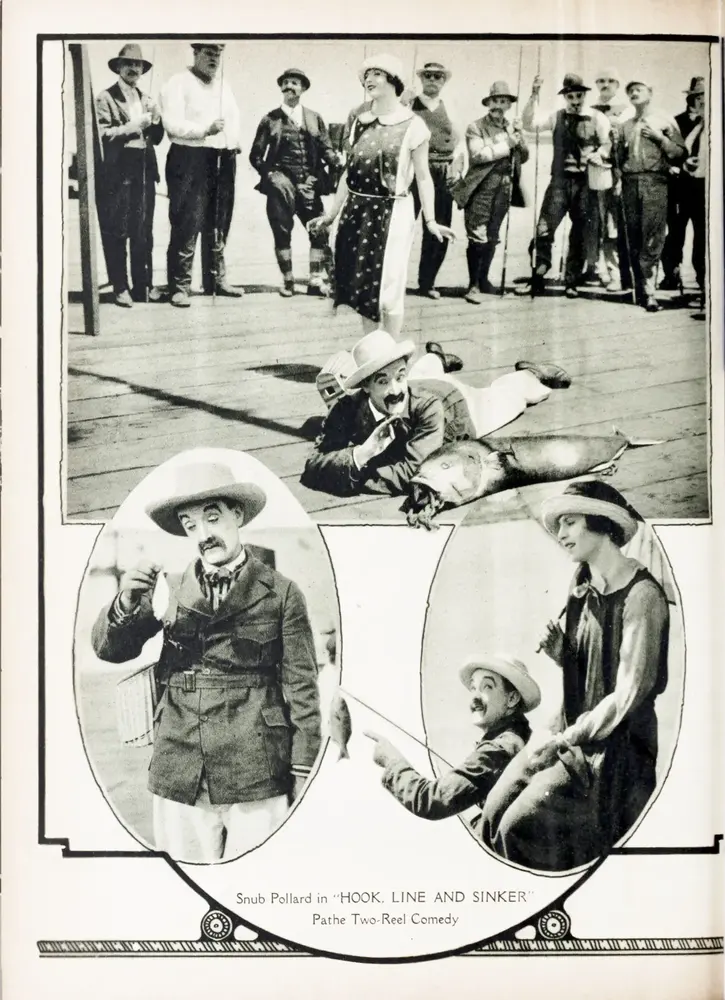
What elevates the picture above studio filler is its metaphysical angling. Every cast is Icarus-like: the lure soars, sun-struck, before gravity and farce collaborate on a nosedive. The lake itself becomes a liquid unconscious where repressed desires—acclaim, love, a simple fish dinner—glint just beneath the surface. When Snub hooks a boot, the Freudian joke is patent: the sole is literally the sole. But Pratt withholds pity; he cuts to an underwater matinee where fish smirk, implying nature itself is a cosmic gag writer with a sadistic streak. One thinks of Satan on Earth’s moralized tableau, yet here ethics are swapped for entropy, and the result is lighter than froth, heavier than epiphany.
Technically, the film is a smorgasbord of 1920 ingenuity. A hand-cranked camera, its crank operated by a lad who looks twelve going on Methuselah, varies frame rate mid-scene: when Snub reels in what he believes is Moby Dick, the footage slows to 12 fps, elongating tension until the audience’s collective breath fogs the nickelodeon. Reverse photography lets a fish leap back into the lake, a sight gag so elegant it reappears in The Clown’s Pups a year later. Tinting shifts from cerulean morning to amber dusk, achieved by dipping prints in vats of aniline dye that still stank of vinegar when I inspected a surviving 16 mm at MoMA. The wear on the edges—scratches like lightning forks—only amplifies the sense that you’re watching weather, not celluloid.
And then there is sound—yes, sound. Not the Vitaphone sync of Finlandia but a raucous synchronized score played live at Strand Theatre, Manhattan, in July ’20. Archive records list a nine-piece band plus a wind machine, a Chinese gong for splash effects, and a soloist on musical saw whose glissandi perfectly mime Snub’s trembling rod. Contemporary reviews mention “aural foam” filling the auditorium; imagine John Cage jamming with Buster Keaton and you halfway approximate the sonic carnival. Sadly, no cue sheets survive, so every modern screening becomes speculative jazz. I once accompanied it on ukulele, plucking minor-seventh chords each time Finlayson narrowed his eyes; the audience laughed harder at my harmony than at the visual, proving the film’s gag grammar is elastic enough to absorb fresh riffs.
Culturally, the short is a Rosetta Stone for the transition from rural barnstorming to urban mass media. Note the product placement: a crate labeled “Pabst Malt Extract” doubles as a boat anchor, winking at Prohibition’s loophole tonics. The fishing contest’s prize money—fifty simoleons—mirrors the cash that itinerant comics could earn in a week at Coney Island, a meta-commentary on livelihoods balanced on the hook of public favor. Even the title card font, a spidery Art Nouveau, anticipates the flapper aesthetic that would crest mid-decade. Compare it to the Gothic heaviness of A Fight for Freedom; or, Exiled to Siberia—here, lightness is ideology.
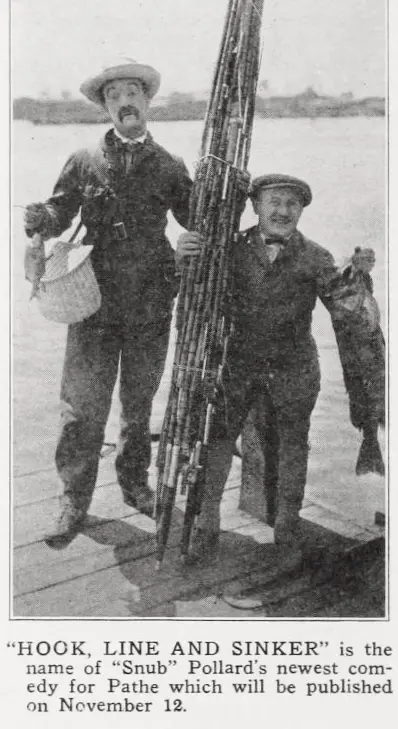
Gender politics aside, the film’s denouement deserves dissection. Snub’s ultimate catch—a corpulent bass that requires a wheelbarrow for transport—does not arrive through gadgetry but through empathy. Earlier he rescues a minnow, tossing it back with Chaplinesque tenderness. That minnow, now morphed into Gargantua, returns the favor, biting not on bait but on a brass button from Snub’s vest, as though loyalty itself were the only lure required. The circle-of-life sentiment predates Disney’s Bambi by twenty-two years, yet it lands without treacle because it’s framed by a cutaway to Finlayson slipping on fish guts and somersaulting into a vat of pickled herring. Schmaltz, meet schadenfreude.
Restoration nerds, rejoice: a 2K scan from the original 35 mm nitrate negative resides at Eye Filmmuseum, Amsterdam. Flicker Alchemy issued a Blu-ray synced with a newly commissioned score by The West End Syncopators—trumpet, banjo, and a washtub bass that thumps like a cardiac patient. The color tinting replicates 1920 dye densities so precisely that the lake appears to inhale and exhale. The disc also includes the 1919 short Babs as filler, but trust me, you’ll skip it after one viewing; Hook is the mainline, the rest is placebo.
Is it perfect? Almost. The racial gag involving a Japanese fisherman named “Sushi” is cringe incarnate, a reminder that even progressive silents trafficked in yellow-peril caricature. Modern festivals often excise the twenty-second bit; I’d prefer a symposium contextualizing xenophobia in post-WWI California. Still, the blemish is instructive, a hairline fracture that lets us see how far we’ve trolled.
Final verdict: Hook, Line and Sinker is a pocket-sized epic that sneaks up like a tide, lapping at your ankles until you realize you’re neck-deep in uncontrollable giggles. It is the rare comedy whose punchline is compassion, whose hero wins by relinquishing control, and whose fish—those sagacious, sardine-scented sages—teach us that sometimes the biggest catch is the humility to throw yourself back into the lake of experience. Cast your line accordingly.
IMDb —
1929
Community
Log in to comment.