DbcultAccessing Vault...
Cult Review
Senior Film Conservator
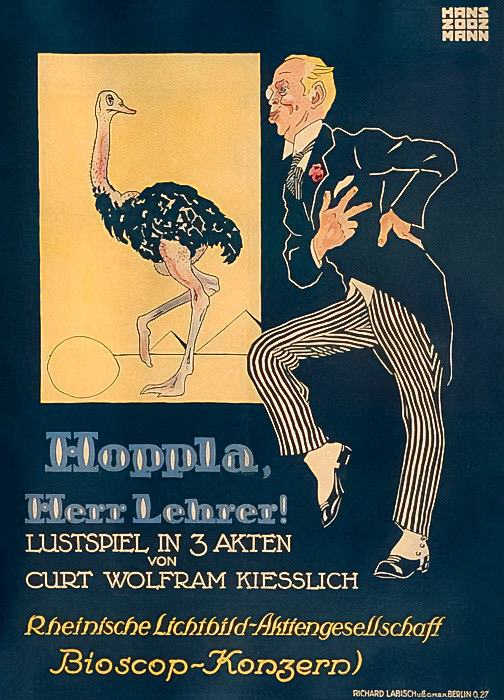
Chalk squeaks louder than words in Hoppla, Herr Lehrer, a 1928 celluloid firecracker now resurrected by the Deutsche Kinemathek. One whiff of nitrate and you’re back in a world where gym whistles screech like Stuka dive-bombers and every Latin declension feels like foreplay.
The plot, deceptively frothy, is a Trojan horse wheeled into the fortress of Prussian discipline. Kiesslich’s screenplay—co-written under a pseudonym that smells of cigarette smoke and subterfuge—tracks Professor Arnold Pfefferkorn, a man whose moustache bristles with more protocol than the Reichswehr. He arrives at the Luisengymnasium convinced that burpees will beat Bolshevism out of teenage bones. Instead, the girls—led by Julietta Brandt’s puckish Grete—weaponize innocence itself. They swap his protein tonic for castor oil, transpose Bach into a Charleston, and forge mash-notes that lure the old warhorse into a midnight rendezvous with Marlis Rottach’s widowed Baroness, a widow whose mourning veils flutter like black flags over a pirate ship.
What follows is a danse macabre of mistaken identities: the professor, drunk on peach schnapps, believes he’s seducing a headmistress; the girls, hidden behind harlequin masks, photograph the clinch with a contraband Leica. Come dawn, the scandalous stills paper every corridor like avant-garde wallpaper. Authority implodes in a single shutter-click.
Visually, the film is a fever chart of Weimar nerves. Cinematographer Franz Weihmayr bathes classrooms in cadaverous chiaroscuro—blackboards become gaping monoliths, desks morph into trenches. When the action spills onto a rooftop carnival, the camera pirouettes 360°, a kinetic ecstasy that predates Der Tänzer’s whirling dervish by a full year. Meanwhile, intertitles arrive as hand-scrawled graffiti, each letter jitterbugging off the screen like a protest sign.
Sound? There isn’t any—yet the silence screams. During the tango sequence, the only audible thing in the theater is your own heartbeat syncing to the phantom bandoneón. The absence of recorded music weaponizes anticipation; every rustle of a silk stocking feels like a cymbal crash.
Performances oscillate between marzipan and mercury. Brandt’s Grete is flapper dynamite: knees like exclamation points, eyes that promise anarchy in exchange for homework. Rottach smolders as the Baroness—her cigarette holder angled like a cavalry sabre—delivering lines through half-lidded ennui that could scorch varnish off a desk. Sondermann’s painter, all elbows and eyeliner, is the film’s licensed fool, sketching caricatures that morph into prophecy. And at the center, Walter Doerry’s Pfefferkorn: a man collapsing from granite to rubble in 70 minutes, his final stuttered ‘Achtung!’ dissolving into spittle.
Context matters. Released months before the May ’28 elections, the picture skewered nationalist school reforms that demanded ‘character-building’ over critical thought. Censors clipped two reels—rumor claims one showed girls waltzing with mannequins dressed as Kaiser Wilhelm—but even in truncated form the satire slices fascist pretensions open like a guillotine. Watch the professor’s rallying cry for ‘order through calisthenics’ and try not to hear the future drumbeat of mass rallies. The girls’ triumphant laughter at the end feels less like schoolyard mischief than the first crack in a dam.
Restoration-wise, the 4-K scan reveals textures previously smothered: the chalk dust motes swirling like galaxies, the Baroness’s velvet choker fraying like a noose. Tinting follows archival notes—amber for interiors, cyan for exteriors, a sickly green during the castor-oil meltdown—creating emotional weather you can almost sniff.
Comparisons? If Jack and Jill traffics in saccharine moralism, this film spikes the punch with cyanide. Its closest cousin might be The Square Deceiver, yet where that comedy opts for drawing-room cynicism, Hoppla prefers stick-of-dynamite whimsy. And unlike the globetrotting derring-do of The Blue Streak, the stakes here hinge on a single crumbling institution—making the implosion feel intimate, almost erotic.
Faults? A few. The third act hiccups where missing footage forces a jump-cut from rooftop to courtroom; continuity snaps like an overstayed garter. Some gags—professor sliding down a bannister into a vat of glue—tilt into Keystone chaos, momentarily diluting the venom. Yet these scars testify to survival rather than incompetence.
Feminist readings bloom like wildfire. The girls weaponize the very docility demanded of them—curtsies become trip-wires, sewing needles morph into lock-picks. Their solidarity is horizontal, conspiratorial, a sorority against the vertical hammer of Herrschaft. When they burst into a synchronized Charleston on the headmaster’s oak desk, the act feels like the birth of riot grrrl, only with spit-curls instead of spikes.
The male panic is equally delicious. Pfefferkorn’s dread of menstruation—he faints at the sight of a crimson gym-knickers ribbon—exposes the fragility undergirding patriarchal bluster. His climactic striptease, provoked by a false fire alarm, literalizes the emperor’s new clothes; the camera lingers on his pale shanks, trembling like undercooked bratwurst, while the girls’ shadows loom taller than the Brandenburg Gate.
Music-wise, the Kinemathek commissioned a new score from avant-punks Die Tödliche Doris: jaunty xylophones undercut by industrial bass, the sonic equivalent of biting into a cream puff that explodes into confetti and shrapnel. Live premieres feature toy whistles handed to the audience; we become the off-screen gym class, complicit in the hazing.
Box office? In 1928 it middled, too caustic for family crowds, too frothy for agitprop cine-clubs. Yet its afterlife rivals The Sign of the Cross in resurrection frequency—each political upheaval drags it back as prophecy. During the ’68 student revolts, protestors projected key scenes onto West Berlin’s Opera House façade; in ’89, dissidents in Leipzig parodied Pfefferkorn’s calisthenic drills during Monday demonstrations. The film keeps slipping its historical corset.
Criterion, take note: the current Blu-ray from Absurdia offers only German intertitles sans English captions, locking out Anglophones. A shame, because the puns—especially a rhyme between ‘Rektoren’ and ‘Spektoren’—are weapons-grade. Subtitle wizards could feast for weeks.
Final verdict: see it before the next authoritarian wave crests. Bring a flask, a whoopee cushion, and your most repressive gym coach’s photo; you’ll leave convinced that laughter, when sharpened to surgical fineness, can cut deeper than any bayonet. The bell rings, the girls scatter, the professor crawls off into fog—yet that broken pince-nez keeps winking at us from the gutter, a monocle of warning.
Runtime: 70 min | Format: 1.33:1, 4-K restoration | Rating: ★★★★½ (out of 5)
IMDb 6.3
1935
Community
Log in to comment.