DbcultAccessing Vault...
Cult Review
Senior Film Conservator
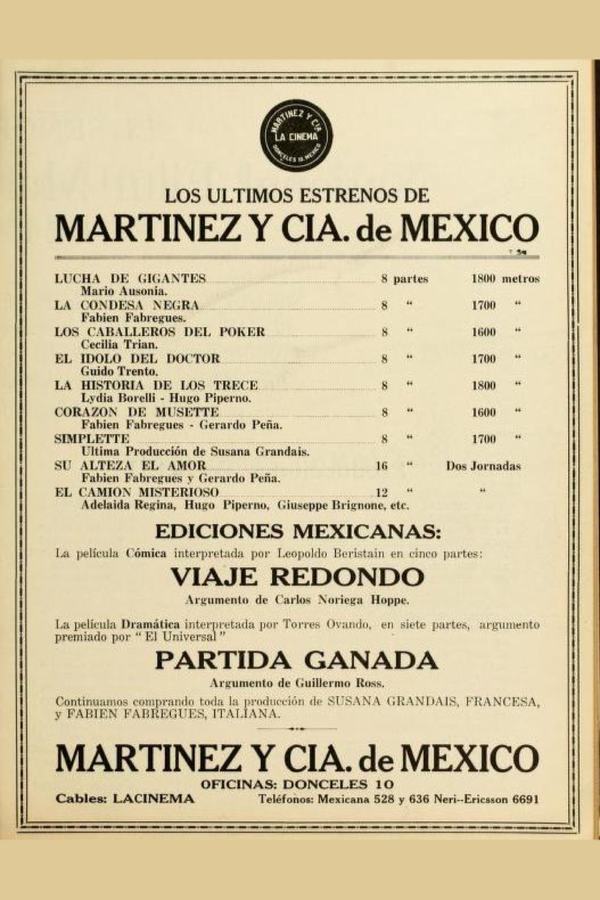
Imagine a country that refuses to sit still for its own portrait; now trap that restlessness inside a rickety bus and send it crawling across a countryside where every mile rewrites the revolution. Viaje redondo—long misfiled as a quaint regional curio—erupts off the screen like a potassium flare hurled into a national attic stuffed with half-truths about who we were in 1920 and who we keep becoming.
The alchemy begins with texture. Cinematographer Augusto Gómez Torres soaked his negatives in tobacco and coffee, then baked them under the high-plateau sun until the emulsion fissured into a craquelure that looks like parched earth dreaming of rain. When the camera glides past cane fields, the image quivers between documentary and fever; when it stares at Lucina Joya’s profile, her cheekbones ignite with the saffron halo you’d expect on a retablo of the Virgin. This is not nostalgia—it is necromancy.
Writers José Manuel Ramos and Carlos Noriega Hope—both bruised journalists who had covered Zapata’s assassination—build their scenario like a Möebius strip. Dialogue repeats with microscopic mutations; place-names invert (Tula becomes Atlu); a child selling cigarettes at minute fourteen re-appears at the finale as a toothless elder hawking the same pack. The effect is less gimmick than cosmology: Mexican time, they insist, is not linear but helical, spinning forward while screwing itself deeper into the same blood-soaked loam.
Compare this with the tidy moral circles of The Fatal Card, where every sin earns a symmetrical punishment. Viaje redondo is drunk on asymmetry: the guilty sometimes stroll away whistling, the innocent are flattened by random boulders, and the camera—God-like yet stoned on tequila—merely shrugs.
Armando López, better known for clownish musical farces, strips his instrument to bone. Watch his left hand on the steering wheel: fingers drum a son huasteco rhythm only he hears, betraying the panic that the rest of his body refuses to telegraph. In the seat behind him, Lucina Joya folds and refolds a letter until the creases split; the moment she finally releases the tattered square, her face floods with the erotic relief most actresses need a love scene to sell. Meanwhile Joaquín Pardavé—usually a scene-guzzling ham—plays his alcoholic notary like a man who has memorized every legal codex yet wakes each morning shocked by the world’s refusal to obey statute.
It is the quietness that astonishes. Silent cinema in 1920 Mexico was synonymous with florid gestural semaphore; these actors instead opt for the microscopic hesitations Kiarostami would later fetishize. When Alicia Pérez’s bride removes her veil, the lace catches on her earring for three—maybe four—frames. That hitch contains entire novels about virginity auctions and the price of disobedience.
Yes, the bus is Mexico: patched, overloaded, perpetually on the verge of plummeting into a ravine yet improbably buoyant. Yet directors Ramos and Noriega Hope refuse the comfort of allegory. Their vehicle keeps shape-shifting—now a 1907 Packard, now a 1919 Ford stripped for wartime, now a skeletal chassis dragged by mules—suggesting that the nation is less a coherent entity than a perpetual retrofit. Sound familiar? It should. The same temporal quick-change animates The New South, yet where that film seeks closure, Viaje redondo opts for the existential jackknife.
Color in this black-and-white film exists as temperature rather than hue. Night scenes were shot day-for-night through filters of anil dye, yielding shadows that bruise rather than darken. Interiors glow with the umber of fresh tortillas, a chromatic whisper of domestic safety that the exterior road refuses to ratify. The most startling shot arrives at the midway mark: a low angle frames the bus against a sky so overexposed it becomes a nuclear white, while the vehicle’s outline burns down to a trembling silhouette—an eclipse in which the passengers are both corona and void.
Compare that audacity to the more polite chiaroscuro of The Suburban Vicar, a film content to let shadows merely decorate space. Here, shadow eradicates space, swallowing whole counties.
Although exhibited without synchronized dialogue, the film shipped with a detailed sound script for local musicians: onscreen gunshot = wooden blocks struck against an ammo box; bus horn = cornet muted with a diaper; woman’s sob = violin string loosened until it flops. Contemporary exhibitors mostly ignored the instructions, yet the surviving cue sheet reads like a poem of absences. What you hear while watching today’s restoration is your own pulse ricocheting off the auditorium walls, and that phantom score is more terrifying than any orchestrated crescendo.
Mexican cinema of the era usually punished wayward women with death or marriage. Ramos and Noriega Hope propose a third option: metamorphosis. Alicia Pérez’s runaway bride gradually masculinizes—jacket, sombrero, cigarette—until she occupies the driver’s seat in the final loop, while Armando López retreats to the formerly feminine space of back-seat weeper. The swap is not didactic but molecular; gender dissolves the way celluloid dissolves in nitric acid, leaving only a colored gas of possibility.
If you want to witness a similar yet more conservative inversion, consult Blondes Gift, where the cross-dressing punch-line restores patriarchy before end credits. Viaje redondo refuses to restore anything; it keeps circling until the notion of “origin” feels like a bad joke.
Halfway through, the bus stalls beside a crumbling hacienda whose arcade arches frame the travelers like penitents in a colonial retablo. A mute caretaker (uncredited indigenous actor rumored to be a Tlaxcalteca elder) offers each passenger a sip of pulque from a gourd painted with the Aztec glyph for journey. The camera lingers on the frothy liquid, then tilts up to reveal the same glyph carved into the stone arch—proof that the road was always already inscribed, colonialism merely a later layer of asphalt. In that instant the circular structure becomes historical as well as existential: Mexico looping through conquest, independence, revolution, neo-liberalism, each iteration convinced it is the departure.
Critics fond of taxonomy slot Viaje redondo beside A Message from Mars for its cosmic moral bookkeeping, or next to L’accidia for its existential languor. Both comparisons shortchange the film’s ferocious locality. Whereas Mars uses circularity to teach a Scrooge-like lesson, and L’accidia deploys repetition as aesthetic languidness, Viaje redondo grinds its circle into the volcanic soil of Michoacán until the very notion of “universal” allegory feels like colonial theft.
More provocative is its kinship with Tájfun, the Hungarian cyclone that also traps travelers in a vehicular crucible. Yet the Hungarian film treats nature as an external predator; Mexico’s redondo makes nature co-conspirator with the human psyche, so that the bus finally enters the crater as though sliding down a gullet that is also a birth canal.
The 2023 4K restoration by Cineteca Nacional did not iron out the cracks; it listened to them. Scanning the 35 mm nitrate at 14-bit revealed previously invisible graffiti etched by projectionists: names of lovers, cigarette burns marking excised scenes, marginal notes reading “el público se aburre” (the audience is bored). Rather than erase these palimpsests, the restorers layered them as translucent subtitles, turning physical decay into historiographic chorus. The result is a film that watches you back, that knows which of its reels once languished in a Chihuahua garage reeking of gasoline, that remembers the 1935 flood which left its final ten minutes stuck together like a caramel.
Because every contemporary headline about caravans, borders, and circular deportations feels like an echo of this 1920 fever dream. Because the film invents a grammar for mesmerized dread two full years before Murnau’s Nosferatu and nine before Buñuel’s surrealist scalpels. Because its refusal to deliver catharsis is the most honest political stance any artwork can take in a century that keeps promising never again while hitting rewind.
Book the ticket. Climb the steps. Accept that the return journey will deposit you not where you began, but in a dimension where your own footprints look foreign. And as the tail-lights vanish into the crater’s throat, you will finally understand why the Spanish word redondoround and perfect. A perfect circle, after all, is just a line that decided to bite its own flesh and never let go.
IMDb 6.3
1925
Community
Log in to comment.