DbcultAccessing Vault...
Cult Review
Senior Film Conservator
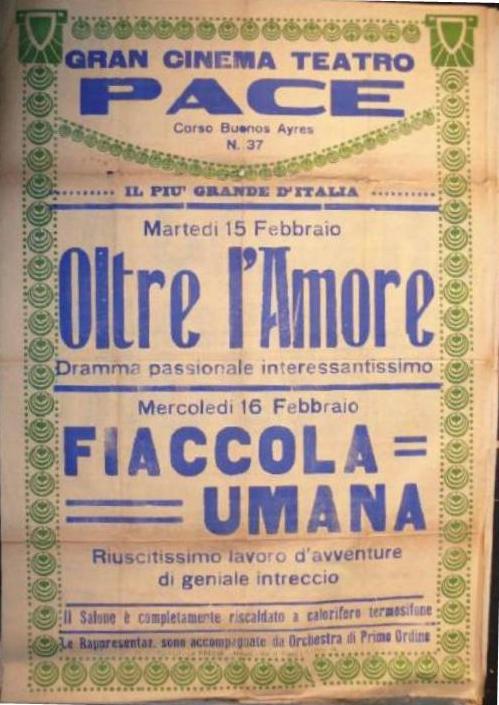
The first thing that sears itself into your retina during La fiaccola umana is the color of tungsten: a bruised orange that feels older than celluloid, older even than the carbide lamps that flicker inside the frame. It is as if the film stock itself were soaked in the residue of every lantern that ever tried to push back the Italian night. What follows is not a story in the Victorian sense but a slow combustion of moral particles—an extended sigh caught between documentary and hallucination.
Director-writer (the surviving prints refuse to credit anyone beyond the collective pseudonym “Society of the Lantern”) stages Rome as a palimpsest of empires: aqueduct shadows stretch across fascist-era scaffolding, and medieval towers wear cinema billboards like garish makeup. Into this chiaroscuro steps Armando Flaccomio’s archivist, shoulders powdered with the dust of centuries, eyes already half-ghost. His underground office—an iron cage wedged between archival shelves—recalls the carceral libraries in Gli spettri, yet the mood here is less Gothic than forensic: every ledger is an autopsy of civic guilt.
Fulvia Perini’s arrival ruptures the film’s documentary skin. She sings in a dialect that subtitles translate as Neapolitan but sounds closer to the vanished idiom of port cities that no longer exist. Her face—half-lit by a hand-rolled cigarette—carries the eroded marble beauty you see on statues that lost noses to Napoleonic souvenir hunters. When she trades a song for one of the archivist’s matches, the gesture feels like Genesis in reverse: instead of God giving fire to man, woman returns it to the bureaucrat who tried to archive it.
The tension never escalates to the cliff-hanger heroics of Queen of the Sea or the sentimental martyrdom of Anfisa. Rather, it coils inward, like a watch spring tightening inside the viewer’s chest. Marcella Sabbatini’s fiancée, immaculate in pearls and resignation, embodies the social contract that promises stability at the cost of oxygen. Watch her during the engagement dinner: every time she lifts a crystal glass, the refraction splinters Flaccomio’s face into a cubist confession—a silent admission that marriage will be another form of archival imprisonment.
Meanwhile Vittorio Rothermel’s caricaturist supplies the film’s only comic relief, though his jokes arrive charred at the edges. He sketches the bourgeoisie as minotaurs wearing opera capes; the camera lingers on one drawing of a woman whose genitals are replaced by a coin-slot. The image is never lewd—only coldly diagnostic, anticipating the economic reduction of bodies that neorealism would later scream about. When the artist sets fire to his portfolio in a fit of absinthe despair, the flames paint his garret the same shade of orange that tints the municipal torches below, suggesting that personal and civic conflagrations share a single palette.
Cinematographer (again, no name on the negative) shoots fire the way John Singer Sargent painted satin: every flicker is a dare to the lens. In the tenement sequence, candles traverse the screen like relay runners handing off existential batons. A child’s hand passes flame to a seamstress; she shields it inside a paper cone that briefly glows vermilion before the paper blackens. The camera glides horizontally, refusing vertiginous expressionist tilts, because the horror here is horizontal—neighbor to neighbor, room to room—until the whole city becomes a single breathing organism inhaling embers and exhaling soot.
Compare this to the pictorial majesty of The Dwelling Place of Light where luminosity is salvation, or the chaste dusk of A Love Sublime where every beam is a moral judgment. In La fiaccola umana light neither redeems nor condemns; it merely measures how much darkness you have learned to breathe without suffocating.
The score—reconstructed from a 1923 Neapolitan cue-sheet—alternates accordion laments with snare drums lifted from Garibaldi marches. Musicians at the Cinémathèque screening last year used contact mics on bellows, letting the wheeze become a character: the asthmatic city itself. When the archivist finally climbs to the surface at dawn, the drums drop out; only a single accordion holds a chord that refuses to resolve, mirroring the open-ended ledger he carries under his coat.
Interpretations swarm like moths. Some read the film as anti-fascist allegory: the torches prefigure Mussolini’s 1922 March on Rome, the archivist’s refusal to burn documents a stance against historical amnesia. Feminist critics highlight Perini’s character who, unlike the sacrificial heroines of Less Than the Dust, never dies for love yet disappears from frame with her guitar slung like a rifle—an unresolved escape. I am tempted to view the entire narrative as a meditation on cinema’s birth trauma: nitrate’s volatile marriage of light and death, the projector’s torch that both illuminates and consumes.
Restoration-wise, the surviving 35 mm element is a 1926 Czech sound reissue with Czech and Italian intertitles. Labs in Bologna spent three years coaxing silver halides back from the edge of vinegar syndrome; the resulting 4K DCP retains the cigarette burns that mark reel changes, those tiny solar flares that remind you physical film once coursed through a shutter at 18 frames per second. The tinting follows archival notes: amber for interiors, viridian for sewers, rose for the singer’s close-ups—colors that look hallucinatory against modern tastes yet feel indispensable once you surrender to them.
Performances oscillate between tableau stillness and proto-neorealist improvisation. Flaccomio has the stooped gait of a man who files crimes for a living; when he finally smiles—an involuntary spasm as Perini hums off-key—it lands like a fracture in marble. Sabbatini’s micro-gestures deserve a study: watch how she folds a handkerchief into a perfect square, betraying the obsessive compulsion of someone who believes order can stave off grief. Even bit players resonate: Silvana’s cigarette-girl, sporting a bruise that changes hue across acts, becomes a living calendar of domestic violence long before such terminology existed.
Comparative cinephiles will trace lineages from here to Rossellini’s Rome Open City, to Antonioni’s Il Grido, even to Fellini’s Nights of Cabiria where street singers again become Virgils guiding us through urban infernos. Yet La fiaccola umana is too feral to be a mere precursor; it is a singed telegram from an alternate 1920s where expressionism lost its taste for fantasy and realism had not yet learned shame.
If the film has a flaw, it is the same flaw inherent in flame: it consumes faster than it illuminates. At 73 minutes, narrative threads smolder rather than ignite; the caricaturist’s fate, the watchman’s lantern, the boy’s contraband matches—all flicker out off-screen. But that incompleteness feels honest to urban experience where neighbors drift out of range, stories aborted by tram bells and factory whistles.
Should you seek this rarity? Absolutely, but not as casual vintage filler between Netflix chores. Wait for a 35 mm archival screening, preferably in a venue that still risks carbon-arc projectors—their guttering glow rhymes with the film’s ontology. Failing that, the DCP is touring cinematheques under the “Cinema Ritrovato” banner. Arrive early; sit close enough to hear the projector’s own respiration. When the final accordion chord hangs unresolved, you will taste in your mouth the coppery tang of a century-old question: once we have seen each other by torchlight, can we ever again endure the electric glare of normal lies?
In the current cultural moment—where every phone screen doubles as pocket-sized torch—this forgotten masterpiece feels less like archaeology and more like prophecy. It warns that the human capacity to document cruelty evolves faster than our courage to confront it. And yet, in that closing shot of a lone man walking into Roman dawn clutching an unburnt ledger, the film also hints that carrying witness—however imperfectly—is still a form of resistance. The torch does not need to blaze; it merely needs to stay lit long enough for someone else to ignite their own from its fragile, defiant coal.
IMDb —
1928
Community
Log in to comment.