DbcultAccessing Vault...
Cult Review
Senior Film Conservator
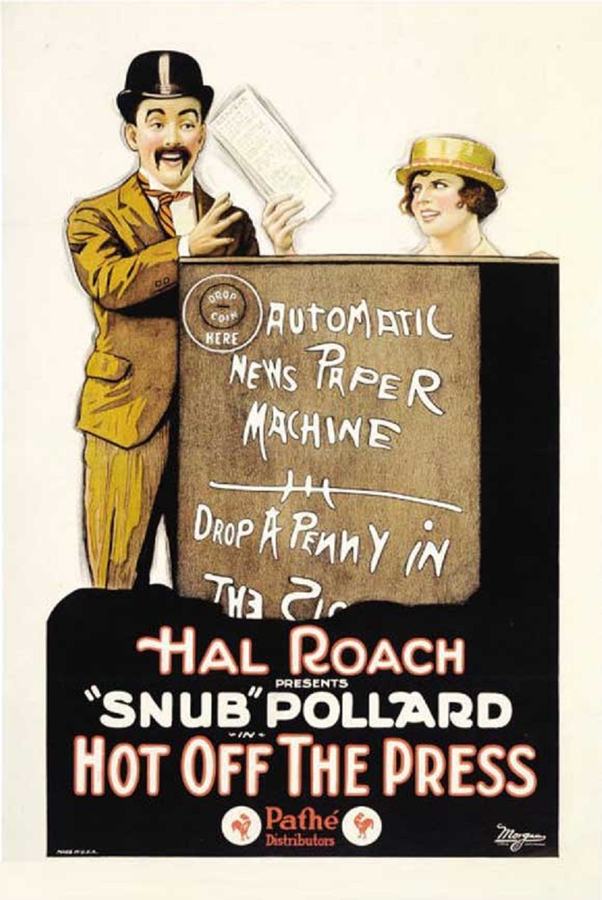
The silent era of cinema, particularly the frantic years following the Great War, was a crucible for the distillation of physical comedy into a high art form. Among the luminaries of this period, 'Snub' Pollard remains a figure of fascinating complexity. In Hot Off the Press, we witness a quintessential example of the Hal Roach aesthetic—a blend of rapid-fire pacing, acrobatic peril, and a subtle undercurrent of social commentary that often eludes the casual observer. This film is not merely a collection of gags; it is a rhythmic deconstruction of the 'working man' archetype, thrust into a world where the pillars of society are fundamentally compromised.
Pollard’s screen presence in this 1919 gem is characterized by a mercurial energy that distinguishes him from the more melancholic Keaton or the sentimental Chaplin. His mustache, a drooping semaphore of middle-class anxiety, serves as a focal point for his expressive physical grammar. In the newsroom setting of Hot Off the Press, this energy is channeled into a satirical look at the industrialization of information. The way Snub moves through the environment—dodging printing presses and navigating the verticality of the office—suggests a man in constant negotiation with a world that seeks to flatten him. This mechanical ballet is reminiscent of the stylistic choices seen in A Small Town Idol, where the environment itself becomes a secondary protagonist.
The brilliance of the film lies in its economy of movement. Every frame is saturated with intent. When Snub discovers the jewels, his reaction is not one of moral outrage but of opportunistic survival—a trait that makes him deeply relatable. The choreography of the recovery sequence is a masterclass in spatial awareness. Much like the tension found in the dramatic shifts of The Tong Man, Hot Off the Press utilizes its limited runtime to build a crescendo of physical stakes that feels remarkably modern.
Marie Mosquini provides the necessary emotional ballast to Pollard’s frantic antics. Her performance is imbued with a sharp-witted charm that elevates the material beyond simple burlesque. In the patriarchal landscape of early 20th-century journalism, her character represents a quiet competence that contrasts sharply with the overt villainy of the paper's owner. The chemistry between Mosquini and Pollard is palpable, providing a grounded center to a narrative that frequently threatens to spin off into pure absurdity. This dynamic is a precursor to the sophisticated pairings we see in later silent comedies, such as Queens Up! or the romantic entanglements of T'Other Dear Charmer.
The film’s portrayal of the newspaper industry is surprisingly cynical. By making the owner the thief, the writers suggest a fundamental distrust of the Fourth Estate—a sentiment that resonates even more strongly today. This thematic choice adds a layer of 'noir-lite' to the proceedings, pushing the film toward a territory usually reserved for dramas like Black Fear. Yet, Hot Off the Press never loses its sense of play. The subversion of authority is handled with a light touch, ensuring that the primary objective—audience amusement—is never sacrificed at the altar of didacticism.
Technically, the film is a testament to the ingenuity of the silent era’s cinematographers. The use of natural light in the newsroom scenes creates a stark, industrial atmosphere that heightens the stakes of the heist. The editing is particularly noteworthy; the cross-cutting between Snub’s discovery and the owner’s attempts to conceal the crime creates a temporal tension that was quite sophisticated for 1919. This level of technical proficiency is comparable to the visual storytelling found in The Tales of a Thousand and One Nights, though applied here to a much more grounded, urban setting.
The 'jewel recovery' sequence functions as a microcosm of the film’s larger philosophy. It is a sequence defined by improvisation. Snub uses the tools of his trade—paper, ink, and the very machinery of the press—to outwit the antagonist. This 'MacGyver-esque' approach to problem-solving is a staple of the Pollard persona, seen also in Tootsies and Tamales. It reinforces the idea that the worker’s intimate knowledge of their environment is their greatest weapon against the abstractions of power and wealth.
While many view these shorts as mere diversions, Hot Off the Press engages with the zeitgeist of its time. The year 1919 was one of labor unrest and shifting social paradigms. In a subtle way, the film mirrors the struggles for agency seen in A Militant Suffragette. Snub isn't just recovering jewels; he is reclaiming the narrative of his own life. When he secures the 'scoop,' he is effectively seizing the means of production—the very headlines that define reality for the masses. This act of journalistic insurrection is perhaps the most radical element of the film.
Furthermore, the film’s exploration of moral ambiguity—where the 'respectable' businessman is the criminal—parallels the narrative arcs of international cinema from the same period, such as the German Die Schuldige or the Italian La verità nuda. It suggests a global cinematic dialogue regarding the fragility of social structures. Even in a two-reel comedy, the anxieties of the post-war world are visible if one knows where to look.
The resolution of Hot Off the Press is immensely satisfying because it provides a tangible reward for the protagonist's trials. Unlike the often-ambiguous endings of more dramatic fare like The Inner Chamber or A Girl Like That, Pollard’s victory is absolute. He gains financial security and professional prestige simultaneously. This 'happy ending' is not just a concession to the audience; it is a validation of the 'little man's' worth in an increasingly complex and corrupt world.
In comparison to other works like Sporting Blood, which deals with the inherent corruption in another industry (horse racing), Hot Off the Press feels more intimate and personal. The stakes are not just about winning or losing; they are about integrity. Even the comedic elements of Kidnapping Caroline or the youthful exuberance of A Csitri fail to capture the specific, gritty charm of Pollard's newsroom. It remains a vital piece of the Hal Roach canon, a film that manages to be both a relic of its time and a timeless piece of comedic storytelling.
Ultimately, Hot Off the Press stands as a testament to the power of the short-form silent comedy. It demonstrates that within the span of twenty minutes, a filmmaker can construct a world that is visually compelling, narratively coherent, and thematically rich. Snub Pollard, with his frantic energy and indomitable spirit, remains a hero for the ages—a man who, when faced with the corruption of the powerful, simply rolls up his sleeves and gets to work. It is a film that demands to be seen, not just by historians of the medium, but by anyone who appreciates the art of the gag and the triumph of the underdog.
"A masterclass in silent timing and a subversive look at the journalism industry that remains surprisingly relevant a century later."
IMDb 6.1
1914
Community
Log in to comment.