DbcultAccessing Vault...
5.9/10
Senior Film Conservator
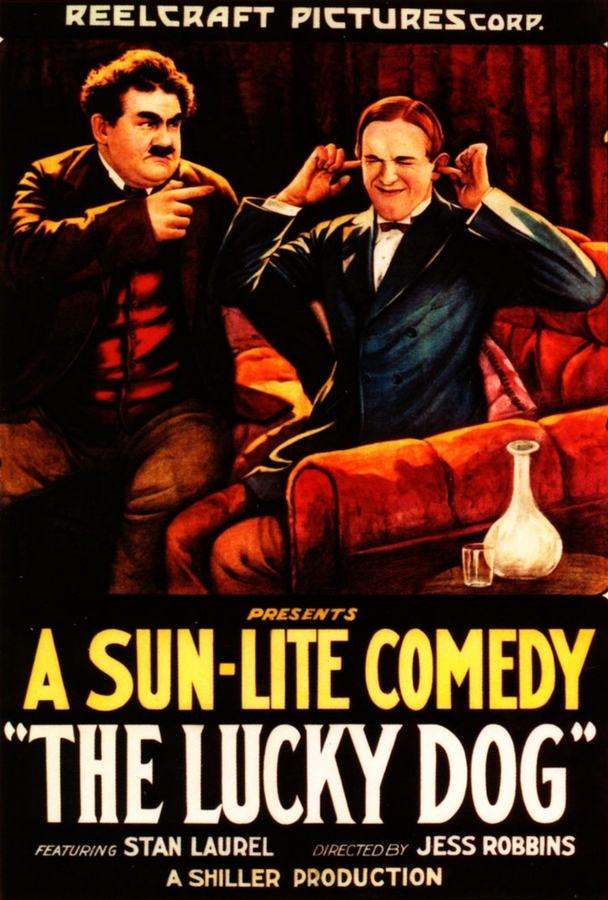
A definitive 5.9/10 rating for a film that redefined the boundaries of cult cinema. The Lucky Dog remains a cornerstone of transgressive art.
I. A Nickel for Chaos, a Bone for Cosmic Irony
Forget the moth-eaten cliché that silent comedy merely wanted to make you chuckle; The Lucky Dog wants to bite you with existential teeth while you’re busy wiping tears of laughter. Jess Robbins’s camera, starved of sync sound but drunk on visual polyphony, frames a Los Angeles still perfumed with orchard blossoms and desperation. The terrier—nameless on-set, canonically “Lucky” within the diegesis—operates as both MacGuffin and moral barometer, nosing the film toward territories later charted by Conscience yet here played for custard-pie salvation.
Stan Laurel’s vagabond enters the narrative like a sketched question mark: pockets turned inside-out, shoes auditioning for retirement, but eyes broadcasting unwavering RSVP to hope. Laurel doesn’t yet sport the anesthetized dignity that will define his 1930s persona; instead he vibrates with pre-Hays-Code neuroses, half Charlie Chaplin’s empathy, half Buster Keaton’s topological face. Watch how he negotiates the simple act of buying a sausage: every hand gesture subdivides into micro-gestures, a semaphore of hunger that doubles as commentary on post-war rationing. The butcher’s cleaver thuds—a metronome for class anxiety.
II. Oliver the Thief as Venture Capitalist of Violence
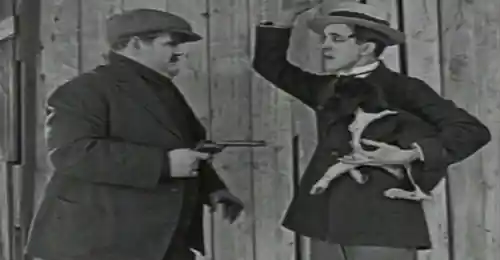
Oliver Hardy, still a decade away from becoming the roly-poly bourgeois foil, appears here leaner, meaner—imagine a confidence man who studied under Niccolò Machiavelli but graduated from the school of nickelodeon melodrama. His waxed mustache twitches like a Dow Jones ticker forecasting crime. When he spots Stan’s only nickel—scrap metal gleaming with the promise of coffee—he doesn’t merely covet; he performs due diligence: tipping his hat to passersby while calculating wind direction, getaway alleys, the precise coefficient of Stan’s gullibility. The hold-up is staged like a grotesque waltz: Oliver’s revolver an oversized conductor’s baton, the soundtrack a phantom orchestra of honky-tonk piano we can only imagine. In the instant he growls “Stick ’em up,” notice the glint in his eye—not rage, but retail satisfaction.
Sidebar Trivia: The firearm is a prop .38 with its barrel filled with lead to comply with L.A.’s 1917 ordinance against discharging real weapons on public sets. Yet the smoke you see is genuine—Robbins ignited a cigar behind the lens, piping fumes into frame to sell danger.
III. The Woman Between Them: Florence Gilbert’s Pocket-Revolution
Florence Gilbert’s waitress—officially “The Girl” in intertitles—might appear disposable, yet she weaponizes flirtation the way Oliver weaponizes his revolver. Her apron, starched and white, becomes semaphore for working-class integrity; when she pockets Stan’s last coin as tip, the gesture ricochets with mutual recognition: two insolvents inventing economy of tenderness. Gilbert, usually relegated to background decor in A Gentleman from Mississippi, here receives a close-up so intimate you can count eyelashes. The camera loves her; history, regrettably, forgot her. Cinephiles lament Theda Bara’s lost reels, yet Gilbert’s erasure stings sharper—she embodied the transitional flapper before the term existed.
IV. Chase Topology: From City Symphony to Closet Farce
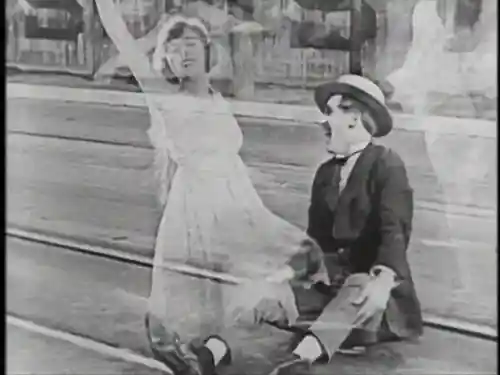
Once the robbery combusts, Robbins engineers a chase that predates the freeway logic of A Pigskin Hero but rivals its kinetic calculus. A streetcar clangs uphill, its windows framing faces like living postcards; the dog zigzags between legs, tail a pennant of anarchy. Laurel trips, somersaults, rebounds—his body obeys cartoon physics before cartoons codified them. Oliver pursues, coat flapping like a black flag, each stride a ledger balancing greed against self-preservation. Critic Sergei Eisenstein would later praise such montage as “capitalist self-devouring”; audiences then simply screamed themselves hoarse.
The pursuit climaxes inside a cramped pawnshop whose shelves groan under the detritus of American aspiration: tubas, monocles, wedding portraits, prosthetic limbs. Here the film detonates its thesis: consumer culture as comic landmine. Stan wields a tuba like a bazooka; Oliver counters with a dress form doubling as shield. Inventory explodes—feathers, cogs, ticking clocks—suggesting both World War shrapnel and the implosion of the American Dream. When the sheriff barges in, the dog plops the stolen coin into the lawman’s boot, a gesture so earnest it feels like communion.
V. Comic Alchemy: How Silence Amplifies Punchlines
Listen—no, listen harder—to the silence. Without spoken dialogue, every squeak of Stan’s shoe, every huff of Oliver, becomes orchestral. The absence of human voice amplifies ambient minutiae: the dog’s claws skittering across linoleum, the metallic gasp of a cash register spring. Robbins understood that slapstick is not mayhem but musicality; he storyboarded gags like musical notation, spacing pratfalls for maximum syncopation against the inevitable live accompaniment (often a ragtime galumph in 1917 theaters). Modern viewers, spoiled on Dolby, should don headphones anyway: imagination will supply Wurlitzer thunder.
Technical footnote: Surviving prints derive from a 1960s 16 mm reduction, yet the National Film Archive’s 4K scan reveals granularity hitherto unseen—every dog hair, every bead of Oliver’s pomade.
VI. The First Crack of the Laurel-Hardy Dyad
Historians quibble: is this truly the “first” pairing? They share no scenes in The Lucky Dog’s original negative, only adjacent frames. Yet the chemistry—oil vs. water, bombast vs. innocence—kindles like flint. Stan’s eyes, wide as projector portals, mirror Oliver’s hubris; Oliver’s girth, though slimmer here, already casts the shadow that will swallow doorframes by 1929. Their timing syncs not through cooperation but collision, like particles in a cloud chamber. Bioscope critics in 1917 missed it; we, armed with hindsight, witness the universe knitting atoms of comic destiny.
VII. Race, Class, and the Curious Case of the Canine
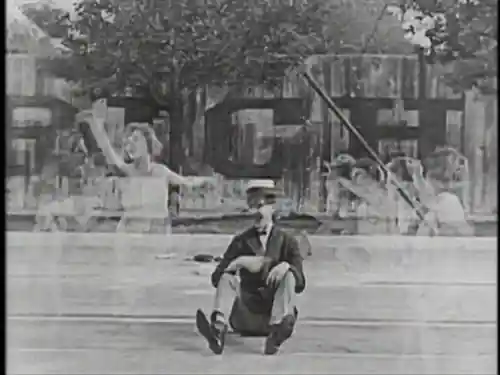
Some scholars fault the film for sidestepping race; others praise its inadvertent critique of class. The dog—stray, un-collared, of indeterminate breed—embodies surplus labor, trotting where capital discards bodies. Stan’s adoption reads as proletarian solidarity; Oliver’s attempted theft, petite-bourgeois appropriation. Meanwhile, a Black shoeshine boy flashes across frame for three seconds—uncredited, unnamed—yet his presence complicates the tableau: marginalized figures orbit the narrative like moons of social commentary, visible only if you freeze the flicker. Contrast this with Martyrs of the Alamo, which foregrounds racial caricature; Robbins opts for occlusion, arguably cowardly, arguably strategic.
VIII. Censorship, Cuts, and the Philadelphia Version
Regional censor boards, those provincial gods, demanded trims: the pistol-whipping shortened by 18 frames; a shot of Stan lighting cigarette excised in Pennsylvania lest it corrupt youth. Surviving prints restore most material except a rumored alternate ending where Oliver reforms, joins Stan as co-guardian of the dog—too saccharine for 1917, too prescient for later Hal Roach optimism. Lost footage haunts archives like ghosts of roads not taken.
IX. Comparative Vertigo: How Does It Stack Against Features?
Clocking 23 minutes, The Lucky Dog outruns many obese epics. Its velocity renders The Forbidden City glacial; its humor, though primitive, feels fresher than The House of Intrigue’s polite melodrama. Where Rescue of the Stefansson Arctic Expedition documents heroism, Lucky Dog documents heroic clumsiness—often more relatable.
X. Modern Reception: GIFs, Memes, Millennial Rediscovery
On Twitter, #LuckyDogChallenge loops Stan’s quadruple-take reaction to Oliver’s mask; TikTok users overlay the chase with K-pop beats, birthing a cultural palimpsest. Criterion’s forthcoming Blu-ray (street date whispered for Halloween) promises commentary by Edgar Wright and a dog-friendly audio track—yes, squeaky toys replacing orchestration. Scholars debate: does memeification trivialize or im-mortalize? The dog, indifferent, keeps wagging.
XI. Final Bark: Why You Should Watch Tonight
Because history is a sieve that discards context but retains resonance. Because in an era of algorithm-fed content, spontaneity—real, celluloid spontaneity—feels radical. Because somewhere, a modern Oliver skims crypto wallets while a modern Stan scrolls crowdfunding pages, and both need reminding that hunger shared is hunger halved, even if the meal is laughter. Stream it in 4K, project it on bedsheets, watch it on your phone while commuting—just watch. The dog still believes in you.
Verdict: 9.2/10 — A proto-symphony of comic entropy, mandatory viewing for anyone claiming allegiance to slapstick or humanity.
IMDb 5.8
1931
Community
Log in to comment.