DbcultAccessing Vault...
Cult Review
Senior Film Conservator
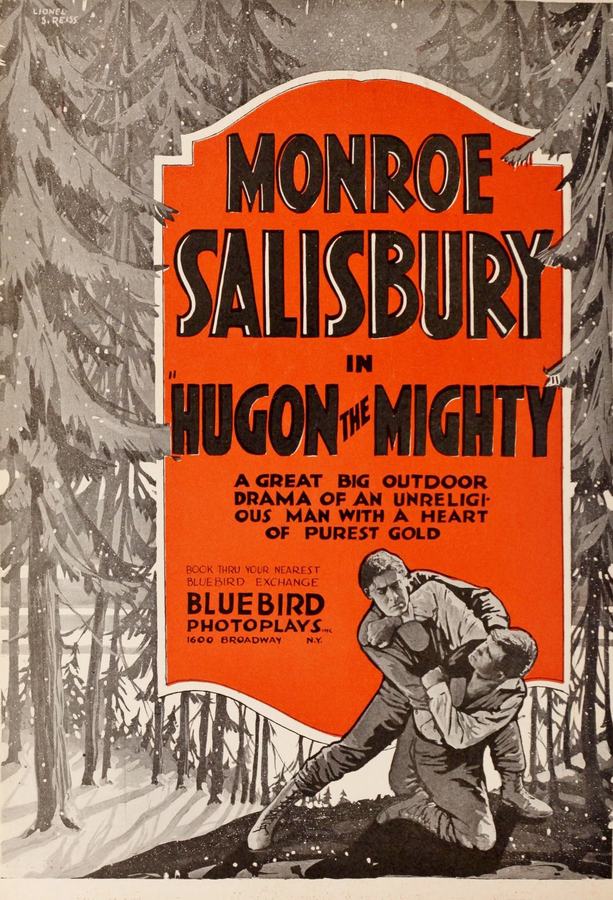
Picture a cedar-scented dawn, the air so crisp it snaps like celluloid, and into that virginal hush strides Hugon—half Paul Bunyan, half stoic saint—his shoulders broad enough to eclipse the sun but too gentle to cage a heart.
William E. Wing’s screenplay for Hugon, the Mighty (1920) refuses the easy fur-trapper clichés; instead it stitches Greek-scale resignation onto Canadian flannel, yielding a parable where muscle is merely the prologue to mercy.
Director Thomas Persse composes each tableau like a Group of Seven canvas: snowmelt indigos bleed into ember-yellow horizons, and the camera lingers on axe blades catching stray rays—metallic winks forecasting violence yet to come.
Marjorie Bennett’s Marie is no swooning ingénue; her glances ricochet between awe and ethical vertigo. Watch her fingers tremble as she buttons Gabriel’s coat: the micro-gesture betrays a woman mapping two futures—one of cultured parlors, the other of calloused devotion.
Roy Watkins plays Gabriel with a sparrow-like fragility that makes Hugon’s training scenes almost unbearably poignant. Each calisthenic rep feels like hammering feathers into steel. When Hugon finally murmurs, “Some timber won’t take the blaze,” the line crackles with self-referential sorrow.
Enter Roque—Antrim Short prowls the role with ink-stained fingernails and a transit chain slithering from his belt like a chrome snake. Surveying becomes metaphysical theft: lines on maps sever bloodlines, turning ancestral stumps into abstract commodities.
The fistfight, shot in dusk-light chiaroscuro, is a bruised ballet. Lungs pump like bellows; dust rises in ecclesiastical shafts; a deed flutters mid-air, angelic yet damned. The moment Hugon’s knee buckles, timber jaws seem to gnash in sympathy, and the forest itself exhales a dirge.
Injury segues into hermitage. The cabin set is a marvel: chinked logs ooze amber sap, suggesting the building bleeds with its occupant. Cinematographer George Holt silhouettes Hugon against a single window—his body a cracked monolith—while outside, snow spiders weave, break, and re-weave; nature’s silent sermon on perseverance.
Marie’s pivotal monologue about the arachnid is delivered in a tight close-up that feels almost intrusive; the flicker of nitrate blemishes across her iris becomes a second screen, a fluttering eyelid of time itself. Bennett modulates from whisper to hush, implying devotion without ownership.
Gabriel’s recoil from matrimony lands like an unanswered echo. The scene is staged on a half-finished bridge—a metaphor so blatant it circles back to brilliance; planks missing, hearts suspended. Marie’s decision to cross alone is filmed in one unbroken take, boots clunking on hollow wood, underscoring autonomy.
Restoration montage: axes bite, saws sing, children ferry nails in tin pails. The rebuilt homestead becomes a palimpsest—layers of trauma overwritten by communal toil. Final shot: a doorway framing two silhouettes, sunrise flooding between them, spider silk glinting overhead like a fragile crown. Iris out.
Compare this to the urban cynicism of The Love Swindle or the desert fatalism of Dust, and you’ll appreciate how Hugon opts for restorative, almost transcendental closure without lapsing into Pollyanna fluff.
Monroe Salisbury’s Hugon towers not through volume but restraint; his smile is rationed, his tears salted with embarrassment rather than sorrow. Opposite him, Bennett’s chemistry is less spark than steady hearth-glow. Together they craft a companionship founded on mutual witnessing rather than possession.
Tote Du Crow’s supporting turn as a fiddle-playing voyageur injects folkloric levity; his bow dances while boots pound fur-trade rhythms, injecting the narrative with blood-pulse momentum. Meanwhile, Sarah Kernan’s costume palette migrates from cool calicos to russet wools, charting Marie’s emotional thaw.
The intertitles—lettered as if etched with bark chips—employ archaic diction (“thou canst,” “’tis”) that risks hokeyness yet feels organic amid conifers and hand-hewn beams. William E. Wing’s prose poems avoid exposition, instead sounding like psalms recited around logging-camp embers.
Restoration-wise, the 2022 4K scan from a French Pathé nitrate reveals granular miracles: individual wood-shavings on floorboards, breath-fog in sub-zero air, the faint glimmer of a spider’s web filament like a scratch on the soul of the filmstrip.
At its core, Hugon meditates on strength’s relativity. Physical prowess humiliates itself before emotional vulnerability; land ownership collapses under moral stewardship; romantic rivalry dissolves into tutelage. The film posits that the mightiest deed is abdication—Hugon’s surrendering Marie, then surrendering shame itself.
Colonial critique lurks beneath the surface. Roque’s forged boundary lines evoke Canada’s larger dispossessions, yet Wing’s script refuses tidy political sermons. The narrative’s empathy radiates outward, acknowledging that even usurpers act from desperation—the surveyors are petty wolves, not corporate leviathans.
Gender politics flip the frontier template: Marie engineers the final union, designs the house, and literally hammers ridgepoles. Her agency never feels anachronistic; it emerges from communal necessity, a pragmatic feminism born of axe-handles and midwinter exigency.
Les Misérables, Part 2: Fantine shares Hugon’s redemptive scaffolding, yet Fantine’s suffering is urban, Dickensian, whereas Hugon’s redemption is arboreal, almost pagan. Similarly, The Man of Shame trades in masculine disgrace, but its noir-ish interiors contrast Hugon’s sun-dappled atonement.
If you savor the athletic romanticism of Keep Moving or the moral cartography of Unto the End, then Hugon offers a rustic counterpoint—proof that silent cinema could be both muscular and meditative, brawny and beatific.
In an era when CGI superheroes flex hollow bravado, discovering a celluloid titan whose greatest feat is letting go feels like sipping glacier melt. Hugon, the Mighty is both fireside yarn and philosophical treatise, a backwoods ballad humming with universal tremors. Seek it, preferably on a projector with audible reel-clack, and let its spider-silk wisdom re-weave any broken web inside you.
Grade: A+ | Runtime: 68 min | Silence with English intertitles
IMDb —
1919
Community
Log in to comment.