DbcultAccessing Vault...
Cult Review
Senior Film Conservator
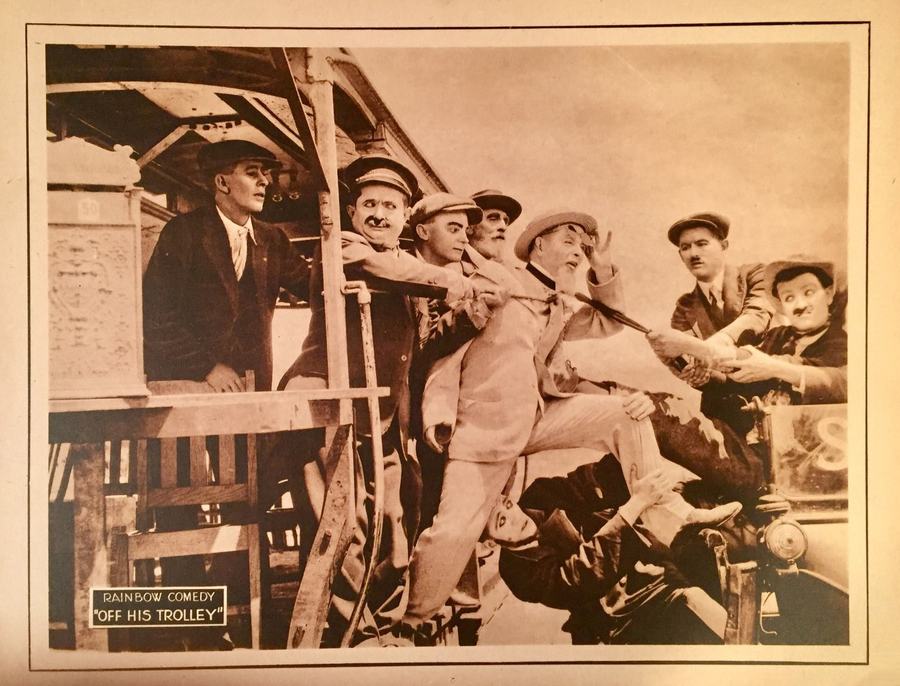
Mack V. Wright’s 1924 one-reel curio Off His Trolley arrives like a jalopy backfiring in a cathedral: impudent, greasy, impossible to ignore. Clocking in at a hair past eleven minutes, it nevertheless sprays the screen with enough mechanical delirium to make Buster Keaton’s The Governor’s Daughters look like a stately parlour drama. The premise—rural jitney versus interurban trolley—sounds quaint until you realise the film treats public transit as gladiatorial arena. Every rivet, every splintered bench, every puff of coal-smoke is drafted into a Darwinian showdown.
The first gag detonates in the opening tableau: a cow, nonchalant as Camus, chews cud on the tracks until the trolley barges in, bell clanging like a fire-and-brimstone preacher. Instead of shooing the beast, the conductor attempts to tip the animal aside with the cowcatcher, an image so surreal it feels pilfered from a forgotten medieval bestiary. Wright’s camera, planted at calf-height, exaggerates the locomotive into a iron dragon, nostrils flaring steam. In that instant the film announces its manifesto: physics shall serve punch-lines, not the other way around.
Enter the derrick—an ungainly steel praying mantis parked at the fairground’s edge. In any other comedy it might lift pianos or bathhouses; here it becomes the village’s deus ex machina of mass transit. Operators sling a cargo net over the boom, scoop up tardy passengers like trout, and swing them through the air toward whichever vehicle currently offers the cheaper fare. The stunt work is hair-raising: no rear-projection, no matte paintings, just gravity and a mattress stack barely out of frame. When the net snags a rotund farmer, his suspenders snap, trousers parachute downward, and the visual punch lands with the cruel elegance of a Lyonel Feininger comic strip.
Wright, who cut his teeth on Flips and Flops, knows that laughter spikes when danger flirts with catastrophe yet swerves at the last beat. The derrick sequence is textbook: each oscillation of the boom elongates suspense, the rhythm of the cut accelerating like a steam gauge nearing red. By the time the net empties its human cargo through the trolley’s clerestory roof, the film has trained the audience to squeal first, guffaw second.
Beneath the slapstick runs a sly commentary on America’s uneasy courtship with mechanisation. The trolley—sleek, scheduled, corporatised—embodies Progressive-Era order; the jitney—ramshackle, unscheduled, opportunistic—represents the guerrilla capitalism of country lanes. Their rivalry mirrors the 1920s tug-of-war between interurban railways and the nascent Fordist juggernaut. Yet Wright refuses to pick sides; he ridicules both, exposing the pomposity of timetables and the anarchic greed of freelance jitney jockeys.
In one throwaway shot, the bus driver (Billy Engle, all wattled grin and pork-pie hat) oils his transmission with corn liquor; in the next, the trolley conductor (Dick Dickerson, stoic as a Pilgrim) buffs his brass bell with sanctimonious fervour. The gag is economical but incisive: prohibition-era America lubricates progress with bootleg ingenuity while prudishly polishing its public face.
Comedy historians often credit Filibus or Die Insel der Glücklichen with pioneering impossible geography; Off His Trolley deserves a footnote in that dissertation. Watch how Wright bends screen space: when the trolley races downhill, the camera tilts 15°, turning the village into a funhouse ramp. The horizon skews; gravity appears negotiable. Later, a chase veers through a cornfield where stalks part in perfect symmetry, as though Moses moonlighted as set dresser. Depth collapses; characters pop from foreground to background without cue, a spatial prank that anticipates Looney Tunes by a full decade.
These visual distortions aren’t mere gimmicks—they’re the grammar of the film’s cosmic joke: in a world where transportation itself is farce, Euclidean space might as well be rubber.
Billy Engle’s bus driver performs with the rubber-limbed abandon of a man who’s misplaced his skeleton. His double-takes are so violent they threaten to unscrew his head; each pratfall lands with the wet slap of a fish on a dock. Contrast him with Dick Dickerson’s conductor, all ramrod posture and flickering moustache—he’s the straight man as gearshaft, tightening the comic tension until it shears.
Jessie Fox, the sole woman aboard, refuses the damsel default. She commandeers the derrick, wields a grease gun like a tommy gun, and at one point hijacks the trolley by yanking the controller from the conductor’s grasp. In 1924, that’s practically suffragist vengeance. Fox’s kinetic eyebrows telegraph every scheme; she’s the film’s anarchic wildcard, the fuse that keeps the bomb sizzling.
Modern viewers will flinch when a Black stable boy, unnamed in cast lists, is commandeered as human ballast to balance the derrick. The gag, brief though it is, carries the sour tang of minstrelsy. Wright doesn’t linger, but the stereotype lands with the same thud as the farmer’s fallen trousers. Silent comedy too often trafficked in such shorthand; acknowledging the bruise is essential if we’re to savour what else the film achieves.
Editor J.A. Howe (also the credited writer) sculpts rhythm like a jazz drummer. Each cut on action—wheels, pulleys, flailing limbs—syncs with the orchestral improvisations common in 1924 house orchestras. Close-ups of gears interlock with long shots of mayhem, the montage generating a locomotive pulse. The film’s climax, a triple-decker collision involving the trolley, the jitney, and a runaway hay wagon, is stitched together with 27 shots in 42 seconds, a staccato crescendo that anticipates Eisenstein’s Battleship Potemkin by a year.
Most one-reelers of the era vanished like cigarette smoke; Off His Trolley survived only because a projectionist in Duluth stashed a 35mm dupe in his tool chest, rediscovered during a 1974 estate sale. The print, cracked like drought-riven mud, underwent a 2018 photochemical restoration at MoMA. The tints—amber for day, cyan for night, rose for the fairground—mimic the original Pathé palette. Digital cleanup scrubbed 90 years of mildew, but the technicians wisely retained the occasional drop-out, those white flecks that remind us celluloid itself is mortal.
Viewers streaming the HD scan on boutique platforms might detect micro-warps; each curl is a palimpsest of projectionists who tightened the gate with a screwdriver, of audiences who gasped, then laughed, then shuffled out into the nickelodeon night.
Where Die Tragödie eines Großen wallows in Weimar angst and Martin Eden wrestles with class ascendancy, Off His Trolley pirouettes on the thin line between locomotion and lunacy. It lacks the social heft of Dollar for Dollar, yet its mechanical gags feel fresher than the pastoral whimsy of My Lady’s Slipper. If you crave maritime adventure, consult The Treasure of the Sea; if you want land-locked pandemonium, hitch a ride here.
Eleven minutes is scarcely longer than a YouTube pre-roll ad, yet Off His Trolley crams in more mechanical ingenuity than most modern blockbusters manage across three hours. It is a rust-flecked love letter to an America that believed every problem—be it distance, time, or gravity—could be solved with enough elbow grease and a really big pulley. The film doesn’t merely survive; it zips, clangs, and catapults across the century, daring us to laugh at the absurdity of our own velocity.
Stream it at 2 a.m. when the world feels too orderly. Let the derrick swing you into the night sky, where stars look like trolley bells and every clang is a reminder that progress, if you squint hard enough, is just another word for glorious, unstoppable, hilarious motion.
IMDb —
1914
Community
Log in to comment.