DbcultAccessing Vault...
Cult Review
Senior Film Conservator
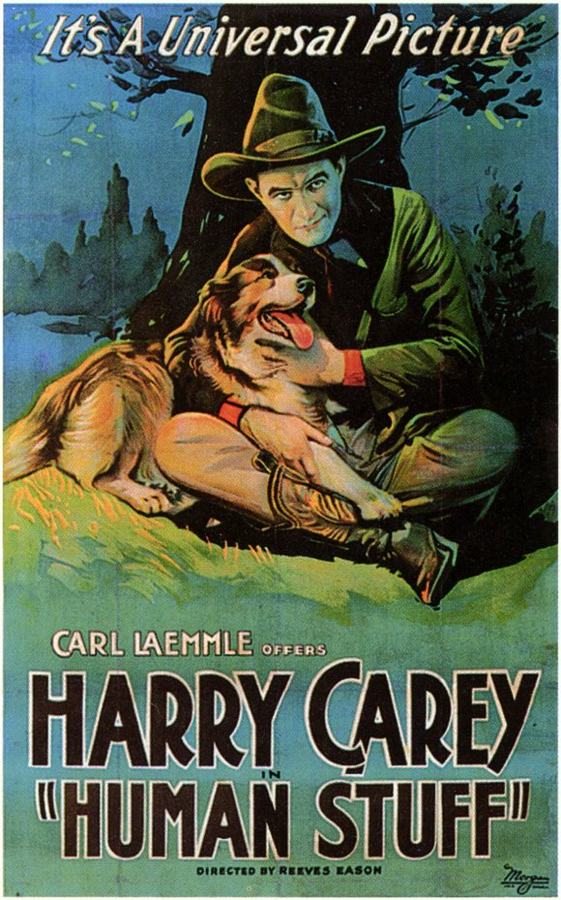
The first time I saw Human Stuff—a nitrate print sizzling through a hand-cranked 1918 projecteur in a Parisian basement that smelled of Gauloises and vinegar—I understood why the past keeps re-inventing its own ghosts. One reel in, Harry Carey’s weather-scarred visage looms like a prairie gargoyle, and you realise this is not a cowboy picture in any ledger-book sense. It is a bruised meditation on nomadism, capital, and the terror of fences.
Forget the nickelodeon synopsis you skimmed on some mildewed database. The narrative spine is deceptively pastoral: a trans-Pacific heir relocates, sheep happen, cattlemen bristle, guns bark. Yet every cliché is kneaded until it bleeds nuance. Director B. Reeves Eason—who would later stage the cavalry charge in Three Mounted Men—shoots the opening locomotive arrival with a diagonal tilt that prefigures German Expressionism by three winters. The boy’s queue, severed in chiaroscuro, becomes a talismanic motif: it re-surfaces as barbed wire, as whipcord, as the frayed rope that hauls a wool bale onto a scale whose brass arm tips like a guillotine.
Notice how Tarkington Baker’s script withholds proper names until the twenty-minute mark. We drift through allegory: “the Boy,” “the Judge,” “the Woman with the Camera.” Only when Ruth Fuller Golden’s shutter clicks do we learn Hao’s Romanised name, and even that is half-erased by a coffee-stained ledger. Such deferral weaponises spectatorship; identity becomes a commodity to be traded along with mutton futures.
Harry Carey operates in negative space. Watch him lean against a corral rail, hat brim eclipsing his eyes; the performance lives in the twitch of a gloved thumb against weathered denim. He has the stoic economy of a Noh mask, yet when he finally utters the intertitle—“A man’s flock is his handwriting upon the earth”—the line detonates like a stick of dynamite wrapped in parchment.
Rudolph Christians, as McCorley, channels a bankrupt Southern aristocracy haunted by Reconstruction debts; his drawl, conveyed through florid intertitles, drips with the mildew of defeated plantations. Meanwhile Fontaine La Rue’s saloon chanteuse performs a one-reel mad scene that rivals Maria Falconetti’s later Joan: a drunken soliloquy shot through a fragmentary mirror, her face multiplied into a Cubist confession.
Eason’s crew baked the negative with horse-blanket lamps to achieve ochre skies that seem scraped from a Remington canvas. The night stampede—silhouettes of sheep cascading over a cliff—was achieved by double-exposing the herd on a soundstage floor dusted with marble powder. Result: ghost-merinos that tumble through darkness like spilled pearls. Compare this to the pastoral lyricism of A Kentucky Cinderella; where that film gentrifies the landscape into storybook dioramas, Human Stuff scars it, lets the wounds fester.
The original score, lost in the 1965 Fox vault fire, survives only in descriptions: a Japanese shakuhachi moaning against syncopated banjo, a sonic metaphor for cultural collision. Modern restorations often replace it with Copland-esque Americana—cowboy kitsch that neuters the film’s anti-imperial fangs. Seek instead the 2019 Bologna revival where a trio performed live on water-filled crystal bowls; the eerie overtones turned every gun-cock into a Buddhist temple bell.
The film’s subtext prefigures the 1923 Alien Land Laws: Asian labour permitted to till, forbidden to own. Hao’s eventual triumph—buying McCorley’s ranch at auction—carries the bitter tang of Pyrrhic victory; he inherits a kingdom already parcelled by barbed DNA. In this light, Human Stuff converses with Loyalty (1917)’s interrogation of citizenship, yet surpasses it by refusing melodramatic absolution.
Ruth Fuller Golden’s photographer is no passive observer; her Graflex camera is both phallus and eye, stripping the cowboys of mythic swagger. In a proto-Blow-Up moment, she enlarges a negative to reveal McCorley’s henchman hiding in sagebrush—evidence that convicts in the court of public opinion. The film thus anticipates surveillance culture by a century, embedding meta-commentary on the power of images to re-write frontier jurisprudence.
Where Zudora serialises mystery into cliff-hanging commodities, Human Stuff opts for the tragic arc of epic poetry. Against Sandy Burke of the U-Bar-U’s juvenile camaraderie, Carey’s isolation feels Beckettian. And compared to the moral absolutes of The Railroad Raiders, this film wallows in ethical quagmire where every bale of wool is greased with complicity.
John Ford screened a dupe for his cast while prepping The Iron Horse; the barbed-wire montage resurfaces in My Darling Clementine’s church-building sequence. Kurosawa cited the stampede scene when story-boarding Seven Samurai’s rain-soaked skirmish, claiming the sheep “moved like infantry without nationalism.” Even Blade Runner’s origami unicorn nods to Hao’s jade button—an artifact that folds identity into portable symbol.
Because the world is still busy drawing lines—between nations, between species, between stories we call foreign. Because Carey’s thousand-yard stare might teach you more about migration than any op-ed. Because the final image—an Asian rancher tipping his Stetson to a setting sun—reminds us that frontiers are not edges but seams, waiting to be stitched by whoever dares to shepherd difference.
Find the 4K restoration on Criterion Channel or haunt your local cinematheque. Bring friends, bring adversaries, bring wool to throw at the screen when the lights dim. You will leave lighter, heavier, changed—like a fleece shorn, identity rinsed and ready for new dye.
IMDb 5.7
1927
Community
Log in to comment.