DbcultAccessing Vault...
Cult Review
Senior Film Conservator
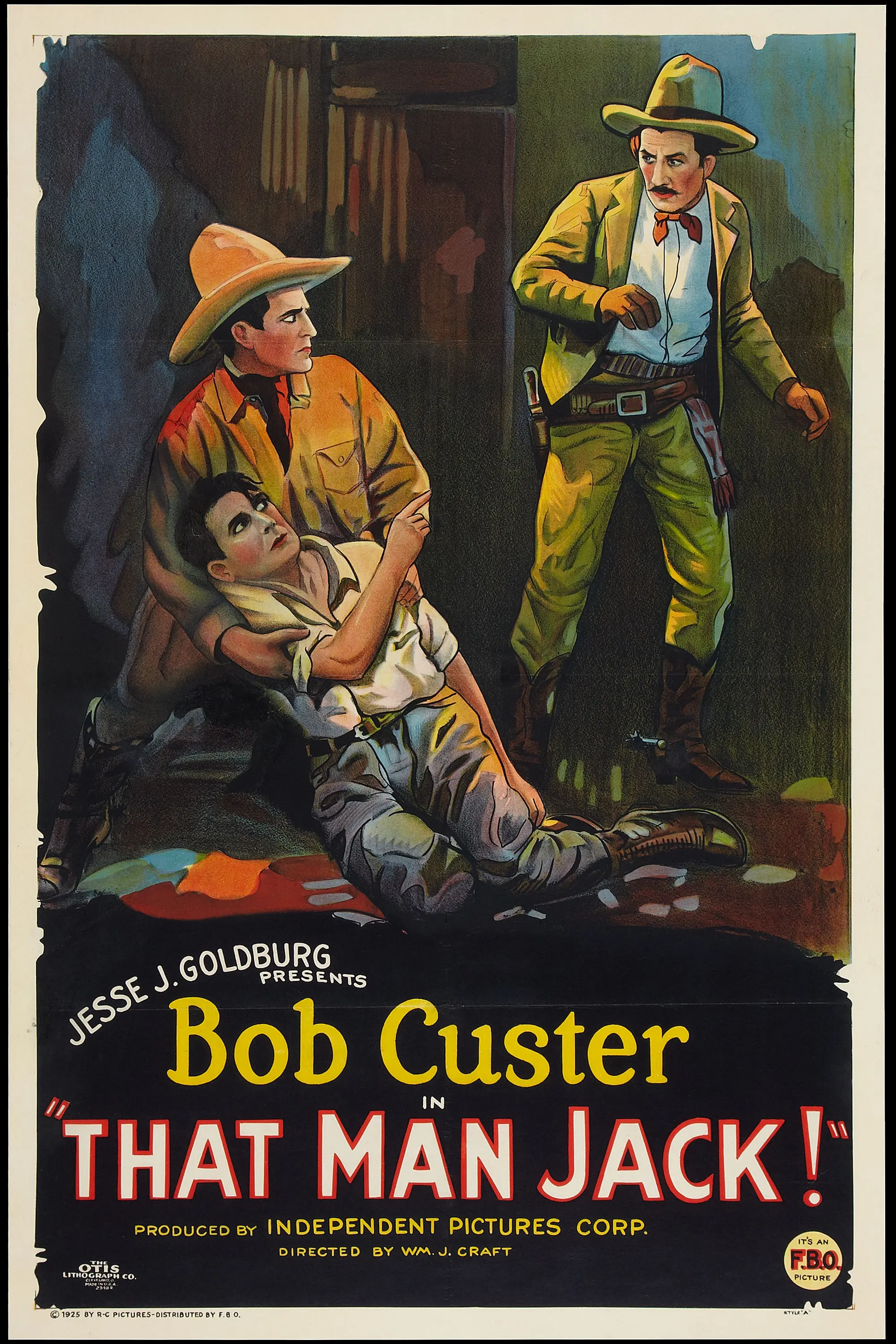
Is 'That Man Jack!' worth watching in the modern era? Short answer: yes, but with significant caveats. This film is a nostalgic trip for staunch fans of early Westerns and silent cinema enthusiasts, but it will likely test the patience of contemporary viewers accustomed to faster pacing and complex narratives. It’s a historical artifact more than a compelling piece of entertainment for the average viewer today.
For those with a deep appreciation for the foundational elements of cinematic storytelling, or historians tracing the evolution of the Western genre, George Paul Bauer's 1924 silent film offers a fascinating glimpse into the past. However, anyone seeking the polished narratives and dynamic action of modern cinema will find it a challenging, if not frustrating, experience.
The plot of "That Man Jack!" is a masterclass in straightforward storytelling, a hallmark of its era. Adele Buffington and George Paul Bauer's screenplay wastes no time establishing Jack Burton as the paragon of virtue. His initial acts – saving Anita Leland from a runaway horse, then intervening in a beating – are not mere plot points; they are declarations of his character. This isn't subtle, but subtlety wasn't the goal.
The film swiftly moves into its central conflict: the partnership with Sam Sills and the inevitable betrayal by Bill Sterns. Sterns isn't just a villain; he's the villain, a force of pure malevolence whose actions drive the entire narrative. The murder of Sam is brutal in its efficiency, designed to propel Jack into his heroic quest for justice, a quest complicated by the classic trope of circumstantial evidence.
Jack's escape and subsequent pursuit of Sterns is the engine of the film's second half, culminating in another rescue of Anita. This repetition of the rescue motif reinforces Jack's unwavering heroic nature. It’s a narrative structure that prioritizes clear moral lines and definitive resolutions, a stark contrast to the morally ambiguous protagonists and complex motivations often seen in contemporary films like The Tigress or even earlier, more experimental works.
While undeniably formulaic by today's standards, this simplicity was a strength in 1924, ensuring broad accessibility and emotional impact for audiences still learning the language of cinema. It’s a narrative built on archetypes, not psychological depth, and it delivers on that promise with unwavering commitment.
The cast of "That Man Jack!" delivers performances that are, by necessity, broad and expressive. Silent film acting relied heavily on pantomime and exaggerated facial expressions to convey emotion without dialogue. Monte Collins as Jack Burton embodies the stoic, noble hero with every gesture. His upright posture, swift actions in moments of crisis, and resolute gaze are all part of a visual shorthand for heroism.
Anita Leland, played by Mary Beth Milford, serves as the classic damsel in distress, a catalyst for Jack’s heroism. Her vulnerability is essential to the plot, and Milford effectively portrays the fear and gratitude required of the role. It’s a performance designed to elicit sympathy and admiration for Jack, rather than to explore Anita's inner world.
The true standout, in terms of sheer force, is Buck Moulton's Bill Sterns. He is pure villainy personified. Moulton's sneers, menacing stances, and aggressive physicality leave no doubt about his nefarious intentions. The scene where he beats Sam Sills (played by Hayford Hobbs) is likely a showcase for his brutality, and his later 'foul advances' on Anita seal his fate as an irredeemable antagonist. It's a performance that doesn't aim for nuance; it aims for impact.
While modern acting favors naturalism, the performances here are theatrical, a product of their time. They are effective within their context, communicating character and emotion without words. To judge them by contemporary standards would be unfair, but to appreciate them requires an understanding of the medium's evolution. Bob Custer also appears, likely in a supporting role, contributing to the ensemble feel of a frontier town.
George Paul Bauer's direction of "That Man Jack!" adheres closely to the conventions of 1920s filmmaking. Pacing, by today's standards, is deliberately slow. Scenes are often held longer, allowing audiences to absorb the visual information and the actors' expressions before moving on. This isn't a flaw; it's a characteristic of silent cinema, where every frame had to work harder to tell the story.
The action sequences, such as the runaway horse rescue or the confrontation with Bill Sterns, would have been carefully choreographed and filmed to maximize their dramatic tension without the benefit of sound. The editing likely employed cuts to build suspense, though not with the rapid-fire intensity we're accustomed to in films like The Rescue. The aim was clarity and emotional emphasis.
Bauer effectively uses the camera to establish setting and character. The wide-open spaces of the Western frontier would have been captured in establishing shots, contrasting with tighter compositions for moments of intimacy or conflict. The direction serves the narrative directly, ensuring that even without spoken dialogue, the audience understood who was good, who was evil, and what was at stake. It’s a functional, rather than flashy, approach to filmmaking, focused on the fundamentals.
The cinematography of "That Man Jack!" would have been utilitarian yet effective, designed to convey information and emotion through stark black and white imagery. We can infer the use of natural light for outdoor scenes, giving the Western landscapes an authentic, rugged feel. Indoor scenes would have relied on artificial lighting, often creating dramatic shadows and highlights to emphasize character expressions or tense moments.
The visual storytelling would have been paramount. Consider the scene of the runaway horse: the camera would have focused on the frantic animal, Anita's terror, and Jack's determined pursuit, using a sequence of shots to build the action. Similarly, Bill Sterns' murder of Sam Sills would have been depicted with clear visual cues – perhaps a struggle, a fall, and a final, ominous shot of Sterns standing over his victim – all without gore, but with undeniable impact.
The film's visual language, while perhaps rudimentary by today's sophisticated standards, was pioneering. It established many of the visual grammar rules that filmmakers still use. The framing of Jack Burton, often centered and strong, would visually reinforce his heroism. Conversely, Bill Sterns might be framed in more claustrophobic or shadowed ways, visually signaling his villainy. It’s a testament to early cinema’s power that it could tell such a complete story through images alone, a skill sometimes lost in dialogue-heavy contemporary productions.
At its core, "That Man Jack!" is a celebration of classic frontier themes: justice, heroism, and the triumph of good over evil. Jack Burton embodies the idealized Western hero, a man who acts not for personal gain, but because it is simply the right thing to do. His actions are driven by an innate moral compass, a comforting simplicity that resonates even today.
The film also touches on the vulnerability of civilization on the frontier, where law and order are often fragile. Sam Sills' murder and Jack's wrongful arrest highlight the precariousness of justice in a developing land, underscoring the necessity of a strong, righteous individual to uphold moral order. It’s a narrative that implicitly argues for individual responsibility and courage.
The romance between Jack and Anita, while secondary to the action, provides a hopeful resolution, symbolizing the promise of a peaceful future once the forces of chaos (represented by Bill Sterns) have been subdued. It’s a straightforward tale, devoid of complex subtext, yet its themes are universal and enduring. This stark dichotomy of good and evil is, in my opinion, refreshingly direct in an age of moral relativism, even if it sacrifices psychological depth.
For the casual viewer, "That Man Jack!" is a challenging watch. Its silent film conventions, slow pacing, and simplistic narrative might feel alien and tedious. However, for film historians, students of the Western genre, or those with a genuine curiosity about early cinema, it offers invaluable insight into the foundations of American filmmaking. It’s a vital piece of history, but not necessarily a thrilling night at the movies for everyone.
Like any film from its era, "That Man Jack!" comes with a distinct set of strengths and weaknesses that define its appeal and its limitations.
Ultimately, "That Man Jack!" is a film that demands a specific kind of engagement. It is not a forgotten gem waiting to be rediscovered by a mass audience. Rather, it is a valuable piece of cinematic history, offering a direct lineage to the storytelling techniques and character archetypes that would define the Western genre for decades. It works. But it’s flawed.
My unconventional observation here is that despite its age, the clear-cut villainy of Bill Sterns feels almost refreshing in its unapologetic evil, a stark contrast to the often-muddled antagonists of today. While it might struggle to hold the attention of many modern viewers, its historical importance is undeniable. Approach it as an educational experience, a window into the past, and you'll find something to appreciate. Approach it as a Friday night blockbuster, and you'll be sorely disappointed. It earns its place in the archives, if not always in your regular viewing rotation.
IMDb —
1927
Community
Log in to comment.