DbcultAccessing Vault...
Cult Review
Senior Film Conservator
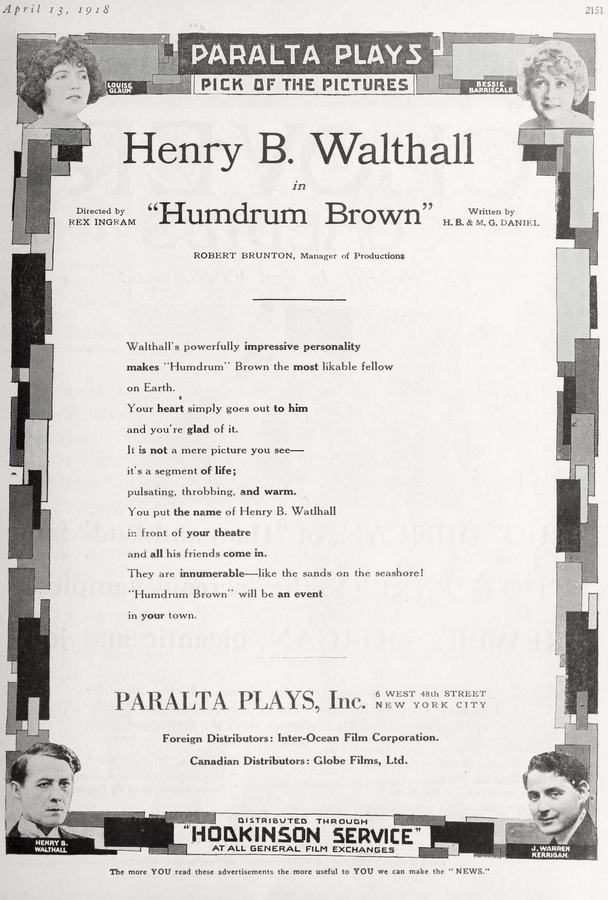
Monotony has its own gravitational pull, and in Humdrum Brown it folds an entire town into its beige event horizon until one timid clerk learns that even a shadow can strike back if the light is cruel enough.
The film arrives like a brittle postcard from 1916, edges browned, corners dog-eared by time’s indifferent thumb. Yet within its flickering nitrate lies a curiously modern fable: the cost of being agreeable, the hidden surcharges of love, the moment when meekness mutates into mettle. Director M.G. Daniel—better known for the urban grime of The Rogues of London—trades gaslit alleys for picket-fence inertia, discovering tension not in knife fights but in ledger columns and parlor silences.
Joseph J. Dowling’s camera lingers on mundane symphonies: steam kettles hissing like gossiping spinsters, a quill blotting the same fiscal scar on parchment, the way dawn light pools like spilled cream across worn floorboards. These are not decorative flourishes but narrative mortar; we feel the weight of days that reproduce themselves like damp wallpaper. When the bank’s vault yawns open—its maw bristling with ranked gold—the shot is framed at ankle height, turning coins into towering obelisks of temptation. In that low, almost predatory angle, money becomes geography, continent enough to strand a soul.
As Hector, Joe Harris channels Buster Keaton’s stone-face by way of a sleep-walking accountant. Watch the micro-twitch at the corner of his mouth when Ed Danforth—played with magnificent, fly-blown bluster by Henry B. Walthall—asks for yet another "loan." It is the tremor of a man feeling the itch of his own spine beginning to grow. Opposite him, Dorothy Clark gifts Alicia Boothe a luminous practicality: she enters every room as if she’s already memorized its exits, a skill learned from a lifetime of men who talk louder than they think.
Their chemistry is never the firework kiss of contemporary romances but rather the slow osmosis of two people recognizing each other’s loneliness across a crowded streetcar. In one devastating insert, Alicia threads a needle by candle while humming a half-remembered lullaby; Hector, glimpsed through a doorway, pockets the melody like contraband hope. No title card intrudes, yet the moment sings.
When the narrative train lurches west, cinematographer Howard Crampton swaps the claustrophobic Midwestern grids for vertiginous hills and maritime fog. The city functions as moral casino: every plank sidewalk creaks like roulette, every gull’s cry could be a croupier’s call. Tanner—in silk topper and guiltless grin—offers Alicia investment advice on a rooftop garden where the bay glitters like spilled chandelier. The camera dollies back until the couple are miniatures against an ocean that devours promises whole. It is here that Alicia’s inheritance evaporates, and the film’s color palette, already wan, drains to porcelain grey, as though the world itself has declared bankruptcy.
The climax aboard the steamer Mercury is staged with a maritime austerity worthy of The Marconi Operator. Ropes lash like nervous veins, cargo nets dangle like gallows, and the foghorn becomes Greek chorus to Hector’s awakening. When he finally seizes Tanner, the struggle is awkward, almost comic—two civilized bodies remembering they were once animals. No fists of fury, just the obstinate grip of a man who has calculated that dignity, like compound interest, accrues if you stop making withdrawals.
Police handcuffs click with the finality of a bank vault sealing, but the true victory is quieter: Hector’s gaze meets Alicia’s across the deck, and for the first time he does not glance away. The iris closes not on a kiss, but on their clasped hands resting atop the recovered money bag—an image that asks whether love can germinate inside the same soil that grew corruption.
If Crooky played pickpocket with slapstick nihilism, and Conscience sermonized morality in capital letters, Humdrum Brown occupies a liminal corridor between them—too earnest for burlesque, too worldly for parable. Its DNA also shares strands with A Magdalene of the Hills: both trace how fiscal catastrophe redraws the map of personal identity, though where Magdalene seeks spiritual absolution, Hector pursues institutional vindication.
Scholars often spotlight the film’s proto-feminist glimmer: Alicia’s inheritance momentarily flips the era’s gender ledger, positioning her as capitalist siren. Yet the screenplay, co-written by R.B. Kidd and H.B. Daniel, refuses triumphalism. Once Tanner swindles her, Alicia’s purse strings are severed, restoring patriarchal equilibrium. Still, Ida Lewis’s performance refuses victimhood; her stride through Chinatown’s lantern fog, purse clutched like a shield, is less despair than reconnaissance. The movie intuits that financial autonomy is not a single windfall but a negotiation renewed daily—a lesson modern cinema still struggles to ledger.
Surviving prints exhibit the acne of time—scratches swarm like iron filings magnetized around the characters’ faces—yet these blemishes act as documentary proof, reminders that the film itself paid compound interest in cultural memory. Contemporary accompanists often score it with skeletal piano, but I recommend a chamber ensemble: pizzicato strings mimicking typewriter clatter, a lone trumpet voicing the steamer’s farewell. The contrapuntal strategy highlights the movie’s underlying thesis: beneath the ledger’s hush, hearts beat in 4/4.
Humdrum Brown is neither towering masterpiece nor footnote fodder; it is the cinematic equivalent of a forgotten passbook unearthed in a thrift coat—its columns of deposits and withdrawals telling a richer story than any melodramatic flourish. The film understands that villainy often wears the cologne of opportunity, that heroism can germinate inside a timid clerk whose only gymnasium is counting other men’s fortunes. In an age when algorithms quantify our worth in micro-transactions, Hector’s arc hums with retroactive relevance: dignity, like money, multiplies once you stop allowing unauthorized withdrawals.
Stream it with lowered expectations of pyrotechnics and raised patience for nuance; let its quiet victories seep like ink into your own ledger of cinematic memory. The closing shot—Norwalk’s sun-bleached street unfurling toward a horizon no longer barricaded by debt—may compel you to audit which portions of your life remain mortgaged to someone else’s dreams.

IMDb 5.6
1931
Community
Log in to comment.