DbcultAccessing Vault...
Cult Review
Senior Film Conservator
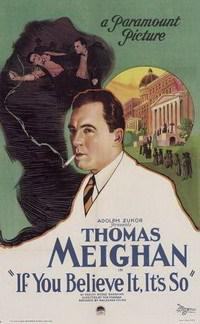
The first time we see Joseph J. Dowling’s nameless grifter, he is licking cigar smoke off his knuckles as if it were sacramental wine. The gesture—caught in a harsh arc-light that turns the smoke into ectoplasm—announces the film’s creed: belief is gesture, nothing more. Over the next seventy-five minutes director Perley Poore Sheehan refuses the spiritual shortcuts hawked by contemporaries like The Lonesome Chap or the moral neon of No Money, No Fun. Instead we get a slow bruise of a narrative in which salvation arrives sideways, like a pickpocket’s hand that slips something in rather than lifts something out.
Shot on location in a mildewed Jacksonville fairground, the picture opens with a traveling shot that feels eerily modern: the camera glides past Ferris-wheel girders, cotton- candy vapors, and a phonograph playing a warped Sousa march. Dowling steps into frame from behind a banner that reads “See the Living Phoenix!”—a carny come-on that foreshadows his own resurrection. Yet the film withholds the usual tropes: no thunderous conversion, no tear-stained hymn. The crook simply lingers, first out of opportunism, then because the tent-show’s communal stove is warmer than the county jail.
The screenplay, co-penned by Waldemar Young, structures itself like a three-card monte game: every time we think we’ve located the moral center, the human pea shifts. Theodore Roberts’s quack physician—equal parts snake-oil and battlefield surgeon—delivers speeches that sound like Mark Twain rewritten by a drunken prophet. Charles Ogle’s one-armed juggler becomes a barometer of the grifter’s conscience; watch how the camera slowly isolates his single sleeve in negative space whenever Dowling contemplates another con. Laura Anson’s faded chanteuse, more bruised than coquettish, sings a half-remembered lullaby that recurs as a leitmotif on the theater’s pump organ, each iteration pitched a semitone lower, as if the song itself were aging.
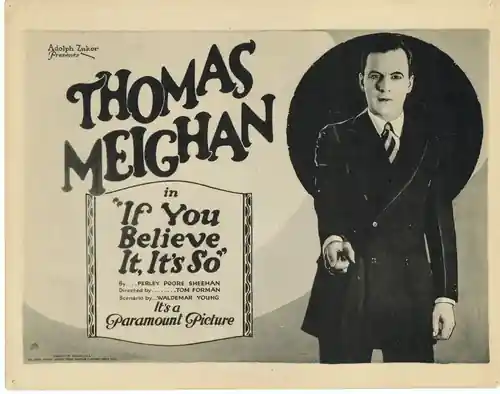
Critics often compare silent-era redemption tales to stained-glass windows: static, didactic, flooded with imported light. If You Believe It, It’s So behaves instead like a fogged mirror: you must breathe on it, repeatedly, before your own face emerges. The crook’s pivotal moment arrives not in a church pew but inside a tattered tableau vivant where he portrays Judas for paying customers. As he stuffs thirty pieces of painted tin into his robe, a child in the front row begins to weep—real tears, not rehearsed. The camera holds on Dowling’s eyes; the smirk collapses into something closer to vertigo. In that instant the film achieves what Kierkegaard called “the sickness unto death”: the recognition that one’s life is a forgery even when the coins are genuine.
Cinematographer Charles K. French shoots Jacksonville’s winter fog as if it were a character refusing billing. Grey swirls seep between tent flaps, turning every lantern into a hesitant halo. Notice how the palette shifts from nicotine browns to sea- blue dusk once the crook begins, almost unconsciously, to reciprocate kindness. The transition is so incremental that when the final shot reveals him hauling crates on the wharf at dawn, the aquamarine sky feels earned rather than bestowed.
Performances operate at the register of bone-tired vaudeville. Dowling, usually cast as granite-jawed heavies, here lets his shoulders sag until his very silhouette apologizes. Watch the way he removes his boater: not with rakish flourish but as if the hat suddenly weighed more than his head. Thomas Meighan’s supporting turn as a railroad dick chasing the protagonist offers a study in minimalist menace; he never raises his voice above post-office courtesy, which makes the threat feel bureaucratic, inexorable. Pauline Starke, barely sixteen during production, plays the child who weeps at the Judas tableau; her tears are the film’s true special effect, outshining even the double-exposure dream sequence where the crook imagines himself juggling his own faces.
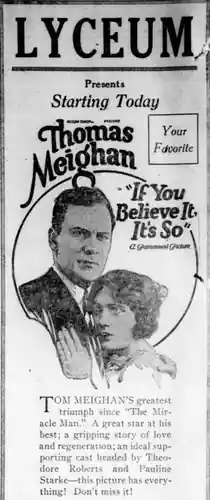
Comparisons are instructive. Where Sleepy Sam, the Sleuth resolves its moral calculus with a last-reel baptism, and The Channel Raiders dispenses grace through patriotic sacrifice, this picture insists that virtue is less acquired than accumulated, like barnacles on a hull. The debt to social realism—rare in 1920—links it more closely to Danish cinema such as Lykkens blændværk than to homegrown melodramas. Yet Sheehan refuses Marxist certainty; the economic substrata are there (pay envelopes thin as onion skin), but the dramatic engine remains interpersonal, almost molecular.
The intertitles, mercifully sparse, display the hard-boiled lyricism Young later brought to The Big Show. One card reads: “He had traded tomorrow for a deck of marked cards—and the deck was missing the joker.” Note the absence of moral thunder; the sentence simply lays out the arithmetic of self-betrayal. Another card, appearing after the crook returns a stolen watch, states: “Sometimes a man gives back the ticking before he can hear his own heart.” Such lines risk aphorism, yet the actors’ weather-beaten delivery prevents sermonizing; they speak like people who have licked postage stamps for breakfast.
Scholars often overlook the film’s sonic design—ironic for a silent. The original exhibition notes call for a live trio to perform a pastiche of Salvation-band brass and barroom rag. Contemporary restorations sometimes substitute generic piano, blunting the cognitive dissonance the score was meant to evoke. When the child weeps at the Judas tableau, the cue shifts to a halting rendition of “Sweet By and By” played off-key on a trumpet with a handkerchief jammed in the bell. The effect is neither sacrilegious nor pious but something far rarer: a lullaby corrupted by lived experience.
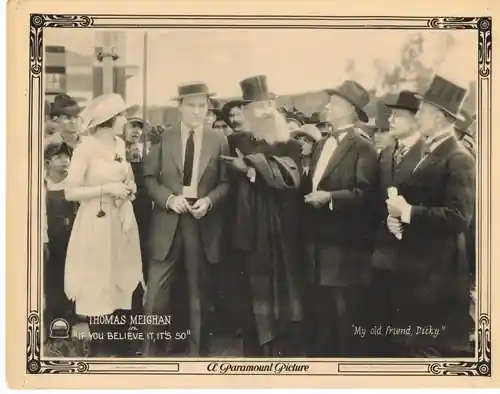
The film’s gender politics merit scrutiny. Female characters occupy the periphery yet anchor the moral infrastructure. Anson’s chanteuse, battered by years of second-story dives, still folds the crook’s laundry without comment; the gesture is transactional (she needs his protection) yet catalytic. When she later sells her only pair of silk stockings to buy him a secondhand overcoat, the film refrains from framing the act as redemptive grace. Instead, it is social glue, the kind of quotidian altruism that keeps transient communities from disintegrating. Compare this to the manic pixie redemption offered in The Wishing Ring Man or the sacrificial maternalism of Dernier amour; here, no woman dies so that a man might weep saline enlightenment.
Structurally, the picture borrows the cyclical form of a carnival circuit: we begin and end on the same wharf, though the protagonist’s gait has changed from strut to trudge. The repetition is not nihilistic but metamorphic—think Nietzsche’s eternal return stripped of bombast. Each revisit to familiar geography invites us to inventory micro-shifts in posture, costuming, spatial relation. Notice how in the opening sequence Dowling occupies the center of every frame; by the finale he gravitates toward peripheries, shoulders aligned with stevedores, just another body hustling for a day’s wage.
The critical neglect of If You Believe It, It’s So stems partly from its refusal to gratify the moral absolutism American audiences expected post-World War I. Studios wanted either the upbeat capitalism of Made in America or the sentimental martyrology of Seven Bald Pates. Sheehan delivers something closer to European miserablism, yet without the affectation that mars many Weimar imports. The result is a hybrid that satisfied neither pulpit nor gin-palace, hence prints languished in regional exchanges until most were recycled for their silver nitrate.
Contemporary viewers may balk at the glacial pacing. Where modern redemption arcs sprint from inciting incident to third-act epiphany, this film stretches the middle—what script gurus deride as “the doldrums”—until it becomes the entire point. The crook’s hesitation to change is not narrative drag but philosophical stance: ethics as viscosity. One thinks of Sartre’s dictum that freedom is what you do with what’s been done to you, except Sheehan arrived at the sentiment two decades earlier and wrapped it in a carnival tent.
Restoration efforts remain spotty. A 2018 4K scan from a Dutch print (retitled Geloof het en het is zo) restores French’s aquamarine dusk sequences but mis-crops the 1.33 frame to accommodate modern aspect ratios. The Library of Congress holds a dupe marred by mold blooms shaped like continental drift. Cinephiles hope for a Blu-ray annotated by a scholar of Gilded-age hucksterism—someone who can contextualize the film’s critique of Social-Darwinist capitalism without reducing it to proto-Marxist parable.
Ultimately, the picture endures because it trusts the mundane to out-perform the miraculous. Faith films of the era want to part the Red Sea; Sheehan asks what happens when you’re ankle-deep and the water never rises. The crook’s regeneration is statistical, not spectacular: a slight uptick in altruistic acts until the mean shifts. When he declines to lift a wallet in the final scene, the triumph feels seismic precisely because the ground has not shaken. One exits the theater—or the Vimeo restoration—haunted less by what the protagonist has become than by the quietly radical notion that becoming is always incremental, like fog lifting off a river you cannot name.
IMDb 4
1917
Community
Log in to comment.