DbcultAccessing Vault...
Cult Review
Senior Film Conservator
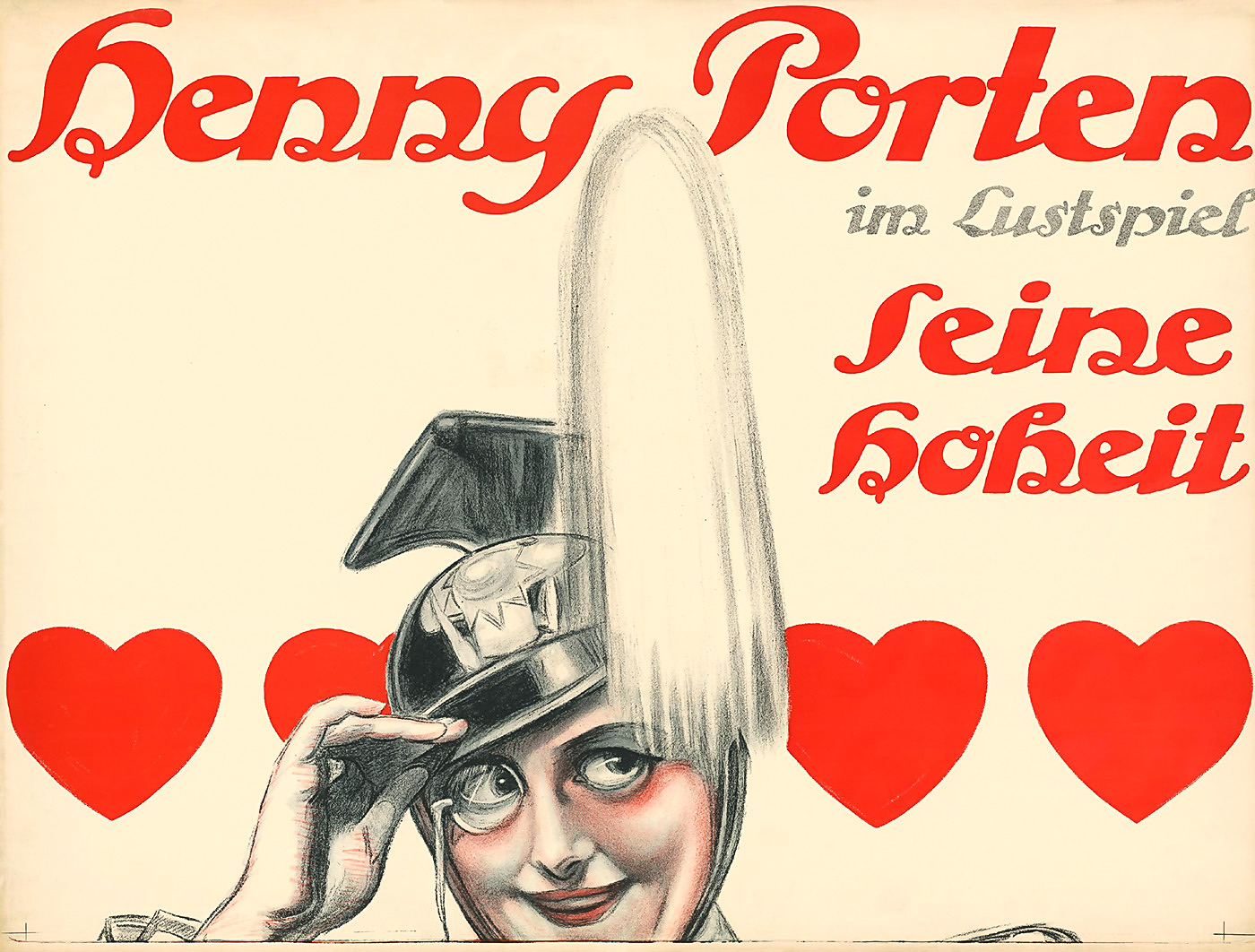
A nitrate dream soaked in kerosene perfume: Ihre Hoheit is not merely another tiara-toppler—it is the missing link between the baroque shadow-play of Balletdanserinden and the civic despair of The Criminal Path.
Let us dispense with the easy epithet: “royal romance.” Henny Porten, that marble-skinned icon whose gaze could refrigerate champagne, spends the film divesting herself of romance the way a snake sloughs off skin. Director/scribe Rudolf Biebrach—equal parts court archivist and anarchist—structures the narrative as a diptych of entrapment: first the palace, a labyrinth of parquet and ancestral dust; then the city, a lattice of beer halls and pamphleteers where monarchy is but a paper mask. The hinge between these worlds is a single close-up of Porten’s pupil dilating beneath a chandelier’s drip of crystal light—an iris eclipsing the Habsburg double-eagle.
The cinematographer, Julius Dewald, treats Viennese interiors like aquariums of stale time: camera tracks backward through ballrooms where footmen appear to levitate an inch above the floorboards, their reflections in polished marble creating phantom twins. Contrast this with the third-act exteriors shot in the working-class Ottakring district—grainy, hand-held, almost newsreel. One match-cut jumps from a gilded doorknob shaped like a laurel-wreathed fist to a brewery tap shaped like the same fist, now cast in cheap tin. The empire’s symbols do not shatter; they merely oxidize.
Color tinting, restored in 4K from the only surviving Czech print, alternates between imperial violet (for candle-lit intrigue) and bile-green (for the republican underbelly). When Porten rips her ducal sash, the tear is hand-painted carmine on each frame—twenty-four wounds per second. The effect is less melodramatic than surgical: monarchy bleeding out one frame at a time.
“We are born wearing porcelain; life is the crack,” whispers the cartographer. The line never appears in intertitles—it is spoken only in the viewer’s retina after the film has ended.
Forget every regal stereotype from The Pride of Jennico: Porten’s arch-duchess never swoons. Her first gesture on waking is to snap a pearl necklace so the beads ricochet like miniature planets—an act less tantrum than experiment in gravity. Throughout the film she retains a zoological alertness, head cocked as if sniffing ozone before thunder. Critics of 1915 dismissed this as “too mechanical,” yet today it reads as proto-modernist: a woman learning to operate her own face as if it were newly issued equipment.
Watch her hands—always the hands. In Act I they rehearse courtly postures: fan-flutter, glove-tug, the fingertip-balance of a teacup rim. By Act III those same fingers, now bare, drum on a tavern table in 3/4 waltz time, except the musicians have shifted to a march. The body rebels against its muscle memory; monarchy becomes a neurological error.
Richard, billed simply as “Der Fremde,” arrives with a leather satchel crammed with maps whose coastlines shift between shots—continents drift like gossip. His performance is all angles: cheekbones sharp enough to slice sealing-wax, elbows that jut when he bows, making deference feel like insult. In a bravura medium-shot he overlays a transparent map of Vienna onto the palace window; street-grid and ballroom align so that a revolutionary procession appears to march straight through the waltzing couples. Geography is exposed as political graffiti scrawled on the same wall.
Yet the film denies him savior status. When he offers the princess a compass, she flips the needle with her thumb so it points perpetually toward the palace. The gesture is ambiguous: nostalgia or ironic curse? The lovers part not in each other’s arms but in parallel tracking shots—she on a train, he on a dirigible—moving in opposite directions along the same matte-painted sky.
Surviving cue sheets indicate the original Vienna premiere employed a reduced “Schrammelquartet” plus military drum. Modern restorations often slap on generic waltz pastiche, but the savvy curator should opt for Anton Webern’s Langsamer Satz—its micro-dissonances echo the film’s hairline fractures of authority. During the necklace-snapping scene, drop out all sound for ten seconds; let the audience hear the inside of their own skulls. Then reintroduce a single tam-tam struck so softly it feels like memory.
While Házasodik az uram frolics in peasant farce and Peril of the Plains gallops through Manifest Destiny, Ihre Hoheit occupies a twilight zone closer to As You Like It’s forest exile—only here the forest is asphalt, the exiled royalty a woman who abdicates her own reflection. Where The Pit wallows in commodity-market savagery, Biebrach’s film stages a stock market of souls: monarchy’s shares plummet in real time.
Even the documentary With Our King and Queen Through India cannot compete with the documentary-of-disintegration that is Ihre Hoheit. The former preserves pomp; the latter pokes pomp until it deflates like a punctured coronation balloon.
Notice how the film refuses to show the princess in official portraiture. Every other royal melodrama immortalizes its heroine on canvas—think Balletdanserinden’s pirouette frozen in oils. Here, the empty frame gapes like a scream. When courtiers bow, they bow to absence, a ritualized void. The camera compensates by fetishizing Porten’s kinetic silhouette: the curve of her scapula as she unlaces her corset, the hinge of her wrist while signing abdication papers. The body becomes mutable text; sovereignty is handwriting that can be crumpled and tossed into a waste-basket that once held the Habsburg seal.
Feminist critics have sparred over whether the final train journey signals liberation or new imprisonment. I posit a third reading: the princess exits the narrative railroad switch by switch, becoming pure trajectory. The last shot—her profile dissolving into steam—fulfills the cartographer’s prophecy: “Where we go, the map ends.”
Viennese police seized the third reel in 1916, claiming it “undermined dynastic morale at a time of war.” Bootleg screenings proliferated in field hospitals—orderlies projected it onto bed-sheets, turning wounded elbows into makeshift curtains. Fast-forward a century: the 2022 Pordenone Silent Festival audience gasped when the necklace beads morphed into falling shrapnel via digital tint, a hallucination no 1915 eye could have witnessed yet feels historically inevitable.
Letterboxd lists Ihre Hoheit under 400 views—criminal for a film that anticipates Queen Christina and Marie Antoinette alike. Algorithms ignore it because royalty in monochrome lacks capes and CGI dragons. Cine-essayists, take up your pens: here is a queen who trades her crown for a rail ticket and still outranks every superhero.
Legend speaks of a lost reel depicting the princess working as a laundress, sleeves rolled to elbows in suds of imperial lace. No negative survives, but the Prague Film Archive holds a single production still: Porten elbow-deep in a basin, steam veiling her like ectoplasm. Scholars debate whether this sequence ever existed; I prefer to believe it does exist—somewhere between the sprocket holes, celluloid breathing like damp linen.
Because we live in an era when monarchy reboots itself as reality TV, Ihre Hoheit offers a detox: royalty as self-dissolving myth. Because Henny Porten’s face—caught between marble and vapor—teaches more about power than a thousand textbooks. Because the film runs only 72 minutes yet contains multitudes: revolutions, heartbreaks, cartographies of the impossible.
Stream it if you can (the restored DCP occasionally tours arthouses). If not, project it inside your cranium: imagine violet tint bleeding into bile-green, imagine the clang of a palace gate that sounds like a starting pistol for the twentieth century. Then walk outside, feel the asphalt under sneakers—your own unmapped republic—and know that somewhere, a princess once traded porcelain for pulse, and the world’s been wobbling ever since.
IMDb 4.3
1931
Community
Log in to comment.