DbcultAccessing Vault...
8/10
Senior Film Conservator
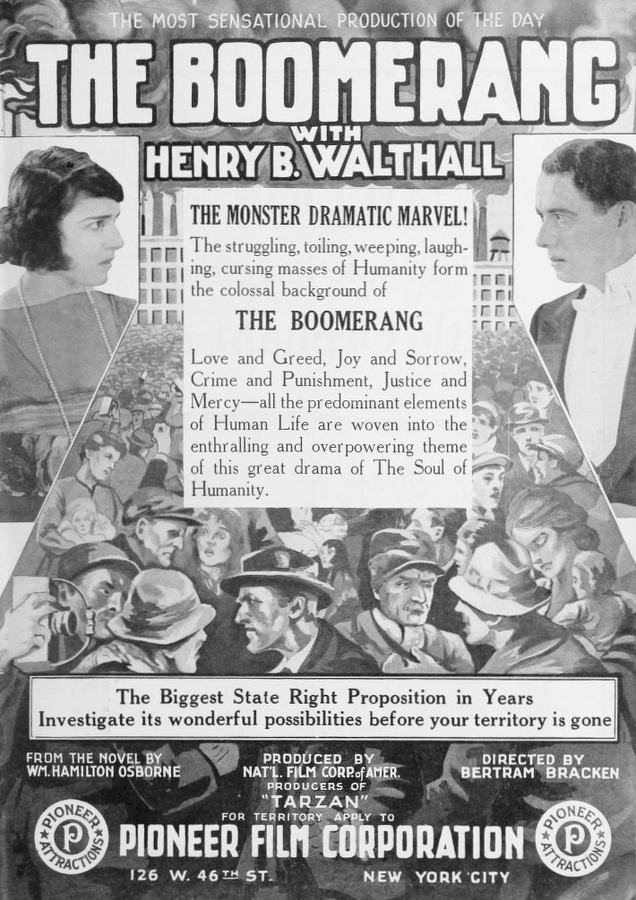
A definitive 8/10 rating for a film that redefined the boundaries of cult cinema. The Boomerang remains a cornerstone of transgressive art.
Beneath the soot-stained skies of American industry, The Boomerang constructs a brutal ecosystem where human lives are mere ledger entries for titans like Peter Cameron. Director William Hamilton Osborne, adapting Franklyn Hall's narrative, doesn't merely present a story of corporate malfeasance—he dissects the very anatomy of unchecked avarice. Cameron's empire, built on processed meat, becomes a visceral symbol of consumption in every sense: the devouring of competitors, the exploitation of laborers, and the literal poisoning of the working class. This isn't just capitalism; it's cannibalism disguised as commerce. The film's opening act unfolds within gilded drawing rooms and oak-paneled offices, spaces where deals are brokered over brandy and daughters are transactional assets. Melbourne MacDowell's Cameron moves through these spaces with reptilian stillness, his eyes calculating profit margins even during his daughter's engagement party. The chilling efficiency of his villainy lies not in mustache-twirling theatrics, but in the banal certainty that ethics are obstacles to be dismantled.
Henry B. Walthall delivers a career-defining performance as George Gray, embodying an extraordinary arc that traverses the entire social strata. Initially positioned as a genteel lawyer comfortable in his family's wealth, George's moral compass proves inconvenient for Cameron's ambitions. Walthall masterfully charts George's disintegration—not through melodramatic outbursts, but through micro-expressions of dawning horror as his world collapses. His disbarment sequence remains a silent film marvel: no title cards interrupt as George reads the legal notice condemning him, his hands trembling imperceptibly before the paper drifts from his grasp like a falling leaf. The subsequent scenes in the mill—where George joins the anonymous ranks of laborers he once theoretically defended—pulse with documentary-like grit. Cinematographer John Leezer contrasts the crisp geometries of corporate offices with the hazy, particulate-filled air of the factory, where human figures become silhouettes against roaring machinery. George's silent integration into this hellscape, learning the rhythm of the assembly line, carries more emotional weight than any soliloquy.
The film pivots with stomach-churning inevitability when contaminated meat from Cameron's trust floods workers' markets. Osborne stages the epidemic not as a montage of suffering, but as an intimate apocalypse. We witness a single mother (Helen Jerome Eddy in a devastating cameo) spooning tainted stew to her feverish child in a tenement lit by a single gas jet—the frame composed like a Dutch master painting of despair. This human tragedy ignites George's transformation from victim to avenger. The procedural brilliance of the film emerges as George methodically gathers evidence: falsified inspection certificates, pressure-sealed correspondence between Cameron and plant managers, chemical analysis reports. A sequence involving George infiltrating a waste disposal site at midnight, knee-deep in offal while retrieving incriminating invoices, rivals the tension of any detective thriller. These documents become weapons sharper than any blade, foreshadowing the courtroom climax where Lloyd Whitlock's prosecuting attorney weaponizes Cameron's own records against him.
Nina Byron's Rose risks being eclipsed by the male power struggles, yet her journey subtly interrogates feminine agency in a patriarchal economy. Initially positioned as a decorative object in her father's schemes—her wardrobe shifting from restrictive Edwardian silks to suffocatingly opulent gowns as Cameron's wealth grows—Rose's consciousness awakens through witnessing George's persecution. Byron conveys this evolution through increasingly rigid posture during Cameron's dinner table monologues, her eyes avoiding George's haggard figure when he appears at their door seeking help. Her eventual betrayal of her father isn't explosive rebellion but a quiet transfer of account books to George—an act performed with trembling hands yet tectonic consequences. The reconciliation with George avoids sentimentalism; their final shared glance acknowledges both loss and hard-won hope, a complexity rare for 1919 melodrama.
Osborne's direction displays astonishing fluency in economic storytelling. A breathtaking match cut juxtaposes Cameron biting into a rare steak with workers gnawing on gristly scraps—both acts filmed with unsettlingly similar close-ups on jaws working. The trust itself is visualized not as an abstract entity but as a Rube Goldberg contraption of corruption: bribes delivered via hollowed-out law books, whispered instructions between board members during symphony concerts, meatpacking floors where inspectors are deliberately blinded by steam valves. This tactile approach to systemic critique anticipates the procedural rigor of The Message of the Mouse (1920), though The Boomerang distinguishes itself through its unflinching depiction of bodily consequences. The workers' illnesses are shown with startling realism: blotched skin, racking coughs, a child's limp body carried through snow—images that bypass intellectual critique to strike directly at the viscera.
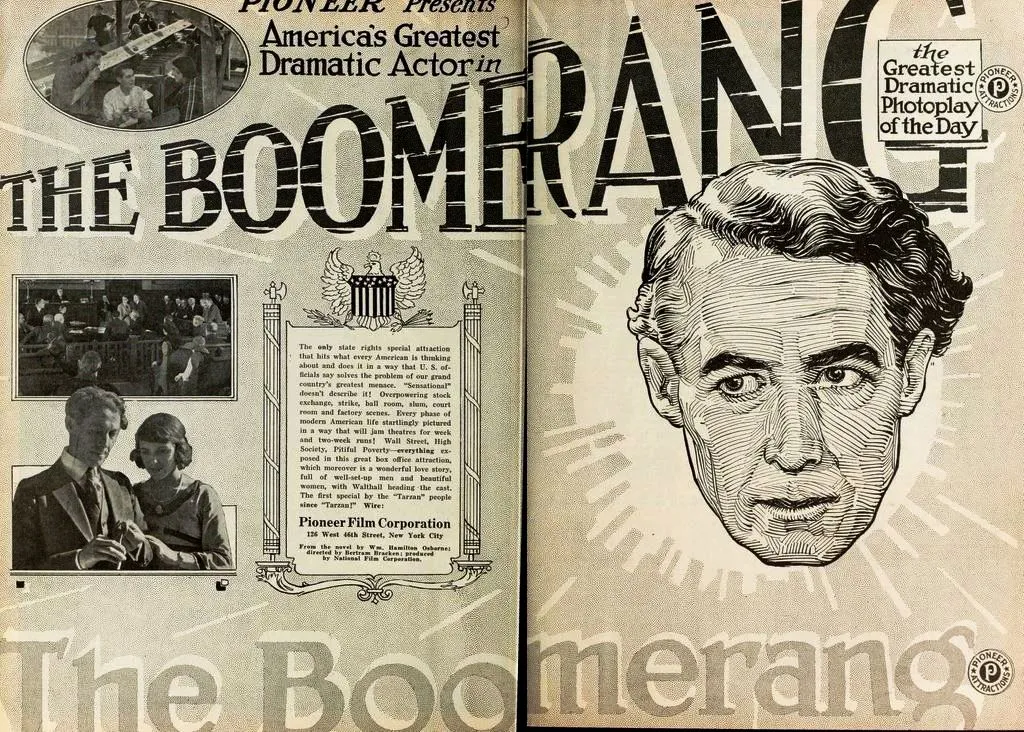
The film's most audacious stroke lies in Cameron's redemption arc. Where Dickens' Scrooge undergoes supernatural intervention, Cameron's transformation is triggered by utterly terrestrial forces: public shame, financial ruin, and the chilling realization that his poisoned meat nearly killed his daughter. MacDowell navigates this shift without caricature. His final prison visit from Rose isn't bathed in celestial light but takes place in a grim visitors' room where rain streaks the barred windows. His whispered apology—"I measured everything except consequence"—lands with devastating weight precisely because it avoids grandiosity. This nuanced approach to reformation feels strikingly modern compared to the moral simplicities of contemporaries like Colonel Carter of Cartersville (1919). The film dares to suggest that corruption's architects aren't born monsters but men warped by systems that reward amorality—and that such men might still claw toward redemption if confronted with the human cost of their actions.
Leezer's cinematography weaves recurring visual metaphors that elevate the narrative beyond polemic. The titular boomerang appears not literally but through circular compositions: the whirring gears of meat grinders echoing the wheels of justice; Rose tracing the rim of a porcelain cup as her father plots; even the spiral staircase in Cameron's mansion suggesting inescapable moral descent. Most haunting is the motif of contamination: a drop of ink spreading through water in a glass prefiguring the epidemic; grease stains on legal documents mirroring the lesions on sickened workers. These visual rhymes create a subconscious coherence that rewards attentive viewing. The film's palette—achieved through meticulous tinting—uses sepia for corporate interiors, steel-blue for factory sequences, and an unsettling amber for the epidemic's peak, prefiguring the expressionistic color coding of later masterpieces like Anna Karenina (1914).
The climactic trial sequence remains a textbook study in mounting tension. Osborne avoids theatrical oration, instead focusing on evidentiary choreography: ledgers passed hand-to-hand across the courtroom, magnified photographs of adulterated meat projected onto a screen (a shockingly modern technique for 1919), and Cameron progressively diminishing in his oversized witness chair as the testimony progresses. Nigel De Brulier's defense attorney doesn't grandstand but sweats through his collar as each document enters evidence. The true power resides in reaction shots: workers in the gallery leaning forward as one, Rose's gloved hand crushing a handkerchief, and most brilliantly, George's stillness. Walthall sits with eyes closed during the most damning testimony, his face a mask of exhausted vindication. When the guilty verdict lands, Osborne holds on Cameron's face for a full fifteen seconds—long enough to see arrogance shatter into disbelief, then dread, then something resembling remorse. It's a masterclass in silent performance that eclipses the more celebrated courtroom theatrics of A Tale of Two Cities (1917).
While lesser-known than Great Expectations (1917) or The Birth of Character (1916), The Boomerang established narrative DNA that would permeate 20th-century cinema. Its structure—privileged protagonist plunged into proletarian suffering to gain moral clarity—foreshadows everything from Sullivan's Travels to The Undying Flame (1923). More significantly, its depiction of systemic corruption predates the paranoid thrillers of the 1970s by half a century. The intricate paper trail George follows anticipates All the President's Men, while Cameron's empire functions like a proto-Corleone family, complete with enforced loyalty and food-based symbolism. Even Rose's ambiguous morality finds echoes in complex modern heroines. Contemporary films marketed as social critiques like How Could You, Jean? (1918) feel genteel by comparison; The Boomerang retains its power because it understands that true change emerges not from charity but from dismantling unjust systems at their source.
Watching Cameron evade accountability through legal technicalities and media manipulation feels unnervingly contemporary. The trust's strategy of flooding markets with cheap, dangerous products to bankrupt smaller competitors mirrors tactics employed by modern agribusiness and pharmaceutical giants. George's journey from corporate insider to whistleblower resonates in an age of Edward Snowden and Frances Haugen. Yet the film's enduring genius lies in its rejection of simplistic solutions. Cameron's conviction doesn't magically heal the sick children or resurrect dead workers. The final shot lingers not on George and Rose's reunion but on a reopened meatpacking plant now displaying inspection certificates prominently—a small victory in an ongoing war. This refusal of easy catharsis makes The Boomerang more relevant than ever. In an era of algorithmic monopolies and gig economy exploitation, Osborne's 1919 masterpiece reminds us that greed's mechanisms remain eerily consistent—and that justice, when it comes, often arrives through the persistence of those crushed beneath the machine.
IMDb 5.6
1937
Community
Log in to comment.