DbcultAccessing Vault...
6.9/10
Senior Film Conservator
A definitive 6.9/10 rating for a film that redefined the boundaries of cult cinema. Ikarus, der fliegende Mensch remains a cornerstone of transgressive art.
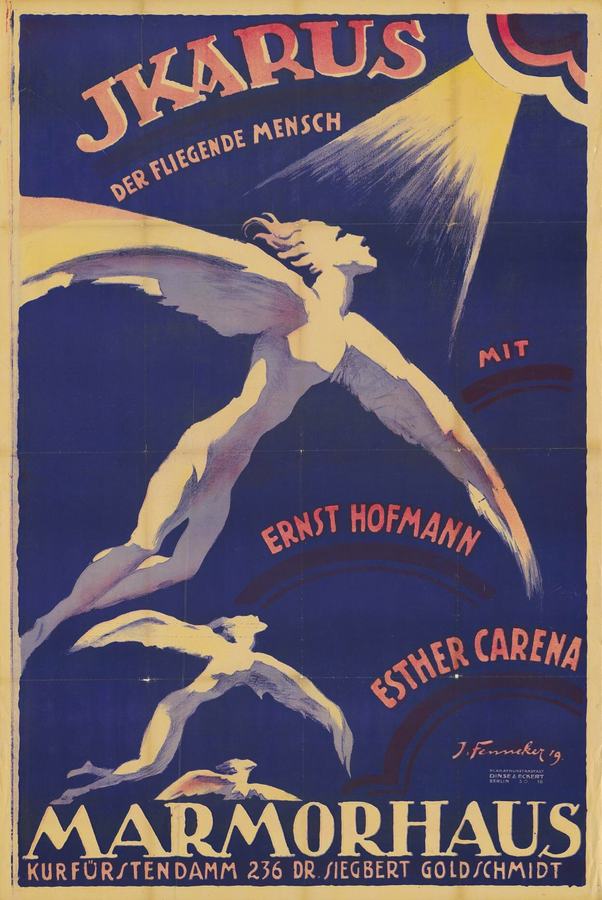
Ah, the silent era! A time when narratives unfolded not through spoken dialogue, but through the eloquent ballet of gesture, the intensity of expression, and the sheer evocative power of visual storytelling. Among the myriad cinematic gems from this epoch, Ikarus, der fliegende Mensch (1921) stands as a testament to humanity's eternal fascination with flight, ambition, and the precipice of hubris. This film, a captivating blend of scientific aspiration and poignant human drama, plunges us into a world teetering on the cusp of modernity, where the impossible was merely a challenge awaiting an audacious mind.
The very title, ‘Ikarus, der fliegende Mensch,’ immediately evokes the ancient Greek myth of Icarus, a tale of boundless ambition and its tragic consequences. Yet, this film, penned by Leo Heller and Herr Breitner, masterfully transposes this timeless allegory into the early 20th century, replacing wax and feathers with gears, canvas, and the nascent science of aeronautics. It’s a brilliant conceptual leap, allowing the narrative to explore the same profound themes of human aspiration and the delicate balance between genius and folly, but through a distinctly modern lens. The protagonist, Karl Richter, brought to vivid, almost manic life by Ernst Hofmann, is not merely an inventor; he is a living embodiment of the era’s boundless optimism and its inherent dangers. His obsession with flight is not just a scientific endeavor; it's a spiritual quest, a yearning to transcend earthly limitations that borders on the divine.
Hofmann’s portrayal of Richter is nothing short of mesmerizing. Without a single spoken word, he conveys the character's internal inferno—the relentless drive, the flashes of inspiration, the mounting frustration, and the poignant isolation that often accompanies true genius. His eyes, at turns sparkling with childlike wonder and shadowed by existential dread, are the true windows to Richter’s soul. The supporting cast, too, plays their roles with remarkable nuance. Esther Carena, as Lena, Richter’s fiancée, delivers a performance steeped in a delicate mixture of love, fear, and quiet despair. Her silent pleas and desperate glances speak volumes about the emotional toll Richter’s ambition takes on those closest to him. Olga Engl, as Frau Richter, embodies the universal maternal worry, her expressions a poignant counterpoint to her son's soaring dreams.
The directorial vision behind Ikarus is evident in every frame. The cinematography, while constrained by the technology of its time, is remarkably sophisticated. Close-ups are employed judiciously to emphasize the emotional weight of a scene, drawing the audience into the characters' inner worlds. Long shots, particularly during the climactic flight sequence, are breathtaking, conveying both the vastness of the sky and the terrifying fragility of Richter’s machine. The use of lighting is particularly noteworthy; shadows play a crucial role, often mirroring Richter’s internal struggles—his workshop bathed in a stark, almost otherworldly glow, contrasting with the warm, inviting light of Lena’s home, representing the life he risks losing. The pacing, a common challenge in silent films, is handled with a deft hand, building suspense gradually, culminating in a crescendo of exhilarating and terrifying moments.
Comparatively, one might draw parallels to the visceral intensity found in films like The Struggle, where human endurance against formidable odds forms the core narrative, or even the psychological depth explored in The Whispering Chorus, though Ikarus grounds its internal conflict in a more tangible, physically demanding pursuit. The film’s visual language, while perhaps not reaching the expressionistic heights of later German cinema, nonetheless utilizes stark contrasts and dynamic compositions to underscore its thematic concerns. The towering industrial backdrops, often shrouded in smoke and steam, serve as a powerful metaphor for the era’s relentless drive towards progress, a force that both enables and threatens Richter’s singular vision.
At its core, Ikarus, der fliegende Mensch is a profound meditation on the eternal conflict between idealism and pragmatism. Karl Richter represents the unbridled spirit of innovation, the belief that with enough ingenuity and will, humanity can overcome any obstacle. His foil, Professor Gruber, symbolizes the cautious, established scientific order, grounded in empirical evidence and wary of reckless abandon. This ideological clash is further complicated by the nefarious machinations of Herr Schmidt, played with chilling effectiveness by Heinz Sarnow, who embodies the corrupting influence of commercialism. Schmidt sees Richter’s dream not as a triumph of the human spirit, but as a commodity to be exploited, a stark reminder that even the most noble endeavors can be tainted by greed.
The film deftly navigates these complex relationships, showing how each character’s perspective shapes Richter’s journey. Lena’s love is a constant anchor, a reminder of the human cost of his obsession. Her fears are not trivial; they are the voice of caution, the silent plea for balance. The dynamic between Richter and Schmidt, in particular, adds a layer of suspense and moral ambiguity. Is Richter’s pursuit of flight truly selfless, or is there an element of ego, of a desire for recognition, that mirrors Schmidt’s own ambition, albeit in a darker form? These are the questions the film poses, without necessarily providing easy answers, inviting the audience to engage in a deeper reflection.
The film’s climax is a masterclass in silent storytelling. The public demonstration of Richter’s flying machine is depicted with a palpable sense of anticipation and dread. The crowd’s faces, a mosaic of hope, skepticism, and fear, reflect the diverse reactions to Richter’s audacious project. When the machine finally takes to the sky, it is a moment of pure cinematic magic. The camera follows its ascent, capturing the sheer improbability and beauty of human flight. The soaring music (in the original theatrical presentation, of course) would have undoubtedly amplified the emotional impact, transforming the visual spectacle into an almost spiritual experience. Yet, true to the Icarus myth, this triumph is fleeting. As Richter pushes his creation to its limits, the mechanical strains become visible, audible in the audience’s collective gasp. The ensuing descent is harrowing, a visceral representation of the fragility of human ambition when confronted with the unyielding laws of nature. It’s a moment that resonates with the raw, untamed spirit seen in films like The Conflict, where man battles elemental forces, or even the personal struggles depicted in Marionetki roka, albeit on a grander, more physically perilous scale.
The ingenuity of the special effects for the era cannot be overstated. The illusion of flight is remarkably convincing, drawing the audience into the spectacle. The sequence is edited with a keen sense of rhythm, intercutting between Richter’s desperate struggle in the cockpit, the horrified reactions of the crowd below, and the machine’s agonizing descent. This rapid-fire editing heightens the tension, creating a sense of impending doom that is almost unbearable. It’s a testament to the filmmakers’ skill that they manage to evoke such profound emotion and suspense without the aid of spoken dialogue or modern CGI. Every gesture, every camera angle, every cut serves to propel the narrative and amplify its emotional resonance.
Unlike the mythical Icarus, Richter’s fall is not fatal, but transformative. He survives, albeit shaken and humbled, his machine a shattered symbol of his unchecked ambition. This conscious departure from the myth’s tragic ending is where the film truly shines, offering a more nuanced and ultimately hopeful message. Richter's survival allows for a profound moment of introspection and reconciliation. The final scenes, where he reunites with Lena, are imbued with a quiet power. His ambition is not extinguished, but tempered by wisdom and a renewed appreciation for human connection. The film suggests that true progress lies not just in conquering the external world, but in understanding and mastering oneself.
The performances in these concluding moments are particularly poignant. Hofmann’s Richter, stripped of his bravado, reveals a vulnerability that makes him all the more human and relatable. Carena’s Lena, her initial fear giving way to profound relief and enduring love, anchors the film in its emotional reality. The resolution, while perhaps less dramatic than a full-blown tragedy, is far more resonant, speaking to the cyclical nature of human endeavor—the inevitable setbacks, the lessons learned, and the enduring capacity for growth and redemption. It echoes themes of personal growth and overcoming adversity seen in films like Winning Grandma, though Ikarus operates on a grander, more philosophical canvas.
Ikarus, der fliegende Mensch, despite its age, remains remarkably relevant. In an era where technological advancements continue to push the boundaries of what’s possible, the film’s cautionary tale about unchecked ambition and the importance of humility resonates deeply. It reminds us that while innovation is vital, it must be balanced with wisdom, empathy, and an understanding of our own limitations. The film’s exploration of the human cost of obsession, the tension between individual genius and societal skepticism, and the eternal quest for transcendence continues to captivate and provoke thought.
The performances by Ernst Hofmann, Ernst Rennspies, Olga Engl, Heinz Sarnow, Gustav Botz, Esther Carena, and Edith Sorel contribute to a tapestry of human experience that transcends the silent film format. Each actor, through carefully calibrated gestures and expressions, adds depth and authenticity to their respective roles, creating a cohesive and emotionally resonant ensemble. The film's enduring power lies not just in its visual spectacle, but in its ability to tap into universal human experiences—the dream of flight, the fear of failure, the solace of love, and the arduous journey of self-discovery. It is a cinematic triumph, a silent symphony of ambition and introspection that continues to soar in the annals of film history, inviting new generations to ponder the timeless question: how high is too high, and at what cost do we pursue our most audacious dreams?
In many ways, Ikarus, der fliegende Mensch is not just a film about an inventor; it is a film about the human condition itself. It speaks to the part of us that yearns for the impossible, that dares to dream beyond the horizon, but also reminds us of the grounding forces that keep us tethered to reality. It's a poignant reminder that while we may reach for the sun, we must always remember the fragile nature of our wings. For those seeking to delve into the rich tapestry of early cinema, and particularly those fascinated by narratives that blend scientific ambition with deep psychological insight, Ikarus, der fliegende Mensch is an absolute must-see. Its artistic merit, thematic depth, and groundbreaking technical achievements secure its place as a pivotal work in cinematic history, a beacon illuminating the profound storytelling capabilities of the silent screen. It’s a film that, much like its protagonist, dared to dream big, and in doing so, achieved something truly extraordinary.

IMDb 6.3
1928
Community
Log in to comment.