DbcultAccessing Vault...
Cult Review
Senior Film Conservator
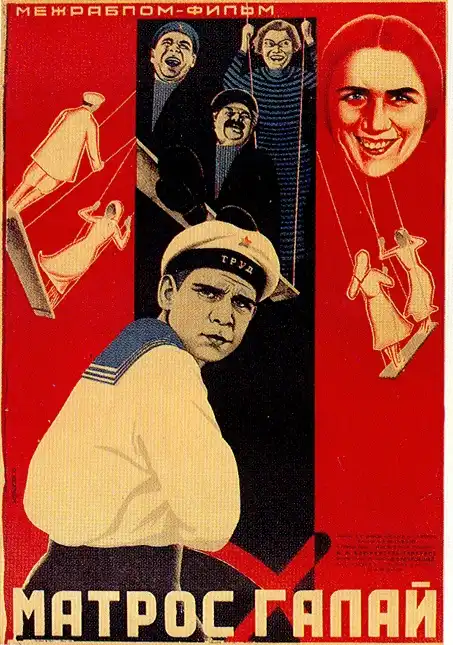
So, is Matros Ivan Galay worth digging up today? Look, if you’re a serious student of film history, or just someone who gets a real kick out of seeing how movies used to be made, then absolutely. For anyone else expecting, well, anything remotely modern in terms of pace or story, you’ll probably be climbing the walls after twenty minutes. This one’s for the patient, the curious, and maybe the slightly masochistic cinema buffs. 🍿
The whole thing feels like someone just pointed a camera and said, “Go on, live your life, Ivan.” There’s a deliberate slowness that feels less like artistic choice and more like, well, that’s just how films moved back then. You really get a sense of a different era, where storytelling was a much more _unhurried_ affair.
Aleksey Muravin as Ivan Galay is interesting. He doesn’t really *act* in the way we think of it now, more like he *embodies* the sailor. His movements are broad, almost pantomime sometimes, but there’s a sincerity in his big, expressive eyes. You spend a lot of time just watching him react, or not react, to things.
There’s this one shot, early on, where Ivan is just staring out at what I assume is a harbor. The camera just holds on him, and holds, and holds. You can almost feel the wind on his face, even though it’s a silent film. It’s **hypnotic**, in a way, but also makes you wonder if the editor just went for a coffee break. ☕
Mariya Blyumental-Tamarina, who plays… well, it’s not entirely clear her relationship to Ivan, but she definitely leaves an impression. Her character has this amazing intensity, particularly in her gaze. She’s got a presence that cuts through the slightly blurry film stock and the often-static camera work. You can tell she knows how to command a scene, even if the scene itself is just her sitting quietly.
There’s a scene where she’s arguing, or at least *gesturing* emphatically, with another character. Her hands are flying, her face is a mask of emotion, and then the other person just kind of shrugs. It’s an **oddly deflating** moment, like all that passion just bounced off a wall. You feel the effort, but maybe not the payoff. It’s very human, that.
The use of light is pretty rudimentary, but sometimes it just _works_. Like when Ivan is framed against a bright sky, and he becomes this silhouette, a real symbol of the working man. Other times, everyone looks a bit flat, like they’re standing in front of a painted backdrop, which, let’s be honest, they probably were. It’s charming in its simplicity.
You can see the foundations of cinematic language being built here. Moments that feel clumsy now were probably groundbreaking then. There’s a bit where Ivan is walking along a street, and for a few seconds, the camera actually _moves with him_, a little jittery, but it’s there! It makes you lean in, almost, like you’re seeing something truly special.
And the boats! My goodness, there are a lot of shots of boats. Big boats, small boats, boats just sitting there. If you like nautical themes, you’re in for a treat. It’s almost like a documentary on early 20th-century maritime life sometimes. I half expected a title card just saying, “Behold! A Ship!”
The whole experience feels less like watching a polished narrative and more like sifting through old photographs. Some are blurry, some are posed, but every now and then, you find one that just *clicks* and shows you a little piece of a world long gone. The Tents of Allah or In the Power of Opium might give you a similar vibe, if you're into this kind of thing.
This film isn't trying to impress you with clever dialogue or a twisty plot. It’s just… a story about a sailor. And for what it is, a historical artifact showing us how they did it back then, it’s kinda cool. Just don't go in expecting a Hollywood blockbuster. Or even a particularly fast Russian one. 😉

IMDb 6.8
1932
Community
Log in to comment.