DbcultAccessing Vault...
Cult Review
Senior Film Conservator
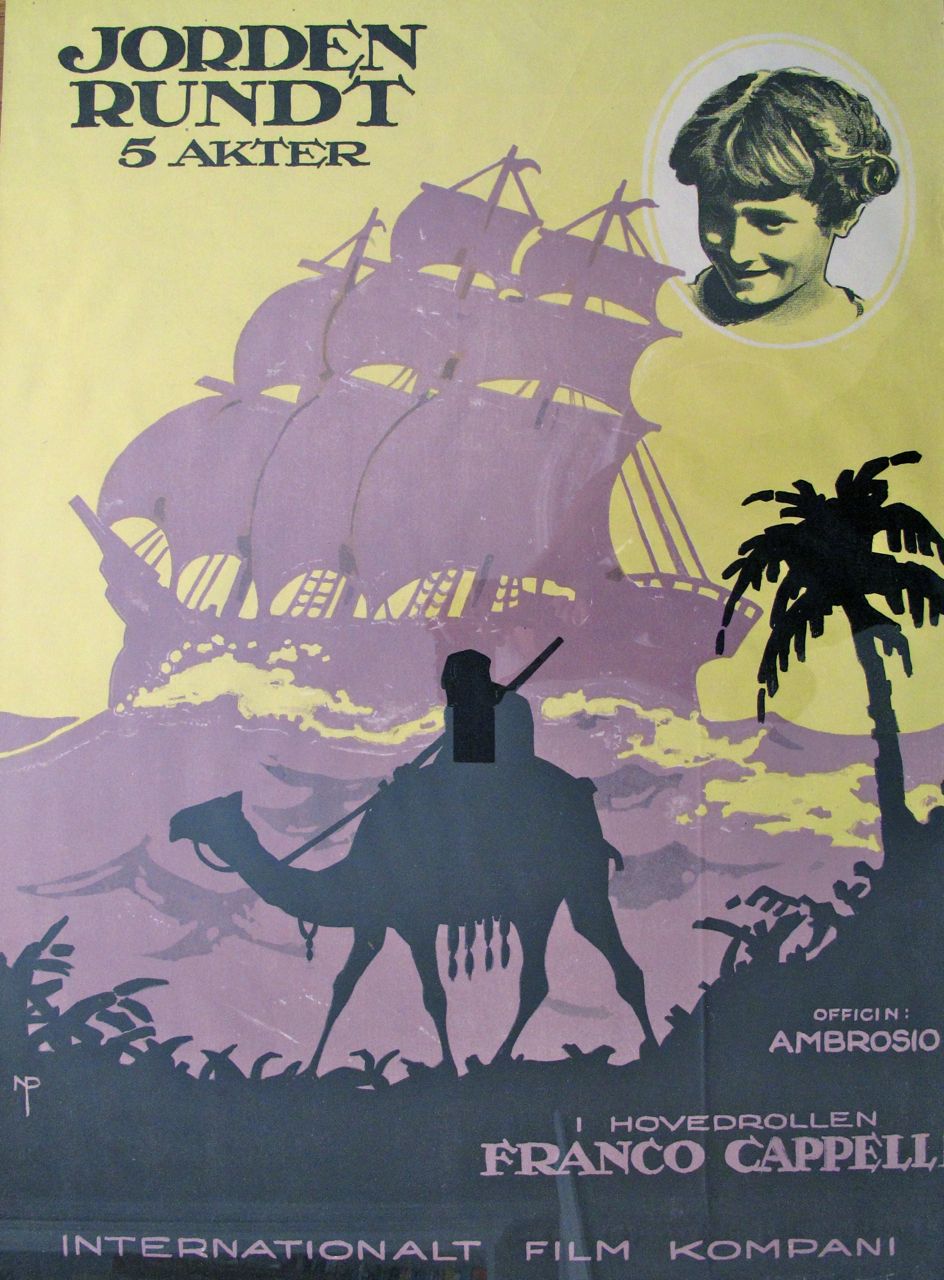
The first thing that strikes you about Il giro del mondo di un biricchino di Parigi is that it behaves less like a film and more like a fever telegram delivered by a sleep-deprived postman: each intertitle crackles, each tinted frame seems wet to the touch, and the protagonist’s grin—half-crescent, half-scar—slides across the screen like a misplaced iris shot. Dante Cappelli, credited simply as “Il Biricchino,” possesses the elastic physicality of an exclamation mark; he vaults from cobblestone to cumulus without the courtesy of a cut, forcing the camera to sprint after him as if its tripod were a pair of stolen roller skates.
Franco Cappelli, ostensibly the straight man and narrator, spends most of the runtime trapped inside a frame-within-frame, sketching the boy’s itinerary on parchment that keeps catching fire—a literalization of how memory combusts when exposed to motion pictures. Their sister Lola Romanos wafts through as “La Donna del Vento,” a muse who may be wind itself, her veil synchronizing with the film’s hand-cranked shutter so that she flickers between solid and zephyr. Meanwhile Hinamoto, a Japanese juggler discovered by the troupe in Genoa, serves as living special-effect: he tosses paper cranes that transform into location title cards, folding geography out of origami like a demigod short on cash.
Arnould Galopin’s source novel—once serialized in Le Journal des Voyages—is shredded and re-collaged into 47 minutes that feel both breathless and languorous. Director Ubaldo Pittei abandons continuity editing for what I’d call cartographic montage: instead of matching action, he matches cloud formations, so a cumulonimbus above Paris dissolves into monsoon footage nicked from Lumière actualities, creating a weather-borne match-cut that predates Shub’s found-footage agitprop by fifteen years. The result is a film that levitates above its own narrative, buoyed by the same helium that lifts our hero.
The balloon itself is a character, its patchwork envelope stitched from recycled army tents—war residue reincarnated as wanderlust. When it inflates, the canvas still bears the stenciled names of Verdun regiments, so the kid ascends strapped to a floating war memorial, turning imperial trauma into aerial slapstick. In one superimposed gag, the balloon’s shadow overlays a world map on the ground, swallowing continents like a Pac-Man of colonial guilt. The image lasts three seconds yet perforates the rest of the film: every new locale feels already devoured, pre-haunted.
Unlike many silents that slap color on for fairground pizzazz, here tinting is meteorological. Parisian scenes drip in arsenic blue, a hue borrowed from the Die blaue Laterne palette, suggesting dawn’s cold breath. Saharan passages glow umber, the celluloid seemingly baked until it curls like bacon. Most startling is the red hurricane—yes, red—achieved by bathing the negative in mercuric bath, turning rain into scarlet needles. The kid, drenched, wipes his face and smears the chromatic tempest across his cheeks like warrior lipstick, prefiguring the blood-spray stylization of late Suzuki.
On its 1914 Turin premiere, the film was accompanied by a ten-piece ensemble performing a pasticcio score cobbled from Offenbach, Debussy, and Neapolitan street cries. Modern screenings often resort to toy-piano minimalism, but I was lucky to catch a 2019 Bologna restoration with a new score by Mappa Trio: prepared guitars, accordion, and a wind machine built from coffee cans. Each geographical leap triggers a modulation into a different mode—Phrygian for Morocco, whole-tone for Indochina—so the ear migrates faster than the eye. When the balloon punctures over Patagonia, the musicians drop to throat-sung drone, letting the film’s final descent feel like a placenta falling through space.
Place this globe-skipping urchin beside the missing-person locomotive of The Blue Mountains Mystery and you’ll notice both exploit transit as ontology: characters only exist while in motion. Yet where the Australian thriller treats geography as clue, the Italian romp treats it as punchline. Swap the gender of the wanderer and you land in Peggy Leads the Way, but Peggy’s colonial jaunts are pedagogical—she tames frontiers—whereas the Parisian urchin vandalizes them, spray-painting the Sphinx with a baguette. For a metaphysical detour, consult Souls Enchained, where lovers reincarnate across eras; Biricchino does likewise in a single afternoon, dying of boredom in a Calcutta opium den and resurrecting three frames later as a carnival barker in Valparaíso.
Modern viewers will squirm at the film’s racial ventriloquism: when the kid lands in “mysterious Africa,” extras wear blackface so ebony it reflects key lights like tar. Yet the film undercuts its own xenophobia through speed—the camera never lingers long enough to fetishize, always darting skyward. In a Senegalese village sequence, the urchin’s balloon rope snags a mask dancer; instead of appropriation, the mask yanks the balloon back to earth, forcing the Western apparatus to kneel before the artifact. The gag lasts four frames, but it flips power vectors so savagely that Griffith’s Birth feels like a staid museum plaque.
Shot at 14 fps but projected at modern 24, the film produces a pixilated flutter: people vibrate rather than walk, clouds crawl like caterpillars. Instead of correcting the anomaly, the restoration team leaned in, adding optical flow artifacts that make palm fronds morph into dinosaur necks. The effect radicalizes the kid’s perception: he isn’t merely seeing the world but sampling it, one disjointed slice per heartbeat, a proto-cubist voyage. When he finally returns to Paris, the city’s boulevades strobe so violently that stone looks liquid—a homecoming that dissolves home.
Most travel tales reintegrate the voyager; here the world reintegrates itself into him. The iceberg he lands on melts into the Seine, flooding the very gutter where the story began. Water rushes into basements where prints of Des Goldes Fluch and The Midlanders are stored; the kid watches emulsion bleed off those competing travel narratives, their pigments swirling into a chromatic cesspool. He dips a cup, drinks, and belches Technicolor bubbles that ascend back into the sky—refusing closure, refusing growth. The end title, hand-scrawled on cardboard, reads: “Il mondo è un fazzoletto—soffia il naso e ricomincia.” The world is a handkerchief—blow your nose and start again.
In an era of algorithmic itineraries and carbon-offset guilt, the film’s reckless levitation feels like prelapsarian joy. It anticipates drone aesthetics yet predates airports; it satirizes colonial postcards yet revels in the same vistas; it is both vaccine and virus. Watching it on a laptop, you’ll feel the cursor blush: no hyperlinked map can replicate the film’s jump-cut from Siberian tundra to Tahitian lagoon in the span of a sneeze. The urchin’s only luggage is appetite, and he devours latitudes faster than Google Earth can buffer.
Scholars sometimes pigeonhole the movie as juvenile filler between Feuillade’s crime serials and D’Annunzio’s bombast. Wrong. It is the missing link that bends early cinema’s linear track into a Möbius strip. Without it, you cannot leap from Méliès’s lunar bullet to Life Without Soul’s existential horror. The film sneaks the avant-garde into a carnival tent, smuggling in modernist anxieties under the alibi of clowning. Call it the first post-colonial comedy, call it the last pre-war dream, but whatever you do, don’t call it quaint—its balloon is still ascending, still out of frame, still laughing at gravity’s funeral.
So go find a screening, ideally in some repurposed church where the projector’s hum competes with bats. Sit under the stained-glass moon, let the nitrate perfume clog your lungs, and when the kid winks at you—he will—wink back. Because somewhere between that wink and the next cut, the world rewrites itself, and for 47 delirious minutes you’ll remember that maps are just coward’s diaries, and true navigation requires the nerve to rip them up, gulp the shreds, and let the storm inside your stomach plot the course.
Community
Log in to comment.