DbcultAccessing Vault...
Cult Review
Senior Film Conservator
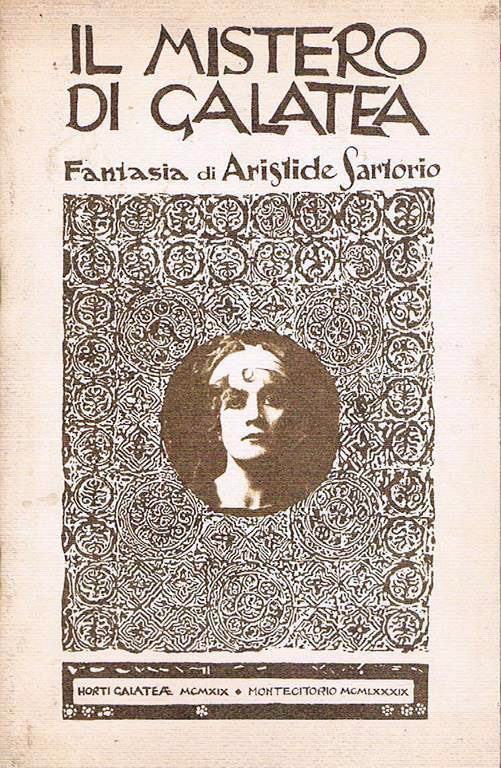
Marble lung, film heart: the island that exhales statues
There are movies you watch and there are movies that watch you while you believe you are watching them. Il mistero di Galatea belongs to the latter species, a 1919 Italian fever dream that treats mythology like wet clay, kneading it until the fingerprints of Ovid, Sartorio and the viewer become indistinguishable. Shot on orthochromatic stock that turns blood into tar and skin into alabaster, the picture feels excavated rather than projected, as if some future archaeologist had brushed away volcanic ash and found a reel still humming with pagan radioactivity.
The plot, nominally, follows a sculptor (Giulio Aristide Sartorio playing himself with the solemnity of a man who suspects he might be a renaissance relic) who discovers a partially submerged statue off Capri. Yet within minutes narrative liquefies; the marble blushes, fractures, and disgorges Marga Sevilla—an actress whose eyes carry the bewilderment of someone newly delivered from the page of a Latin poem. From here the film abandons sequential logic the way a snake sloughs skin, slipping through epochs: Fascist balconies where lovers trade eyelashes as currency; subterranean chapels where frescoes perspire; modernist penthouses that fold like paper boats. Each vignette is bound by whispered hexameters, the voice-over treating footage as wax tablets to be inscribed, erased, reinscribed.
Silent cinema usually flatters the past by embalming it; Sartorio instead infects the present with antiquity. He double-exposes each frame so that cracks in the emulsion resemble fissures in marble, then scratches the negative with volcanic sand until light itself seems carved. The result is a living quarry where shadows behave like chisels and actors resemble statuary in mid-eruption. When Galatea bleeds, her ichor pools into tiny effigies of the sculptor—an auto-generative metaphor for artistic ego metastasizing into viral idolatry. Compare this to Cupid Angling where color tinting merely prettifies, or the static tableaux of Joseph in the Land of Egypt; here the medium itself becomes metamorphosis.
Sevilla performs like someone who has read her own footnotes in a palimpsest. Watch the moment she recognizes her reflection in a mirrored grotto: her pupils dilate not with wonder but archival fatigue, as if she already knows every future adaptation of her myth. The actress modulates between statuesque stillness—breathing so subtly she appears to be operated by hidden puppeteers—and spasmodic jerks that evoke stop-motion. Critics often praise The Devil's Bondwoman for its femme fatale, but that performance coils around male fear; Sevilla instead radiates ontological vertigo, the terror of being both origin and replica.
Archival notes reveal that Sartorio screened rough cuts for a string quartet who improvised on themes from Monteverdi and Neapolitan work songs. Contemporary restorations graft a score of clinking pumice, bowed marble slabs, and breathy flutes carved from tufa. The percussion mimics chisel strikes, accelerating during dissolves until the viewer senses tectonic plates of narrative grinding. Thus the film anticipates the musique concrète of the 1940s by two decades, proving that Italian experimentalists were already mining the quarries of noise cinema while Hollywood still courteted the nickelodeon.
Shot months after the Armistice, the picture smuggles post-war anxiety into antique flesh. Futurist acquaintances of Sartorio populate the screen with metallic corsets and speed-worshipping choreography, yet these modern eruptions are always reabsorbed into pastoral languor—olive groves that sigh, tides that erase tyre tracks. The dialectic suggests Italy itself suspended between mechanical destiny and agrarian memory, a nation unsure whether to sculpt or be sculpted. In this light Galatea’s awakening reads as a referendum on national identity: will the country animate its classical heritage or shatter it into modernist shrapnel?
Where The Unwelcome Wife treats marriage as contractual haunt, and Iris frames courtesans as porcelain commodities, Galatea eroticizes the moment flesh calcifies. Close-ups of Sevilla’s thigh morph into strata of sediment, each vein a love letter sedimented by time. The spectator’s desire is thus redirected from skin to stone, from transience to lithic permanence—an anti-voyeuristic epiphany that destabilizes the male gaze by revealing its fossilized outcome.
Ovid’s Metamorphoses ends with Pygmalion kissing living ivory; Sartorio refuses catharsis. His lovers merge into a single tectonic scar that slashes the horizon, implying creation and annihilation are conjugations of the same verb. While The Bargain moralizes over carnal transaction, and Satan in Sydney externalizes guilt as urban noir, this film dissolves ethics into geology: crime and virtue sediment equally into strata.
Contemporary cine-club bulletins dismissed the work as “a mineralogical fever.” Yet within five years surrealists in Paris were projecting bootleg prints onto walls smeared with plaster, letting cracks in the wall rhyme with cracks in the emulsion. During the 1970s feminist scholars reclaimed Sevilla’s performance as proto-corporeal cinema, while Marxist critics interpreted the petrifying contagion as capital’s alchemical mutation of labor into commodity. The most recent 4K restoration scanned surviving nitrate at 16-bit depth, revealing previously invisible lavender dyes that flicker like diluted arteries across marble. Streaming platforms now serve the film with optional AI-generated lip-read subtitles of the Latin hexameters, though purists insist the whispers should remain untranslatable, an auditory fissure where meaning petrifies.
In an era where algorithms sculpt desire into data-marble, a film that literalizes the metaphor feels prophetic. Consider deep-fake technologies that animate busts in museums, or NFT markets where GIFs are minted into digital limestone. Sartorio’s nightmare anticipates each gimmick, proving that every technological awakening merely repeats the old myth: creator yearns for living likeness, forgets that likeness might not wish to be owned. Thus Il mistero di Galatea endures less as antique curio than as tectonic warning—an ancient-fresh reminder that art, once animated, may choose to sculpt its maker in return.
Verdict: mandatory viewing for anyone who suspects that statues dream while museums sleep. Rent the restoration, turn off the AI subtitles, let the Latin murmur; maybe, like Galatea, you will step out of yourself, leaving only a faint seam where the chisel kissed.

IMDb —
1925
Community
Log in to comment.