DbcultAccessing Vault...
6/10
Senior Film Conservator
A definitive 6/10 rating for a film that redefined the boundaries of cult cinema. Love and Hate remains a cornerstone of transgressive art.
The silent era, often underestimated in its narrative complexity and emotional depth, frequently delivered tales of profound human drama that resonate even today. Among these, the film Love and Hate stands as a compelling testament to the period's capacity for intricate storytelling and poignant character arcs. It is a cinematic experience that plunges headfirst into the tumultuous waters of human desire, betrayal, and the arduous journey toward redemption, all without the aid of spoken dialogue, relying instead on the raw power of visual expression and the emotive performances of its cast.
At its core, Love and Hate is a meticulously crafted melodrama, yet it transcends the genre's common pitfalls by imbuing its characters with a palpable sense of internal conflict and external consequence. The narrative pivots around the insidious machinations of George Howard, a character who embodies the very essence of avarice and obsessive desire. Howard is not merely a villain; he is a force of nature, driven by an unyielding fixation on Helen Sterling, a woman whose marital bliss becomes the unfortunate target of his predatory ambition. His ruthless pursuit of Helen, undeterred by ethical boundaries, sets in motion a chain of events that unravels lives and challenges the very fabric of trust.
Howard's strategy to dismantle the Sterling household is a masterclass in calculated deception. He enlists the aid of Rita Lawson, a figure whose motivations are as deeply etched in personal grievance as Howard's are in covetousness. Rita, a scorned former lover of Robert Sterling, Helen's husband, sees in George's scheme an opportune moment for retribution. Her involvement elevates the plot beyond simple romantic rivalry, transforming it into a intricate dance of intertwined resentments and desires. The fabrication of an affair between George and Helen is executed with such chilling conviction that it successfully poisons Robert's perception, leading him down a path of suspicion and ultimately, a tragic misjudgment of his wife's fidelity.
The film's exploration of jealousy and its destructive power is particularly potent. Robert Sterling's swift descent into distrust, his inability to perceive the truth beneath the veneer of fabricated evidence, serves as a stark commentary on the fragility of marital bonds when confronted with external malice. This aspect of the narrative could draw parallels with other films of the era that delved into the psychological impact of deceit on relationships, such as Dødsklokken, which often explored the torment of characters trapped in morally ambiguous situations. The legal proceedings that follow are a brutal spectacle, culminating in a divorce that not only dissolves a marriage but also severs Helen from her child, a devastating blow that underscores the profound injustice she suffers.
Madeleine Le Nard, portraying Helen Sterling, would have been tasked with conveying an immense spectrum of emotion without uttering a single word. Her character's journey is a harrowing odyssey through betrayal, public humiliation, and profound maternal grief. The silent film medium demanded an exceptional physicality and facial expressiveness, and one can only imagine the nuanced performance Le Nard would have delivered to convey Helen's anguish, her resilience, and ultimately, her desperate resolve. The film places Helen in an almost unbearable position, a testament to the era's fascination with the suffering heroine, yet it also grants her a formidable inner strength.
Even after the divorce, George Howard's obsession remains unquenched. His inability to win Helen's affection through conventional means pushes him to an even more heinous act: the kidnapping of her daughter. This escalation transforms the narrative from a domestic drama into a high-stakes thriller, placing Helen in an unimaginable ethical dilemma. The choice presented to her – to sacrifice her dignity for her child's safety – is a moment of profound moral crisis, reflecting societal pressures and the limited agency often afforded to women in such melodramas. This desperate situation, where a woman is forced to make an impossible choice to protect her child, echoes themes found in films like Zaza, which often explored the sacrifices made by female protagonists in challenging circumstances.
Helen's agreement to George's abhorrent demand is a testament to her boundless maternal love. The tension leading up to this point, and the subsequent relief of her daughter's return, would have been masterfully built through visual cues and the dramatic pacing characteristic of silent cinema. However, the ordeal is far from over. The discovery of a revolver in George's apartment ignites a final, explosive confrontation. This scene is the narrative's emotional and physical apex, a struggle for survival that culminates in George's death. The ambiguity surrounding the shooting – was it self-defense, an accident, or an act of calculated desperation? – is cleverly resolved by the film's plot, which frames it as a suicide, clearing Helen of any criminal charge.
The legal exoneration, however, does not erase the trauma. Helen carries the weight of her experience, a silent burden that only one person can truly understand: Robert. Her eventual recounting of the true story is the dramatic fulcrum upon which the entire narrative pivots. It is a moment of raw vulnerability and profound revelation, where the truth, long obscured by lies and misjudgment, finally illuminates the dark corners of Robert's understanding. His realization of the egregious mistake he made, the pain he inflicted through his blind trust in deceit, is the catalyst for his own emotional transformation. This poignant moment of truth and reckoning provides a powerful counterpoint to the earlier scenes of manipulation and betrayal, offering a glimmer of hope amidst the wreckage.
The film culminates in a deeply moving act of reconciliation. Robert, humbled and enlightened, asks Helen to marry him once again. This proposal is not merely a return to the status quo; it is a profound acknowledgment of error, an act of mature love forged in the crucible of shared suffering and rediscovered trust. Helen's acceptance signifies not only forgiveness but also a belief in the possibility of rebuilding a life shattered by malice. The ending, while perhaps conforming to the melodramatic conventions of happy resolutions, feels earned. It underscores the film's thematic exploration of the enduring power of love and forgiveness to heal even the deepest wounds.
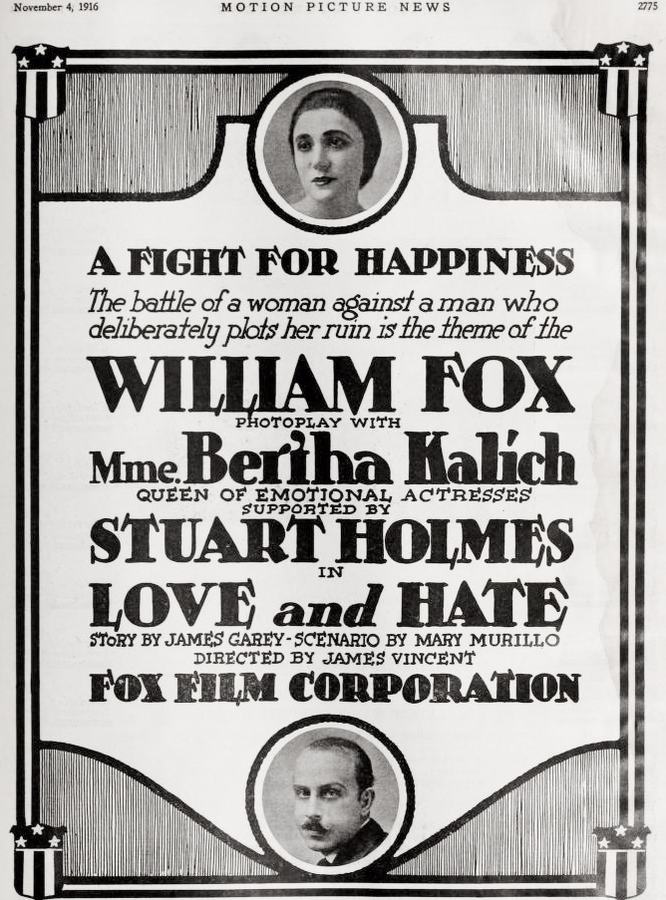
The performances, even in their silent grandeur, would have been pivotal in conveying these complex emotions. Bertha Kalich as Rita Lawson, for instance, would have had to embody the simmering resentment and calculated malice that drives her character, making her a formidable antagonist whose motivations, while destructive, are rooted in a believable personal slight. Stuart Holmes as George Howard would have had to project an aura of charming menace, a man whose outward sophistication masks a truly dangerous obsession. The interplay between these characters, conveyed through gesture, expression, and the evocative use of intertitles, would have been crucial to the film's impact.
Beyond the thrilling plot, Love and Hate delves into several universal themes. The most obvious, as the title suggests, is the duality of human emotion, how love can be corrupted by obsession, and how hate can fuel destructive actions. It also explores the theme of justice, both legal and moral. While Helen is legally cleared, her trauma and the journey to clear her name in Robert's eyes represent a deeper form of moral justice. The narrative implicitly critiques the ease with which societal judgment can be swayed by appearances and how challenging it can be for truth to emerge amidst a cacophony of lies. This struggle for truth against overwhelming odds is a recurring motif in cinematic history, resonating in works like The Shadows of a Great City, which often depicted individuals fighting against systemic corruption or societal prejudice.
The film's exploration of obsession, particularly George Howard's relentless pursuit, finds echoes in more psychologically complex silent films. One cannot help but draw a parallel to the themes of psychological torment and a character's internal struggle with their darker impulses seen in a film like The Student of Prague, where a man's very soul is at stake due to a Faustian pact. While Love and Hate may not venture into the fantastical, the psychological grip George has on Helen and his own self-destructive path certainly evoke a similar sense of tragic inevitability.
Furthermore, the breakdown of the family unit due to external forces and internal mistrust is a powerful undercurrent. Robert's initial inability to see through the deception leads to the fracturing of his family, a theme that was often explored in moralistic dramas of the era, such as Ten Nights in a Barroom, which depicted the devastating effects of vice on domestic harmony. The eventual rebuilding of the Sterling family, therefore, carries significant emotional weight, symbolizing hope and the possibility of renewal after profound loss.
The writers, Mary Murillo and James R. Garey, crafted a narrative that is both intricate and emotionally resonant. Their ability to weave together multiple character motivations and escalating dramatic stakes within the constraints of silent film storytelling is commendable. The plot is not merely a series of events; it's a carefully constructed edifice of cause and effect, where every action, every deception, leads inevitably to its consequence. The film, in its entirety, serves as a poignant reminder of the enduring power of cinematic storytelling, even in its earliest forms.
In conclusion, Love and Hate is more than just a historical artifact; it is a vibrant piece of cinematic art that speaks to timeless human experiences. Its sophisticated plot, compelling characters, and profound emotional arc demonstrate the silent era's capacity for producing engaging and thought-provoking entertainment. For modern audiences willing to immerse themselves in its unique language, the film offers a powerful journey through the darkest corners of human nature and ultimately, toward the redemptive light of truth and forgiveness. It stands as a testament to the fact that compelling drama and profound human insight do not require dialogue, but rather a keen understanding of the human heart and the visual artistry to convey its deepest stirrings. Its legacy lies not just in its historical context, but in its continued ability to stir the soul and provoke reflection on the intricate dance between love and its destructive antithesis.
IMDb 6.3
1923
Community
Log in to comment.