DbcultAccessing Vault...
Cult Review
Senior Film Conservator
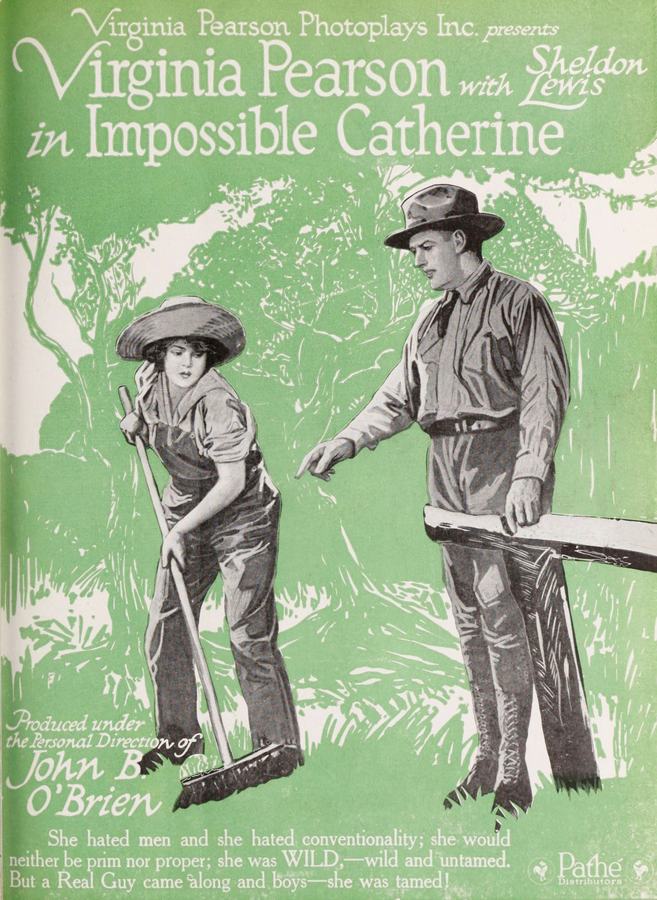
As the flickering images of early cinema unfurl, we are often presented with societal snapshots, reflections of an era grappling with its own evolving norms. Few films capture this tension with such audacious clarity as "Impossible Catherine" (1919), a cinematic artifact that, despite its age, remains a provocative discussion piece. Frank S. Beresford's screenplay, brought to life by a spirited cast, plunges us into the opulent yet tumultuous world of the Kimberly household, where traditional gender roles are not merely challenged but utterly inverted by the formidable presence of its eponymous protagonist.
At its core, "Impossible Catherine" is a fascinating, if sometimes troubling, exploration of power dynamics, gender expectations, and the very definition of love and submission. It is a film that demands contextualization, a lens through which to view the early 20th century's anxieties surrounding the burgeoning women's suffrage movement and the shifting landscape of social order. It's a testament to the enduring power of narrative that a film from over a century ago can still ignite debate and offer insights into the complex tapestry of human relationships.
The narrative introduces us to Catherine Kimberly (Virginia Pearson), a character so dominantly etched that she practically leaps from the screen. She is not merely strong-willed; she is a force of nature, an intellectual titan who has seized control of her wealthy father Grant Kimberly's (J.H. Gilmour) household with an iron fist. Grant, a Wall Street magnate, is reduced to a peripheral figure, a symbolic representation of emasculated patriarchy in his own domain. Catherine's moniker, 'Impossible Catherine,' is not a term of endearment but a grudging acknowledgment of her unyielding spirit and her philosophical crusade: to unequivocally prove the superiority of the feminine gender over the masculine.
Pearson's portrayal of Catherine is nothing short of captivating. She imbues the character with a regal bearing, an intellectual intensity, and an undeniable charisma that makes her initial dominance entirely believable. Her arguments, conveyed through action and expression in the silent film tradition, are not merely petulance but a deeply held conviction. She is a radical feminist for her time, a woman who refuses to be confined by the societal dictates that typically relegated women to the domestic sphere or to a supportive role. This defiance, this unwavering commitment to her ideology, sets the stage for the dramatic confrontation that defines the film's central conflict. Her character, in its sheer audacity and self-possession, stands apart from many contemporary heroines, perhaps even overshadowing the more conventional moral struggles seen in films like Virtuous Sinners, where virtue itself is often the primary battleground. Catherine's battle is for existential validation, a far grander ambition.
Enter John Henry Jackson (William B. Davidson), a Yalie with a classical education and a dangerously literal interpretation of Shakespeare's 'The Taming of the Shrew.' Jackson is no ordinary suitor; he is a man convinced of his intellectual prowess and his ability to 'correct' Catherine's perceived transgressions against traditional gender roles. Davidson plays Jackson with a peculiar blend of arrogance and determination, his eyes gleaming with the self-assurance of a man who believes he holds the key to unlocking Catherine's 'true' feminine nature. His character is a fascinating, if deeply problematic, antagonist-turned-love-interest. He represents the entrenched patriarchal response to female assertiveness, a desire to restore a perceived natural order.
Jackson's methods are, to put it mildly, extreme. His initial gambit involves luring Catherine into an airplane, a marvel of modern technology at the time, only to subject her to a terrifying series of tailspins. This aerial coercion, a bold and perhaps unprecedented cinematic stunt for its era, culminates in a chilling proposition: marry him or jump. The sheer audacity of this scene, a precursor to many cinematic thrillers and a stark illustration of psychological manipulation, underscores the film's willingness to push boundaries. Catherine, facing certain death, chooses marriage, but her capitulation is purely pragmatic, not emotional. This initial 'victory' for Jackson is hollow, as Catherine immediately flees, her spirit unbroken, her defiance merely postponed. It's a testament to the film's nuanced (for its time) portrayal of female agency that even under duress, Catherine's will remains intact. The intensity of this personal conflict, a battle waged with psychological and physical stakes, resonates with the thematic undercurrents of films like Das amerikanische Duell, where individual wills clash with dramatic force, albeit often in a more overtly violent context.
Jackson's pursuit takes Catherine to his remote Canadian ranch, a stark contrast to the luxurious Kimberly estate. Here, his 'taming' strategy shifts from aerial terror to domestic subjugation. He installs her firmly in the kitchen, attempting to force her into a role she vehemently rejects. This segment of the film is a deliberate visual and thematic counterpoint to Catherine's earlier life. The grand gowns are replaced by aprons, intellectual debates by culinary chores. Yet, even amidst the flour and the heat, Catherine's spirit remains defiant. Pearson masterfully conveys Catherine's internal struggle, her simmering resentment, and her refusal to be reduced to a mere domestic servant. Her actions, though perhaps constrained, still project an air of rebellion, a refusal to truly yield. This prolonged resistance highlights the film's complex portrayal of gender roles; while Jackson actively tries to enforce a traditional role, Catherine's enduring spirit questions the very validity of such enforcement.
The film, up to this point, walks a precarious tightrope between romantic comedy and psychological drama. Jackson's actions are undeniably coercive and problematic from a modern perspective, yet the film frames them within the context of a man determined to 'win' his woman, albeit through highly questionable means. This portrayal of a stubborn, even 'grouchy' character, and the attempts to mollify or control them, might draw a loose thematic parallel to the titular character in The Grouch, though Catherine's motivations are far more philosophical than mere cantankerousness.
The true turning point, and perhaps the most narratively convenient, arrives when Jackson is wounded while protecting Catherine. This act of chivalry, an unexpected display of self-sacrifice from the man who has relentlessly tormented her, shatters Catherine's defenses in a way that neither his aerial threats nor his domestic impositions could. It is the classic trope: the hero, wounded in the line of duty, finally earns the affection of the seemingly unassailable heroine. For Catherine, this moment redefines Jackson not as an oppressor, but as a protector, a hero. Her conviction in male inferiority crumbles in the face of his vulnerability and courage. This resolution, while satisfying within the narrative conventions of its time, is undoubtedly the most problematic aspect of the film when viewed through a contemporary lens. It suggests that a woman's strength and independence can only be truly 'tamed' or redirected by an act of masculine heroism, a concept that many modern viewers would find reductive and regressive.
However, it is crucial to understand this resolution within its historical context. In an era grappling with the 'New Woman' and changing social structures, such a narrative provided a comforting fantasy of restored order, a reconciliation of gender roles where strength and protection found a harmonious balance. It speaks volumes about the societal anxieties of the time, revealing a desire for traditional structures to ultimately prevail, even after being vigorously challenged. This final act, the ultimate 'taming' through an appeal to emotion and a sense of protection, is a stark contrast to the more overtly manipulative tactics seen earlier. It pivots the narrative from a battle of wills to a surrender of the heart, driven by a perceived selfless act.
Frank S. Beresford's screenplay, while adhering to certain genre conventions, manages to create compelling characters whose internal lives are remarkably expressive for a silent film. The reliance on strong visual storytelling, exaggerated gestures, and powerful expressions is paramount, and the cast delivers. Virginia Pearson, as Catherine, carries the film with an intensity that never wavers. Her transformation, while swift at the end, feels earned through her consistent portrayal of a woman of immense conviction. William B. Davidson, as Jackson, is equally effective, managing to make his character both infuriatingly arrogant and, by the end, surprisingly endearing, a testament to his ability to convey complex emotions without dialogue.
The supporting cast, including Johnnie Walker, J.H. Gilmour, Edward Roseman, James Hill, Mabel McQuade, and Sheldon Lewis, contribute to the film's vibrant atmosphere, each playing their part in the elaborate dance of social commentary and romantic intrigue. Gilmour, in particular, as the hapless Grant Kimberly, effectively portrays the impotence of traditional authority in the face of Catherine's dynamism.
The direction, while not as grand in scope as an epic like Intolerance, is effective in its intimate focus on character and conflict. The use of the airplane sequence as a dramatic device is particularly noteworthy, showcasing early cinema's willingness to incorporate thrilling spectacle into its narratives. The contrast between the opulent city life and the rugged Canadian ranch is also skillfully utilized to emphasize Catherine's journey and the drastic changes in her environment.
"Impossible Catherine" is more than just a romantic comedy; it is a cultural artifact that speaks volumes about the societal anxieties of its time. It grapples with the emergent concept of female independence and the patriarchal response to it. While its resolution might seem problematic today, it offers a crucial window into the prevailing attitudes towards gender, marriage, and power dynamics in the early 20th century. The film's 'taming' narrative, a direct reference to Shakespeare, reflects a cultural comfort with the idea that a woman's will, no matter how strong, could ultimately be bent towards a prescribed domesticity, often through unconventional means. This theme of a challenging individual being brought into line, often for their 'own good,' can be seen in various forms across cinematic history, but here, it's explicitly tied to gender.
The film's exploration of a woman challenging societal norms and a man determined to reassert them provides a rich ground for discussion. It prompts us to consider how far we've come, and perhaps, how far we still have to go in achieving true gender equality. The character of Catherine, in her initial defiance, is a powerful figure, a proto-feminist icon whose eventual capitulation, while narratively expedient, doesn't entirely erase the impact of her earlier strength. Her journey, even if it ends in a traditionally prescribed way, highlights the inherent tension between individual will and societal expectation.
In conclusion, "Impossible Catherine" is a spirited and thought-provoking film that, despite its age and its sometimes uncomfortable thematic resolution, remains a compelling watch. It is a testament to the power of strong characters, a daring narrative, and the ability of early cinema to engage with complex social issues. It invites us to reflect on the historical evolution of gender roles and the enduring fascination with the battle of the sexes. It's a film that, much like its eponymous heroine, is impossible to ignore.
IMDb —
1925
Community
Log in to comment.