DbcultAccessing Vault...
Cult Review
Senior Film Conservator
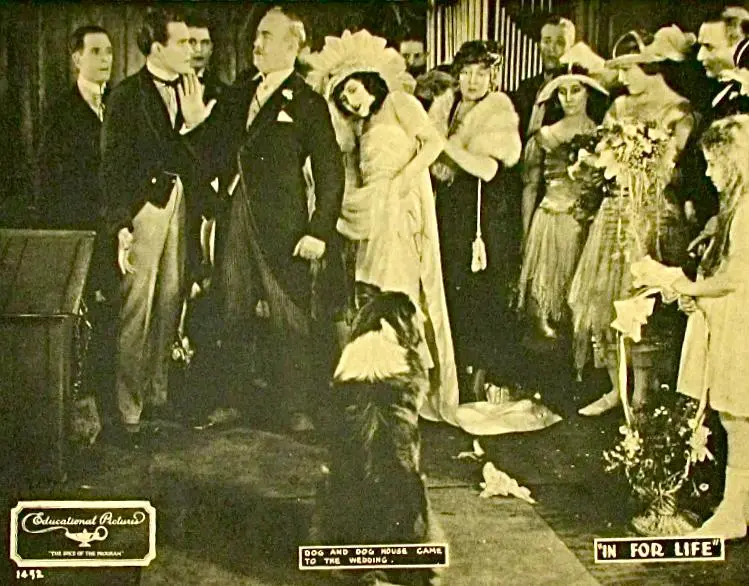
Is In for Life (1927) worth watching today? Short answer: absolutely, if you appreciate the kinetic, often absurd humor of early silent cinema. This is a film for those who revel in slapstick, physical comedy, and the charming simplicity of a bygone era, but it will likely frustrate viewers accustomed to modern narrative complexity or nuanced character development.
It’s a breezy, unpretentious ride that serves as a delightful snapshot of 1920s comedic sensibilities, perfect for a quick, engaging watch. However, if you prefer deep character arcs, intricate plotting, or dialogue-driven wit, you might find its relentless gag-driven structure a tad exhausting.
The year is 1927, and young Neely and Connie are poised to tie the knot, their love seemingly boundless, their future bright. Yet, as so often happens in the realm of silent comedy, fate, or rather, a pair of highly agitated parental units, has other plans. Their wedding ceremony at the justice of the peace’s office is unceremoniously interrupted by an indignant parental blockade, transforming the solemn occasion into a madcap scramble. This initial burst of familial disapproval sets the tone for the entire film, a rapid-fire succession of escalating misfortunes that define the couple's ill-fated journey to marital bliss.
Their escape, a frantic dash in a car, quickly morphs from a romantic getaway into a desperate flight from legal consequence. A single speeding ticket, a minor infraction in the grand scheme of elopement, becomes the first domino in a hilariously disastrous chain reaction. The film then meticulously chronicles their descent into bureaucratic hell: a lawyer friend, their supposed political saviour, is himself arrested for speeding, a delicious irony that underlines the film’s central theme of inescapable legal entanglement. Returning to their vehicle, Neely and Connie discover a veritable blizzard of parking tickets – for standing too long, for blocking a fireplug, for countless other violations that pile up with comedic rapidity. Their bewildered, and frankly dishonest, attempt to deny ownership to a vigilant police officer only earns them another citation, this time for lying. The climax unfolds in a courtroom, where Neely, desperate and defeated, weaves a preposterous, heart-wrenching tale of woe to the magistrate. In a final, audacious stroke of comedic justice, the judge, rather than punishing them further, decides to solve their problems by simply marrying them, bringing their chaotic odyssey full circle.
This film, like many of its era, operates on a specific comedic wavelength. Understanding its strengths and weaknesses is key to appreciating its place in cinema history.
This film works because: Its relentless, escalating series of absurd misfortunes is genuinely funny. The pacing is breathless, rarely allowing a moment for the audience to question the logic, instead sweeping them along on a tide of pure slapstick. Neely Edwards’ physical comedy is central to its charm, conveying exasperation and desperation with remarkable clarity.
This film fails because: The characters, particularly Consuelo Dawn's Connie, are largely archetypes, serving the plot rather than driving it with internal motivations. The narrative, while entertaining, is thin and predictable beyond the individual gags, offering little in the way of emotional resonance or thematic depth. The resolution, while comedic, feels a touch too convenient, even for a short film.
You should watch it if: You are a fan of classic silent-era slapstick, enjoy physical comedy over nuanced dialogue, or are interested in the historical evolution of comedic filmmaking. It’s also an excellent choice for those seeking a light, undemanding viewing experience that offers genuine laughs.
Director and writer (likely a collaborative effort, as was common in the era, though no specific writers are credited) of In for Life understood the fundamental mechanics of silent comedy: build a simple premise, then pile on the complications with escalating absurdity. The film’s strength lies in its unyielding commitment to this principle, transforming a minor domestic dispute into a full-blown legal nightmare. The visual storytelling is paramount, relying heavily on exaggerated reactions and well-timed physical gags to convey the narrative.
Neely Edwards, as the perpetually bewildered Neely, is the comedic anchor of the film. His performance is a masterclass in silent-era exasperation. From the initial shock of parental intervention to the mounting despair as ticket after ticket accumulates on his car, Edwards conveys a spectrum of increasingly frantic emotions without uttering a single word. Observe his facial expressions during the courtroom scene, a blend of feigned innocence and genuine bewilderment, as he attempts to spin his "hard luck" story. It’s a performance that doesn’t demand intellectual engagement but rather a visceral reaction, drawing the audience into his hapless predicament. His physical comedy, though not as acrobatic as a Keaton or Chaplin, is precise and effective, particularly in the rapid-fire exchanges with various authority figures.
Consuelo Dawn, as Connie, plays the supportive, if often equally bewildered, fiancée. Her role is largely reactive, mirroring Neely's escalating distress with her own wide-eyed disbelief and growing anxiety. While she doesn’t get as many opportunities for overt comedic performance as Edwards, her presence grounds the chaos, providing a touch of emotional reality to Neely’s increasingly outlandish predicaments. Her reactions to the mounting tickets, for instance, are perfectly calibrated to amplify Neely’s despair, making his plight feel even more acute. It’s a testament to her ability to play the straight woman in a world gone mad, a crucial, often underappreciated, role in silent comedy.
The direction of In for Life is undeniably brisk, a hallmark of short comedies from this period. The film wastes no time establishing its premise before launching into the frantic chase and subsequent legal entanglement. The editing is sharp, cutting between reaction shots and the accumulating evidence of their misfortune with a rhythmic precision that enhances the comedic timing. The sequence where the tickets are piled onto the car, each new violation more absurd than the last, is a prime example of this tight pacing. There’s a relentless forward momentum that ensures the audience is always engaged, always anticipating the next unfortunate event. This isn't a film that lingers; it pushes forward, gag after gag, until its surprisingly neat conclusion.
Given its age, the cinematography of In for Life is functional and clear, prioritizing the visibility of the gags and the actors' expressions. There are no groundbreaking visual effects or sweeping landscape shots; the camera is primarily a static observer, allowing the physical comedy to unfold naturally within the frame. This simplicity, however, is a strength. It ensures that the audience's focus remains squarely on the escalating chaos and the couple's reactions. The tone is consistently lighthearted, even as Neely and Connie face what seems like insurmountable legal woes. The film never veers into genuine drama or despair, maintaining its comedic veneer throughout. This unwavering commitment to humor, even in the face of what would be frustrating real-world scenarios, is what makes it so endearing.
What strikes me most about In for Life isn't just its slapstick, but its surprisingly pointed, albeit lighthearted, critique of bureaucratic overreach. The film takes the mundane frustrations of everyday life – speeding tickets, parking violations – and magnifies them to a ridiculous degree. The idea that a simple desire to marry can lead to such an avalanche of legal trouble is, at its core, a darkly humorous commentary on the arbitrary nature of law and order. It's a precursor to later films that would satirize governmental red tape, like some sequences in The Girl from Beyond, but here, it's played purely for laughs. The fact that the lawyer friend, supposedly savvy to the system, also falls victim to a speeding ticket, feels like a subtle jab at the idea that anyone is truly above the law, or perhaps, simply, above bad luck. It works. But it’s flawed.
In for Life fits comfortably within the tradition of short silent comedies that prioritized immediate laughs over complex storytelling. It lacks the grand scale and poignant moments of a Charlie Chaplin feature like The Devil's Circus or the architectural ingenuity of a Buster Keaton vehicle, but it shares their spirit of physical comedy and situational irony. Its focus on a relatable, if exaggerated, predicament — the desire to marry thwarted by external forces — is a common trope, seen in many films of the era. One could draw parallels to the domestic chaos found in shorts like Sunny Side Up, where everyday life spirals into comedic disarray. The film's strength lies in its simplicity and directness, delivering its comedic payload efficiently and effectively, without pretension.
IMDb 6.6
1933
Community
Log in to comment.