DbcultAccessing Vault...
Cult Review
Senior Film Conservator
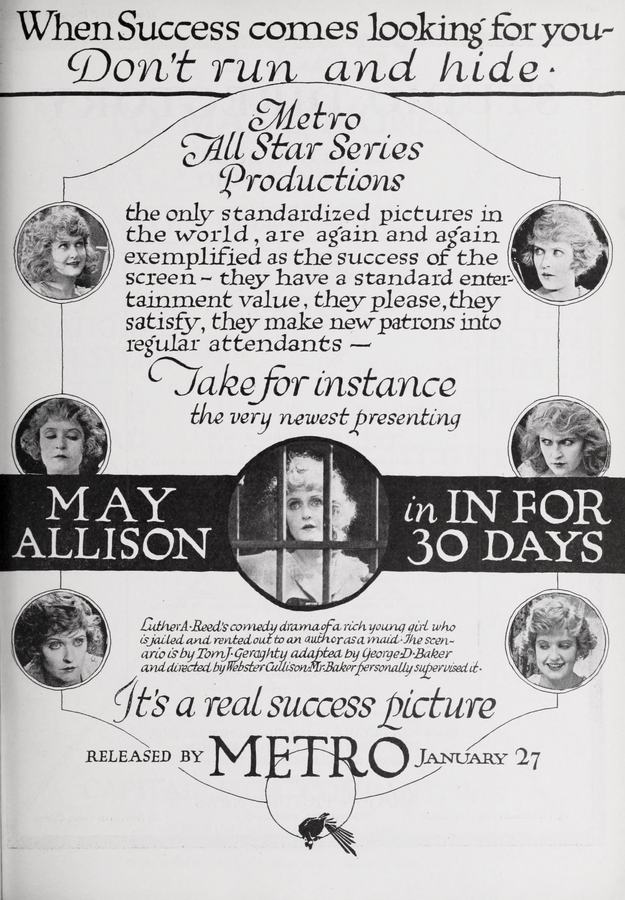
Step back into the roaring, yet silent, twenties with In for Thirty Days, a delightful cinematic romp from 1919 that perfectly encapsulates the vivacious spirit and burgeoning comedic sensibilities of its era. Directed by George D. Baker and penned by the collaborative talents of Luther Reed, Thomas J. Geraghty, and Baker himself, this film delivers a charming blend of slapstick, social satire, and burgeoning romance. It’s a testament to the enduring appeal of well-crafted character dynamics and a plot that, while simple, possesses an infectious energy that transcends the decades.
At its heart, In for Thirty Days is a tale of clashing cultures and unexpected transformation, set against a backdrop of Southern charm and Northern impudence. It’s a classic fish-out-of-water story, but one executed with such verve and comedic timing that it feels fresh even today. The film plunges us headfirst into the world of Helen Corning, portrayed with effervescent charm by the luminous May Allison. Helen is introduced as a quintessential "Yankee" heiress, a privileged daughter of a wealthy widow, whose spirited independence often borders on outright recklessness. Her chosen mode of expression? A roaring roadster, which she pilots with an abandon that sends ripples of consternation through her more sedate Southern neighbors. Allison, a prominent star of the era, imbues Helen with a captivating blend of haughtiness and underlying vulnerability, making her initial antics both exasperating and undeniably engaging.
The narrative’s comedic engine truly kicks into gear with Helen's audacious disregard for local customs and traffic laws. Her speeding escapades aren’t just minor infractions; they’re catalysts for escalating chaos. First, she inadvertently causes the ignominious overturning of Brett Page’s modest Ford. This initial mishap introduces us to Robert Ellis as Brett, a character who, at first glance, appears to be just another victim of Helen’s heedlessness. Ellis, with his understated yet compelling screen presence, begins to lay the groundwork for a character far more complex than a simple country bumpkin.
But Helen’s reckless streak doesn't end there. In a moment of pure cinematic slapstick brilliance, she rams Judge Carroll’s wagon. The consequence? A cascade of market-bound eggs, which, in a stroke of comedic genius, find their messy resting place directly within the venerable Judge’s whiskers. Jay Dwiggins as Judge Carroll plays this scene to perfection, his fury palpable even without spoken dialogue, his egg-splattered visage a portrait of outraged dignity. This sartorial disaster is the final straw, leading to the Judge’s swift and decisive pronouncement: Helen is to be incarcerated for thirty days. It’s a sentence that, while seemingly harsh, is delivered with a comedic flourish that prevents it from feeling genuinely punitive. The film expertly balances the perceived severity of the punishment with the underlying absurdity of the circumstances.
Here’s where the plot takes a truly inventive turn, weaving in a quaint, almost folkloric, element of small-town justice. The town, it turns out, possesses an ancient ordinance allowing citizens to hire prisoners for a meager twenty cents a day. Seizing this peculiar opportunity, Brett Page, the very man whose Ford Helen had overturned, steps forward to 'employ' her. This decision, seemingly born of a desire for retribution or simply cheap labor, sets the stage for the film’s central romantic dynamic. Helen, accustomed to a life of leisure and luxury, finds herself thrust into the unfamiliar and utterly unwelcome role of a domestic servant, cooking and cleaning in Brett’s home.
The initial friction between Helen and Brett is a comedic goldmine. Helen’s defiance and her complete ineptitude at household chores provide ample opportunities for physical comedy and exasperated glances from Brett. Yet, through this enforced proximity, something unexpected begins to blossom. Helen, initially resentful, starts to observe Brett more closely. She discovers that he is not merely a simple country man, but an affluent author, a man of intellect and quiet strength. This revelation shifts the power dynamic, challenging Helen's preconceived notions about status and worth. It’s a classic narrative arc where superficial judgments are slowly eroded by genuine character, a theme that resonates through many romantic comedies, including those with similar 'unlikely pairing' premises like Betsy's Burglar, where unusual circumstances force two disparate individuals into close quarters, leading to unforeseen affection.
May Allison’s portrayal of Helen’s gradual transformation is subtle yet effective. We witness her initial disdain slowly morph into respect, and then a deeper, more profound affection. Robert Ellis, as Brett, complements this beautifully. His character is a beacon of calm and integrity, a stark contrast to Helen’s initial tempestuousness. He doesn't seek to 'tame' her in a derogatory sense, but rather allows her to discover her own capacity for empathy and genuine connection. Their chemistry, communicated through glances, gestures, and the unspoken language of silent film, is palpable and utterly charming. The screenplay, under the guidance of Luther Reed, Thomas J. Geraghty, and George D. Baker, masterfully paces this emotional evolution, ensuring it feels earned rather than rushed.
This period of domestic servitude also serves as a crucible for Helen’s independence, ironically solidifying her resolve against her mother’s machinations. Her mother, Mrs. Corning (Mayme Kelso), is a delightful caricature of a social climber, determined to secure a financially advantageous, if loveless, match for her daughter. Her chosen suitor? The diminutive and rather pathetic Count Dronsky (Rex Cherryman), a man whose primary asset seems to be his title and a rather lean physique. The contrast between Dronsky’s superficial allure and Brett’s authentic appeal further highlights the film’s underlying commentary on societal values. This kind of comedic villainy, driven by greed and social climbing, is a common trope in silent comedies, offering a clear antagonist against the budding romance.
The climax of In for Thirty Days is a masterclass in silent film farce. Desperate to extricate Helen from her 'ignominious' situation and push her towards the Count, Mrs. Corning and Dronsky hire a bumbling ruffian named "Hot Stove" Kelly (Bull Montana) to break her out of Brett’s custody and spirit her across state lines. Kelly, with his imposing physique and comical ineptitude, adds another layer of physical comedy to the proceedings. Bull Montana, known for his roles as villains and strongmen, brings a unique blend of menace and buffoonery to the character, making him a memorable, if ultimately ineffective, obstacle.
However, Helen, having undergone a significant transformation, is no longer a passive participant in her own fate. Demonstrating a surprising and exhilarating burst of agency, she takes control of Kelly’s getaway car, deftly, or perhaps wildly, redirecting its trajectory. Her target? Brett’s very own bungalow. This act of deliberate vehicular chaos is both humorous and symbolic, signifying her unequivocal choice of Brett over her mother’s materialistic aspirations. The collision into the bungalow is a wonderfully executed piece of slapstick, characteristic of the era’s penchant for grand, physical gags.
What follows is a delightfully frantic chase sequence. Brett, ever the protector, thrashes Kelly with a satisfying display of masculine vigor, dispatching the bumbling henchman. As Mrs. Corning and Dronsky pursue them with renewed determination, Brett and Helen seize the moment. In a final, utterly madcap flourish, they are married in their careening automobile, officiated by Judge Carroll (Jay Dwiggins), who, in a truly memorable image, performs the ceremony while precariously perched on the car’s hood. This chaotic, on-the-go wedding is the perfect culmination of a film that delights in upending expectations and embracing the absurd. It’s a moment of pure cinematic joy, a fitting end to a romance born out of legal decree and blossoming amidst comedic mayhem.
Beyond the laughter and the frantic chases, In for Thirty Days subtly explores several compelling themes. There's the obvious clash between North and South, a recurring motif in American storytelling, often used to highlight differences in temperament, social custom, and economic standing. Helen’s "Yankee" brashness is softened by the more grounded, albeit comically exasperated, Southern sensibilities embodied by Brett and Judge Carroll. This regional dynamic is played for laughs, but it also underscores a deeper message about finding common ground despite cultural differences.
The film also delves into class and wealth disparity. Helen, with her inherited riches, initially views the world through a lens of privilege. Brett, though revealed to be affluent, initially appears unassuming, challenging Helen's superficial judgments. The narrative suggests that true worth lies not in inherited wealth or social titles, but in character, intelligence, and genuine affection. This mirrors themes found in other silent films of the era that often explored the tensions between old money and new, or the inherent value of an individual regardless of their economic standing.
Perhaps most significantly, the film is a story of transformation and redemption, albeit in a lighthearted comedic vein. Helen begins as an antagonist, a spoiled and reckless individual. Her thirty days of forced labor, far from being a mere punishment, become a catalyst for self-discovery and growth. She learns humility, develops a work ethic, and, crucially, learns to value genuine human connection over superficial status. This arc is a staple of romantic comedies, where characters evolve and become better versions of themselves through the crucible of love. This theme of personal growth under unusual circumstances can be seen in other narratives of unexpected pairings, much like the dynamic in The Mail Order Wife, where individuals are thrust into unfamiliar roles and find themselves changed by the experience.
Director George D. Baker, along with his talented cast and writers Luther Reed and Thomas J. Geraghty, crafted a film that is visually engaging and narratively cohesive. The use of intertitles is particularly effective, not just for dialogue but also for injecting wry humor and advancing the plot with efficiency. The physical comedy, a hallmark of silent cinema, is executed with precision, from the egg-splattered Judge to the chaotic car crash. The pacing is brisk, maintaining a lively rhythm that keeps the audience invested in Helen and Brett’s tumultuous journey. The cinematography, while perhaps not groundbreaking for its time, effectively captures the rural Southern setting and the expressive performances of its leads. The film's ability to tell a compelling story primarily through visual cues and exaggerated expressions speaks volumes about the skill of these early filmmakers.
The performances are uniformly excellent, anchoring the comedic chaos with relatable human emotions. May Allison shines as Helen, navigating her character’s transformation with grace and comedic timing. She commands the screen, making Helen’s journey believable and endearing. Robert Ellis provides a strong, sympathetic counterpoint, his quiet strength and intelligence a perfect foil to Allison’s initial exuberance. The supporting cast, including Mayme Kelso as the meddling mother, Jay Dwiggins as the memorable Judge, Rex Cherryman as the effete Count Dronsky, and Bull Montana as the comically inept "Hot Stove" Kelly, all contribute significantly to the film’s vibrant tapestry of characters. Even minor roles, like those played by George Berrell, add texture and depth to the small-town milieu.
In an era that gave us everything from grand epics to intimate dramas, In for Thirty Days stands out as a charming example of the silent romantic comedy at its best. It may not possess the dramatic weight of an Uncle Tom's Cabin or the introspective depth of a European art house film, but its goals are different. It seeks to entertain, to charm, and to deliver a heartwarming story with a healthy dose of laughter, and in this, it succeeds admirably. Its themes of finding love in unexpected places, overcoming class prejudices, and the transformative power of genuine connection remain timeless, ensuring its place as a delightful discovery for modern audiences interested in the rich history of cinema. It’s a joyous reminder that sometimes, the best way to find yourself, and perhaps true love, is to be thrown, quite literally, into an entirely new situation, even if it means doing thirty days.
IMDb 6.3
1926
Community
Log in to comment.